
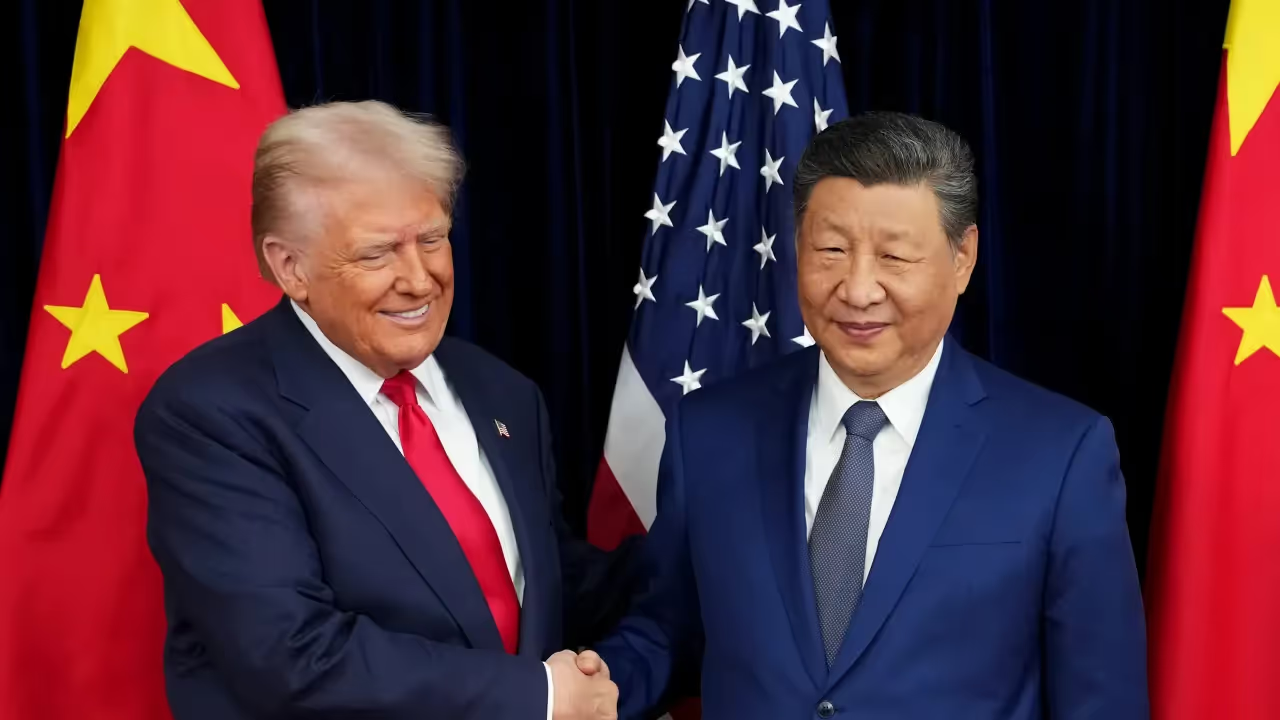
China’s threat to cancel the Trump-Xi summit raised fears of renewed critical-mineral supply problems and more volatility for U.S. rare earth stocks.
- Trump played down concerns about the summit being canceled, saying he is not worried and expects to maintain a good relationship with Xi.
- China’s critical-mineral dominance and shipment curbs raise concerns about renewed supply-chain disruptions.
- Some Chinese suppliers have halted U.S. shipments despite export licenses.
MP Materials (MP), USA Rare Earth (USAR), Energy Fuels (UUUU) and Critical Metals Corp. (CRML) stocks drop overnight, facing fresh volatility after Beijing warned it could cancel the Sept. 24 Donald Trump-Xi Jinping summit over a pending $14 billion Taiwan arms package, threatening to reignite the supply-chain tensions.
U.S. rare earth stocks slipped between 0.8% and nearly 2%.
Trump Downplays Risk Of Summit Collapse
According to the Telegraph’s report, Beijing has signaled it will cancel the Sept. 24 White House summit if Washington approves the Taiwan arms sale that Congress authorized in January, but Trump has not yet signed.
However, President Trump downplayed the risk this weekend, as per a Bloomberg report, telling reporters he is not worried that Xi will cancel the visit, saying "we have a great relationship" and "we're going to get along." The mixed signals leave rare earth investors caught between two competing narratives, diplomatic thaw versus renewed confrontation, each of which moves the stocks in opposite directions.
The Trump-Xi meeting could have a major impact on critical minerals. China currently produces 70% of these minerals and processes 90% of them, giving Beijing significant leverage over the U.S. The U.S. is trying to reduce this dependence, but building new mining and refining capacity takes years. China’s export restrictions could therefore quickly affect global supply and prices. Any possible agreements on the front, therefore, can ease supply chain concerns.
Some Chinese suppliers have stopped some U.S. shipments since early August, even after getting export licenses, because they fear penalties from Beijing or that the materials could end up with sanctioned buyers. China’s dominance of yttrium has also made the obscure rare earth a key pressure point in U.S.-China trade. The U.S. has faced repeated supply disruptions since China imposed export controls, with shipments arriving only sporadically. The shortages have affected aerospace, energy and semiconductor industries, highlighting U.S. dependence on China for critical minerals.
Rare Earth Producers Build U.S. Defense And Energy Capacity
MP Materials, USA Rare Earth, Energy Fuels and Critical Metals thus sit at the center of Washington's push to break China's grip on critical minerals. MP Materials runs the only active U.S. rare earth mine (Mountain Pass) and is building the "10X" magnet facility in Texas, backed by a Pentagon equity stake.
USA Rare Earth is scaling magnet manufacturing and acquired Brazilian miner Serra Verde for $2.8 billion. The company has also received a $1.6 billion in government funding to support a "mine-to-magnet" ecosystem. Last week, the company broke ground on a new $1.2 billion rare earth metal and magnet facility in South Carolina with a targeted annual production of 6,400 metric tons of NdFeB magnets and 5,000 metric tons of rare earth metal and alloy, with commissioning planned for 2028.
Energy Fuels is expanding beyond uranium into rare earth processing, producing dysprosium in Utah to improve heat resistance and magnet performance. Critical Metals is developing the Tanbreez heavy rare earth project in Greenland, helping build a non-Chinese supply chain for defense and clean-energy magnets.
USAR, MP, UUUU, CRML Stocks: Retail View
On Stocktwits, retail sentiment around all four stocks remained in ‘bearish’ territory.
CRML, MP, and UUUU stocks have declined between 0.02% and 11%, while USAR stock has gained 30%.
For updates and corrections, email newsroom[at]stocktwits[dot]com.<
