
U.S. stock futures slipped late Sunday as escalating U.S.-Iran tensions pushed investors toward safe-haven assets such as Treasuries, gold, and the dollar.
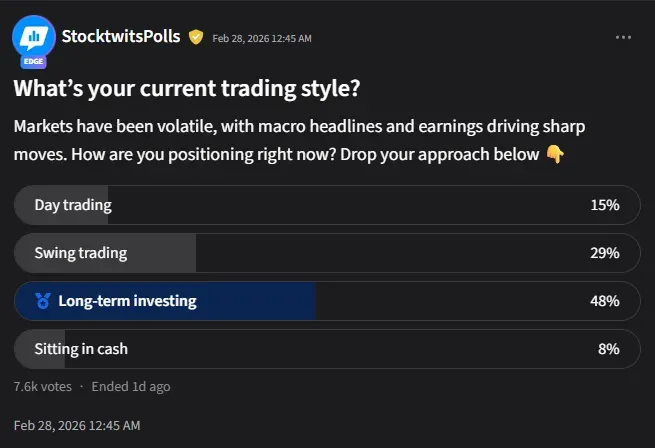
- A Stocktwits poll showed retail investors remain largely invested, with 48% identifying as long-term investors.
- Analysts flagged growing haven demand and warned that oil moving toward $80-$90 could trigger inflation fears.
- At the same time, analysts pointed to diversification away from richly valued U.S. equities toward Asia and Europe.
Retail investors appear to be staying invested in the current market even as escalating tensions between the U.S. and Iran add fresh uncertainties and drive traders toward safer assets.
As of 11.10 p.m. ET, Nasdaq 100 futures were down by 0.9%, while S&P 500 and Dow futures were down 0.8%.
Retail Investors Lean Long-Term
A Stocktwits poll showed 48% of 7,600 respondents identified as long-term investors, followed by 29% swing traders and 15% day traders. Only 8% said they were sitting in cash.
On Stocktwits, retail sentiment toward the SPDR S&P 500 ETF Trust (SPY) was ‘bullish,’ while sentiment toward the Invesco QQQ Trust (QQQ) was ‘neutral,’ and sentiment toward the SPDR Dow Jones Industrial Average ETF Trust (DIA) was ‘extremely bearish,’ with all ETFs under ‘normal’ message volumes.
One user said they were a “long-term investor with a small portfolio of trading shares to play the momentum,” while another noted they were “swing trading but sometimes playing the momentum.”
A third user outlined an aggressive options approach, saying they buy long at-the-money (ATM) calls, “average down repeatedly,” and wait for the moment the stock “rockets” to generate large gains.
Safe-Haven Demand Builds
Traders sought haven assets in early Asian trading, with the U.S. dollar strengthening and gold gaining as investors weighed the possibility of prolonged turmoil and the ripple effects of higher oil prices.
Natixis strategist John Briggs said traders will be adopting “haven first, ask questions later,” adding that “the scale of the attacks and Iranian retaliation is larger than what the market expected.” Briggs said Treasuries are likely to extend moves from Friday, when short-term yields fell to levels last seen in 2022, according to a Bloomberg report.
Charles Schwab said that higher crude prices could spark a near-term inflation scare that unsettles equities, though any impact may fade if growth and earnings remain intact.
Amerivet Securities sees scope for safe-haven demand to push Treasury yields lower even if the conflict lasts several weeks without materially altering U.S. fundamentals. Buffalo Bayou Commodities, meanwhile, views the strikes as a near-term selloff catalyst for an already fragile market, though history suggests geopolitical shocks often result in temporary drawdowns rather than lasting bear markets.
Meanwhile, JPMorgan noted that even the possibility of disruption in the Middle East can influence inflation expectations and policy outlooks. Arkevium said that if crude oil moves toward the $80-$90 range due to Hormuz disruption, the resulting flight to safety could initially pull Treasury yields down by 5 to 10 basis points.
SLC Management said the “Iran strike over the weekend constitutes almost a perfect sell-off catalyst for an already fragile equity market,” adding that volatility is likely to extend in the shorter term.
Diversification Trend Emerges
Recent earnings have supported growing calls to diversify away from richly valued U.S. markets toward Asia and Europe. While U.S. companies delivered strong profit growth, performance has mixed, and market breadth has narrowed, according to Bloomberg.
Additionally, European and Asian equities have shown stronger relative momentum, supported by industrial strength and continued demand tied to AI supply chains.
“You can pay 16 times forward earnings in Europe or 23 times in the US for what consensus expects to be similar earnings growth by 2027,” said Adrian Helfert, chief investment officer of multi-asset strategies at Westwood Management. “My highest conviction region right now is the euro zone, specifically European industrials, defense, and banks.”
Goldman Sachs added that improving earnings expectations in Asia’s technology sector reinforce the case for further regional upside.
Dip-Buying Risk Rises
Barclays warned against buying dips too quickly, saying the conflict may last longer than previous flare-ups.
“Markets are pricing a limited conflict, with broader investment implications still manageable unless escalation proves prolonged,” global asset management group Janus Henderson said, while eToro noted geopolitical shocks often produce sharp but temporary market moves.
The Kobeissi Letter described the situation as an “expectations versus reality” test, noting oil has risen about 20% in six weeks and gold roughly 13% in a month. The firm highlighted the Strait of Hormuz as the key near-term driver, warning that prolonged disruption could push oil above $100 and lift U.S. inflation toward 5%, though a short conflict could see markets stabilize once uncertainty clears.
For updates and corrections, email newsroom[at]stocktwits[dot]com.<
