
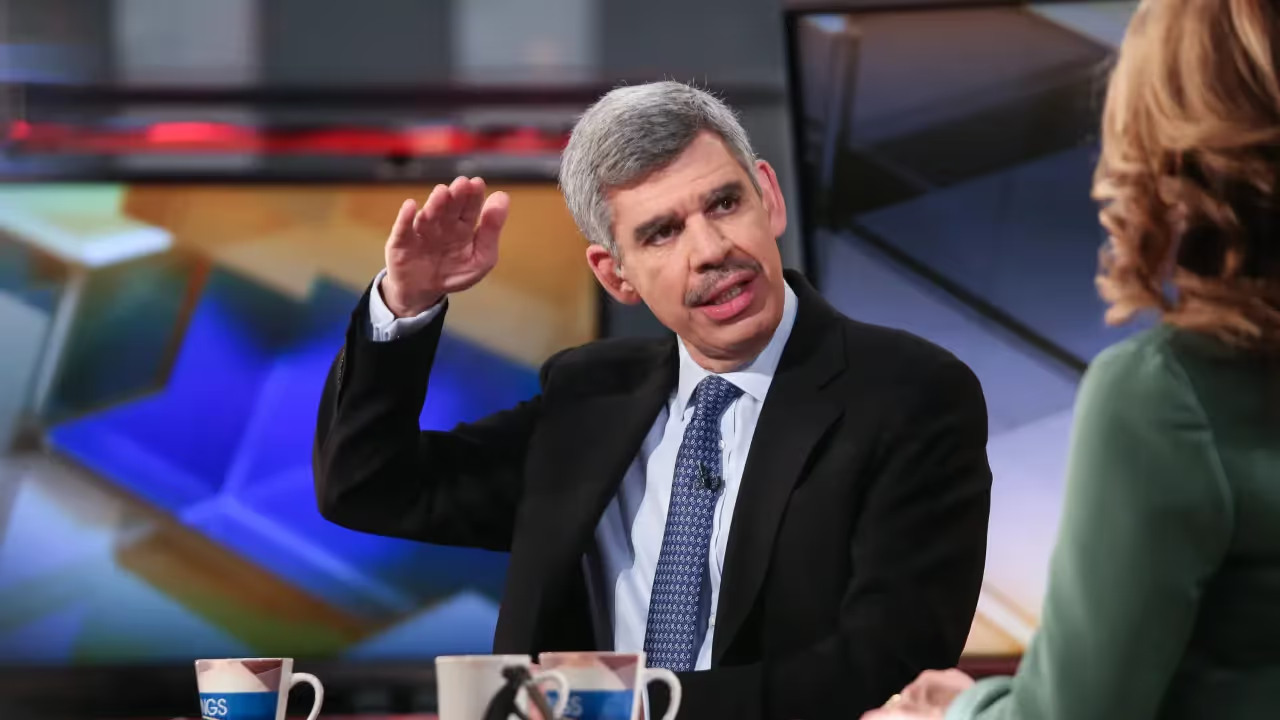
Allianz's chief economic adviser noted that the fundamental drivers have pointed to this scenario for some time.
- The U.S. 10-year Treasury yield surged to close at 5.11%, its highest level since July 2007.
- The surge followed S&P Global’s U.S. Composite PMI Output Index, which increased from 56.0 in Aug. to 58.4 this month.
- Economist Steve Hanke said in an interview with Going Underground that he would not want to be holding long-term U.S. bonds.
The U.S. 10-year Treasury yield surged about 13 to 17 basis points in a single day on Wednesday to close at 5.11%, notching its highest level since July 2007.
The surge followed rising inflation concerns after S&P Global said its flash U.S. Composite PMI Output Index, which tracks the manufacturing and services sectors, rose from 56.0 in Aug. to 58.4 this month, the highest level since July 2021.
Mohamed El-Erian, chief economic adviser at Allianz, said the surge should not be “as big a surprise as it is,” noting that fundamental drivers have pointed to this scenario for some time.
Why El-Erian Thinks Bond Yields Surge Was Coming
In a post on X, El-Erian outlined multiple reasons for the rally in bond yields. “Borrowing plans for major issuers, such as the government and large corporates (particularly tech), have been well telegraphed,” he said. The economist also noted that the Federal Reserve has been signaling strong economic activity,
The Federal Reserve has been signaling strong economic activity, adding that the endpoint for the U.S.-Israel-Iran conflict has been widely debated. The war in the Middle East has been ongoing for almost seven months now, with a diplomatic resolution yet to be reached.
“The reasons behind the declining willingness and capacity of some traditional holders/buyers of US bonds have been well covered,” El-Erian said.
He also pointed out that psychological anchoring is playing a large role in markets, with “the collective mindset shaped by more than a decade of artificially low, repressed yields following the 2008 Global Financial Crisis.”
Experts’ View On Rising Yields
The Kobeissi Letter noted in a post on X that the 10Y yield marked its largest single-day gain since Liberation Day in April 2025. “This time, however, nothing notable happened today. This is just another day in the 2026 bond market,” it said.
The commentary service also added that following Sept.’s 25 basis point rate hike from the Federal Reserve, another 25 bps hike is likely in Oct., given current market conditions.
“Keep in mind, just 9 months ago, markets thought the Fed would be on its third rate cut of 2026 by now. It’s truly incredible how fast things can change in today’s markets,” it added.
Meanwhile, Keith McCullough, CEO at Hedgeye Risk Management, said in a post on X that “Bonds failed, right where they should have,” without providing further explanation.
Economist Steve Hanke said in an interview with Going Underground that he would not want to be holding long-term U.S. bonds. “I’ve indicated for months to stay away from the bond market, and just as I said it would, the bond market is tanking.”
How Are Markets Reacting?
Among ETFs tracking benchmark indexes, the SPDR S&P 500 ETF (SPY) was down 0.12%, and the Invesco QQQ Trust (QQQ) lost 0.20% amid ‘bullish’ sentiment at the time of writing.
One user said, “$SPY if you think 5% bonds aren't worth it then guess what...rates are going higher.”
The SPDR Dow Jones Industrial Average ETF Trust (DIA) traded 0.14% lower amid ‘neutral’ sentiment.
Meanwhile, the iShares 20+ Year Treasury Bond ETF (TLT) was down 0.17% amid ‘neutral’ sentiment.
A user said, “$TLT Wait for the waterfall price action, and the blowout of yields. Then maybe the Fed and govt will get the hint.”
For updates and corrections, email newsroom[at]stocktwits[dot]com.<
