
GLJ’s Gordon Johnson said tariff relief added $447 million to gross profit, masking an underlying earnings miss.
- Canaccord raised its target to $442, retaining 'Buy', and sees Tesla becoming the Berkshire Hathaway of physical tech.
- Tesla reported over 1.7 million paid FSD customers, while New Street estimated annual recurring FSD revenue approaching $1 billion.
- JPMorgan, Morgan Stanley and Mizuho raised targets, while SpaceX takeover potential prompted BNP Paribas to upgrade Tesla to 'Neutral'.
Shares of Tesla, Inc. (TSLA) are on track for their best week in two months as Canaccord saw the makings of a Berkshire Hathaway of physical tech, while GLJ Research argued that tariff relief drove its third-quarter (Q3) earnings beat.
TSLA stock fell 3% to $374.58 on Thursday but is still up 6% for the week, heading toward its strongest weekly gain since late August.
Tesla reported adjusted earnings of $0.48 a share versus a $0.45 consensus, with revenue of $28.05 billion versus an expected $28.25 billion.
Canaccord Bets On Physical AI
Canaccord raised its target to $442 from $410 and retained 'Buy', implying 17.8% upside. The firm sees Tesla potentially becoming the “Berkshire Hathaway of tomorrow’s physical technology,” using AI and connectivity to transform businesses on Earth and beyond.
That vision spans autonomous transport, robotics, energy and semiconductor manufacturing. On the earnings call, CFO Vaibhav Taneja said: “I'd like to stress that what we are trying to do is literally take over every part of terrestrial transportation.” Tesla now has more than 1.7 million paid Full Self-Driving customers globally, half through subscriptions, Taneja said.
New Street Research analyst Pierre Ferragu highlighted the recurring-revenue opportunity: “But then, of course, FSD generates more than $1,000 a year, so it makes a minimal impact on numbers in the quarter the car is sold. But over the lifetime of the car, it probably at least doubles the profit per car.” Ferragu estimated FSD was approaching $1 billion in annual recurring revenue. “Yeah, I think the numbers which you shared are correct,” Taneja replied.
GLJ Says Tariff Relief Masked An Earnings Miss
On the other hand, GLJ Research’s Gordon Johnson focused on the quarter’s tariff benefit. “$TSLA’s Q3 beat came from a court ruling, not operations,” he said on X, pointing to Note 11 of Tesla’s quarterly filing.
Tesla’s filing shows the Supreme Court tariff ruling unlocked $786 million in cost reductions, including 526 million in energy and $260 million in automotive, offset by a $339 million revenue reduction for customer refunds.
Johnson put the net gross-profit boost at $447 million, or 62% of operating income. Without it, he calculated gross margin at 17.8%, down from 19.6%, and operating margin at 1%, versus 2.6% reported and 1.4% in the previous quarter.
His recalculations turned earnings beats into misses: “GAAP EPS: $0.22 → $0.12 vs $0.20 est.” and “Non-GAAP EPS: $0.48 → $0.38 vs $0.44 est.” He used a $0.44 adjusted consensus, versus the $0.45 figure.
Johnson estimated energy gross margin at about 23.8% excluding refunds, versus 33.1% reported, with the adjusted figure still benefiting from a vendor warranty adjustment. He put automotive margin excluding credits at 16.8%, versus 18.1% reported, and cited 39% operating-expense growth. “$TSLA's gross profit is not keeping pace with spending,” he said.
Taneja also acknowledged on the call that tariff refunds and warranty adjustments primarily drove the sequential energy-margin improvement.
Analysts Lift Targets, Flag Spending Risks
JPMorgan raised its target to $430 from $415, retaining 'Neutral' and implying 15% upside. It welcomed stronger margins and autonomy progress but flagged spending, with SpaceX speculation supporting shares. Morgan Stanley lifted its target to $410 from $400, keeping 'Equal Weight' and implying 9.2% upside, on Robotaxi, FSD and improving fundamentals.
Mizuho raised its target to $460 from $450, retaining 'Outperform' and implying 23% upside. Cantor Fitzgerald maintained 'Overweight' and $485, implying 29% upside, citing autonomy and robotics opportunities despite uncertain commercialization timelines.
SpaceX takeover potential drove BNP Paribas’s upgrade to 'Neutral' from 'Underperform' and target increase to $420 from $266, implying 11.9% upside, despite AI execution and cash-burn concerns.
Morningstar maintained a $475 standalone fair value estimate, implying 26.6% upside, and saw merger synergies across energy, AI and connectivity. “We think valuation (specifically, the merger ratio for each company) is likely a sticking point in negotiations,” it said.
How Do Retail Traders Feel About TSLA?
On Stocktwits, retail sentiment for TSLA flipped to ‘bearish’ from ‘bullish’ levels a day ago amid ‘high’ message volume.
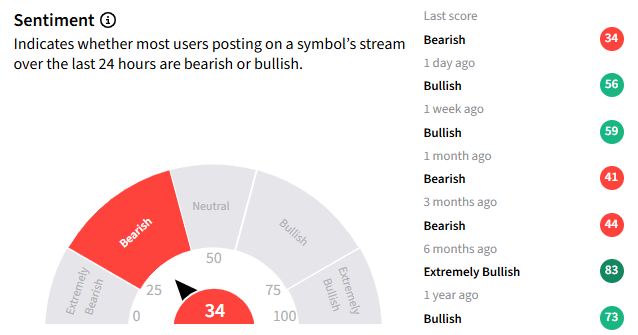
One user said, “$TSLA is an super expensive stock why would $SPCX want to merge and dilute shareholders? Why would Musk want to??? I think the obvious reason is clear…Musk is the best financial engineer/manipulator in the history of mankind!”
View this Stocktwits post
Another user said, “$TSLA for this to be bullish needs to push past 378.5 and retest to the upside”
View this Stocktwits post
So far this year, Tesla's stock has lagged its "Magnificent Seven" peers, making it the group's worst performer, down about 17%.
For updates and corrections, email newsroom[at]stocktwits[dot]com.<
