

Capricor and Savara face Nov.22 FDA deadlines, while Beren Therapeutics awaits a Tuesday decision on Adrabetadex.
- The FDA rejected Summit’s Ivonescimab combination after its lung-cancer trial failed to show a statistically significant survival benefit.
- Lilly will highlight weight loss and health benefits at ObesityWeek, while Corbus will present early findings for its obesity pill.
- Alpha Tau will review preliminary brain-cancer findings on Monday, followed by Innate Pharma’s early-stage cancer-drug results on Wednesday.
The regulatory stakes in biotech firms rise this week as Capricor and Savara near FDA decisions, while Alzheimer’s presentations and obesity-drug updates offer fresh catalysts after Summit Therapeutics’ weekend setback.
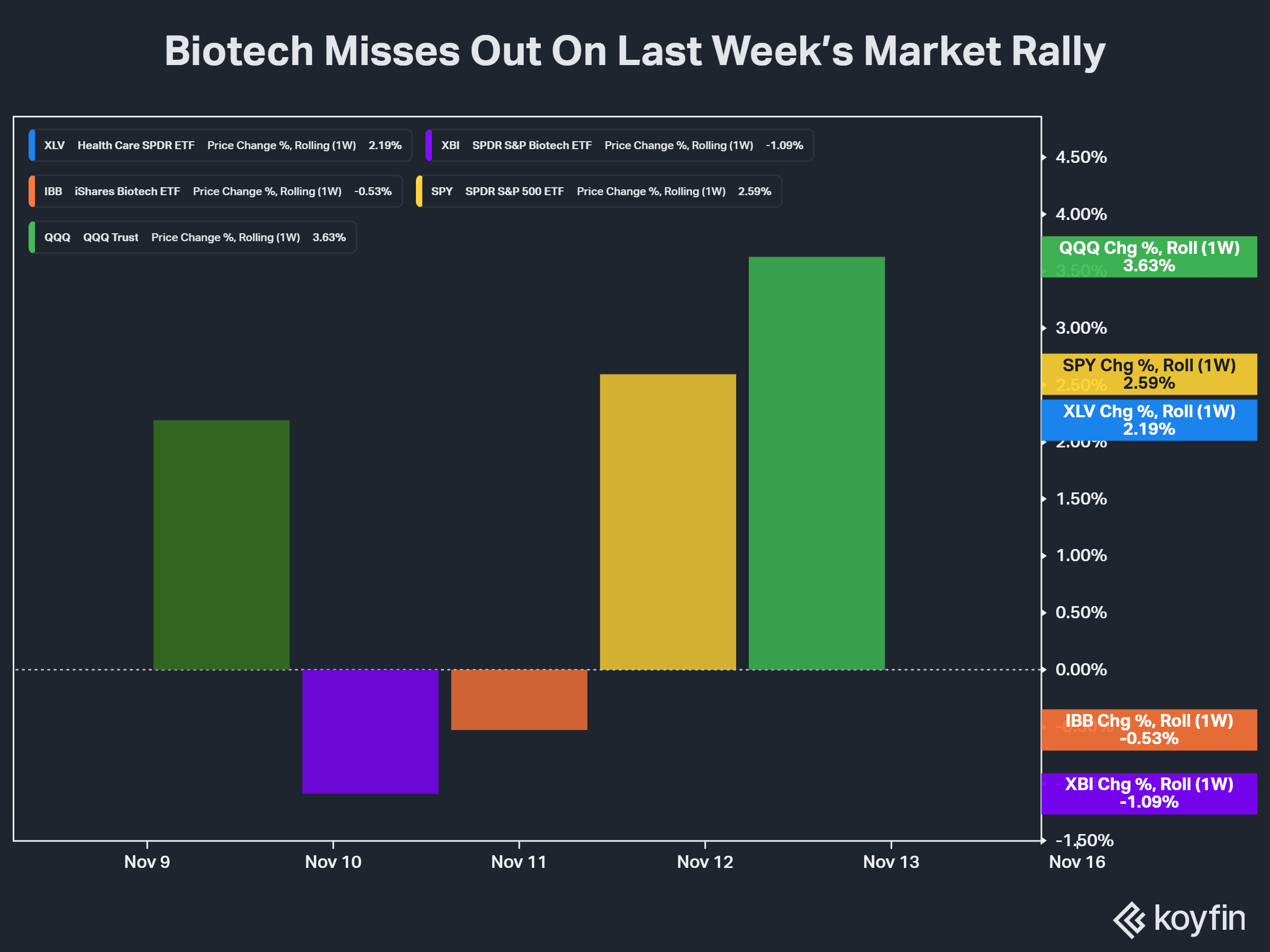
Healthcare and biotech lagged the broader market last week. The Health Care Select Sector SPDR Fund (XLV) gained 2%, while the iShares Biotechnology ETF (IBB) fell 0.5% and the SPDR S&P Biotech ETF (XBI) dropped 1%. Comparatively, the SPDR S&P 500 ETF Trust (SPY) rose 3%, and the Invesco QQQ Trust (QQQ) climbed 4%.
| Date | Ticker / Event | Development |
| Nov.16 | DRTS | Alpha Tau reviews interim REGAIN brain-cancer findings |
| Nov.16 | RHHBY | Updated early-stage Trontinemab findings at CTAD |
| Nov.16 | Eisai / BIIB | 5-year Lecanemab findings |
| Nov.16-Nov.17 | ObesityWeek / LLY / CRBP | Final conference sessions after Sunday’s Lilly and Corbus presentations |
| Nov.17 | ACAD | Detailed Phase 2 Radiant results in Alzheimer’s disease psychosis |
| Nov.17 | RHHBY | Neuroinflammation symposium featuring experimental drug RG6434 |
| Nov.17 | Beren Therapeutics | FDA target date for Adrabetadex in infantile-onset Niemann-Pick disease type C |
| Nov.18 | RHHBY | Phase 3 PrevenTRON prevention-study presentation |
| Nov.18 | Eisai / BIIB | Leader symposium on real-world lecanemab treatment |
| Nov.18 | IPHA | Phase 1 IPH4502 findings and investor event |
| Nov.22 | CAPR | FDA target date for Deramiocel in DMD |
| Nov.22 | SVRA | FDA target date for Molgramostim in autoimmune pulmonary alveolar proteinosis |
| November, date unspecified | SLS | Phase 3 Regal topline results expected this month |
CAPR And SVRA Face Crucial FDA Week
Capricor Therapeutics (CAPR) and Savara (SVRA) face Nov.22 FDA deadlines, putting two rare-disease treatments in focus heading into next weekend.
Capricor seeks approval for Deramiocel to slow upper-limb impairment in Duchenne muscular dystrophy (DMD) patients older than nine. In the open-label Hope-3 extension, patients’ upper-limb decline slowed by 76% after switching to treatment compared with their earlier year on placebo.
The company has also responded to an FDA clinical-trial inspection observation and is awaiting feedback. “With our San Diego facility operational, we are prepared to move quickly to bring Deramiocel to patients, if approved,” CEO Linda Marban said.
On the other hand, Savara awaits a decision on Molgramostim, proposed as Molbreevi, for a rare lung disease that causes material to collect in the air sacs and impair oxygen transfer. The inhaled treatment is under priority review. Savara said that the FDA extended its review to assess additional information, citing no safety, efficacy or manufacturing concerns in the extension correspondence.
FDA Rejects Summit’s Lung-Cancer Application
Summit Therapeutics (SMMT) enters the week after the FDA declined to approve Ivonescimab plus chemotherapy for previously treated, EGFR-mutated advanced lung cancer, the company said on Sunday.
The HARMONi trial showed that the combination delayed disease progression or death but failed to demonstrate a statistically significant overall survival benefit. The FDA said the progression benefit alone did not support approval. Summit cited later, post-hoc survival analyses showing consistent results across regions, but the findings did not resolve the agency’s concerns.
“We are disappointed for patients and their families awaiting additional treatment options in this setting,” Chairman and Co-CEO Robert Duggan said. The company is still developing Ivonescimab in other settings, including first-line lung cancer and colorectal cancer.
Eisai And Roche Bring Alzheimer’s Updates
Meanwhile, Alzheimer’s research is in focus at the Clinical Trials on Alzheimer’s Disease conference, running Monday through Thursday in Boston.
Eisai presents five-year findings Monday for Lecanemab, sold as Leqembi and jointly developed with Biogen (BIIB). The results span the original Clarity AD trial and its open-label extension.
On Tuesday, Eisai presents safety data from everyday use of Leqembi, including brain changes detected on scans, known as ARIA. Wednesday’s Leader session looks at how patients use the drug, their results and their experience with at-home injections.
Roche (RHHBY) will present early results Monday for Trontinemab, including its ability to clear amyloid from the brain and its safety. On Tuesday, it discusses RG6434, an experimental pill designed to reduce brain inflammation.
On Wednesday, Roche will outline PrevenTRON, a Phase 3 study in people who show biological signs of Alzheimer’s but have no problems with memory or thinking. “Amyloid clearance remains a vital foundation, but halting a disease as complex as Alzheimer’s demands multifaceted and complementary strategies,” Roche Chief Medical Officer Levi Garraway said.
Acadia To Detail Alzheimer’s Psychosis Data
Acadia Pharmaceuticals (ACAD) will present detailed Phase 2 results for Remlifanserin on Tuesday. The drug aims to treat hallucinations and delusions linked to Alzheimer’s disease, for which no FDA-approved treatment exists.
The drug’s results were mixed in September. The 60-milligram dose narrowly missed the study’s main goal but showed improvement on a separate symptom-severity measure. The lower 30-milligram dose showed little benefit over placebo. Acadia is continuing its Phase 3 studies, while dropping the lower dose.
ObesityWeek Looks Beyond Weight Loss
ObesityWeek runs through Tuesday in Washington, D.C., with Eli Lilly (LLY) presenting updates on its weight-loss treatments. Lilly’s experimental combination of Eloralintide and Tirzepatide, called EloraTZP, delivered average weight loss of up to 23.3% over 48 weeks in a Phase 2 study of adults with obesity or overweight and type 2 diabetes.
Lilly is also highlighting benefits beyond weight loss. Retatrutide reduced sleep-apnea breathing disruptions by up to an average of 60.6% at 80 weeks in Triumph-1. Other findings examine knee pain and Zepbound’s effects on body mass index and quality of life in adolescents.
Meanwhile, Corbus Pharmaceuticals (CRBP) is developing an experimental weight-loss pill, CRB-913. In its early-stage Canyon-1 study, the highest daily dose produced average weight loss of 5% at 12 weeks, with weight still declining. The drug works mainly outside the brain by targeting CB1 receptors. Corbus scheduled its presentation for Sunday, ahead of ObesityWeek’s final two days.
Early Cancer Data Put DRTX And IPHA In Focus
Alpha Tau Medical (DRTS) will hold an investor call on Monday to discuss results released on Sunday from Regain, a small study of its implanted radiation treatment for recurrent glioblastoma, an aggressive brain cancer.
All eight treated patients were alive as of Nov.11. Of the six assessed for treatment response, five had complete responses and one had a partial response. Median follow-up for those six patients was 6.9 months. The study mainly tests whether the treatment can be delivered safely. No unexpected serious adverse events were reported, but scans showed radiation-related tissue damage without symptoms in several patients.
Additionally, Innate Pharma (IPHA) will present early-stage results for IPH4502 at the EORTC-NCI-AACR cancer symposium on Wednesday. An investor event later that day will discuss safety, how the drug behaves in the body and signs of activity against tumors. IPH4502 uses an antibody to deliver a cancer-killing drug to tumors carrying a protein called Nectin-4.
SLS: A November Wild Card
Sellas Life Sciences (SLS) expects topline results from its Phase 3 Regal trial this month, but has not set a release date. The trial tests Galinpepimut-S (GPS) in acute myeloid leukemia (AML) patients who achieved a second complete remission. The 80th death occurred last month, reaching the threshold needed to begin the final survival analysis.
“If successful, we believe GPS could be a transformative new immunotherapy for AML patients in second complete remission,” CEO Angelos Stergiou said.
For updates and corrections, email newsroom[at]stocktwits[dot]com.<








