
The multi-year partnership gives chip developers access to Teradyne’s advanced test systems as increasingly complex AI and next-generation semiconductor designs require more intensive evaluation before production.
- The new 42,000-square-foot Silicon Valley facility will serve AI, silicon photonics, automotive, RF and power-management chips.
- The companies will jointly pursue customers to accelerate Teradyne-based design wins and broader adoption.
- GSME is expanding its test-engineering team across the U.S., Taiwan, Europe and the Gulf Cooperation Council region
Teradyne Inc. (TER) shares rose Tuesday after the semiconductor-testing company announced a multi-year partnership with GS Microelectronics U.S. to establish a new test-and-evaluation center focused on AI and other next-generation chips.
The center will combine GSME’s chip design and manufacturing capabilities with Teradyne’s automated test systems, helping customers move more quickly from device evaluation and engineering development to production.
New Center Targets AI And Silicon Photonics Chips
GSME will operate a dedicated Teradyne-equipped test floor at its new 42,000-square-foot Silicon Valley headquarters. The facility will support chip developers working across AI, silicon photonics, automotive, power management, and radio-frequency technologies.
Customers can use the center for demonstrations, device evaluations, engineering development, pilot production, and technical training, with access to Teradyne's test handlers and probers. The facility is scheduled to open in the fourth quarter of 2026.
The partnership also has a commercial component. GSME and Teradyne plan to work together on joint sales engagements, target accounts, technical workshops and customer briefings, with the stated goal of accelerating Teradyne-based design wins and expanding market adoption.
GSME is also expanding its test-engineering team across the U.S., Taiwan, Europe and the Gulf Cooperation Council region to support customer programs and application-specific requirements.
AI Complexity Is Increasing The Need For Chip Testing
As semiconductor designs grow more complex, driven by AI data center buildouts, rapid access to high-performance test development capabilities becomes essential, Teradyne Semiconductor Test Group President Shannon Poulin said.
He added that combining Teradyne’s test platforms with GSME’s engineering capabilities is intended to help customers move more efficiently “from development into volume production.”
That demand is already showing up in Teradyne’s business. Its Semiconductor Test segment generated a record $1.12 billion in revenue in the fiscal second quarter (Q2), up 128.1% year over year, primarily due to higher AI-related compute and memory sales.
Overall Q2 revenue reached $1.33 billion, up 104% from $652 million a year earlier. The company’s semiconductor-testing business hit a record for the second consecutive quarter, driven by continued AI investment across the compute and memory markets.
The company also recorded more than $200 million in memory-test revenue for a third straight quarter, supported by demand for high-bandwidth memory (HBM) and DRAM testing for AI compute deployments.
Retail Sentiment Around TER Stock
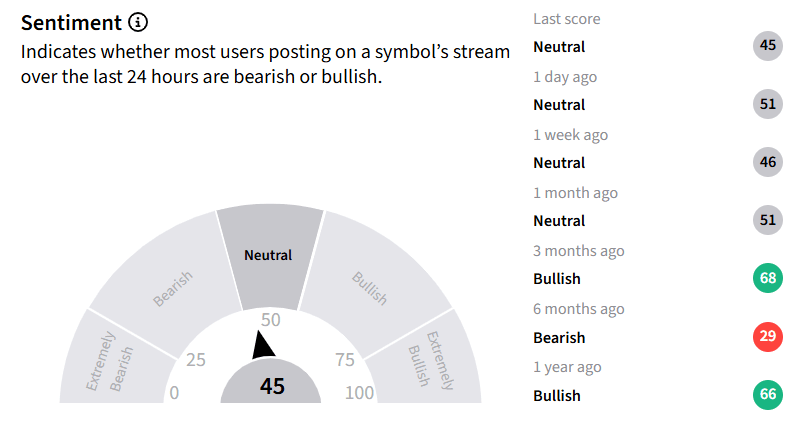
Retail investor sentiment around TER stock remained ‘neutral’ on Stocktwits.
So far this year, Teradyne shares have surged nearly 90%. In comparison, the ARK Autonomous Technology & Robotics ETF (ARKQ), which holds the stock, has risen around 5% over the same period.
See Also: PayPal Joins Meta’s Muse Checkout Ecosystem — Partnership Extends AI Shopping Across Its Merchant Network
For updates and corrections, email newsroom[at]stocktwits[dot]com.<
