
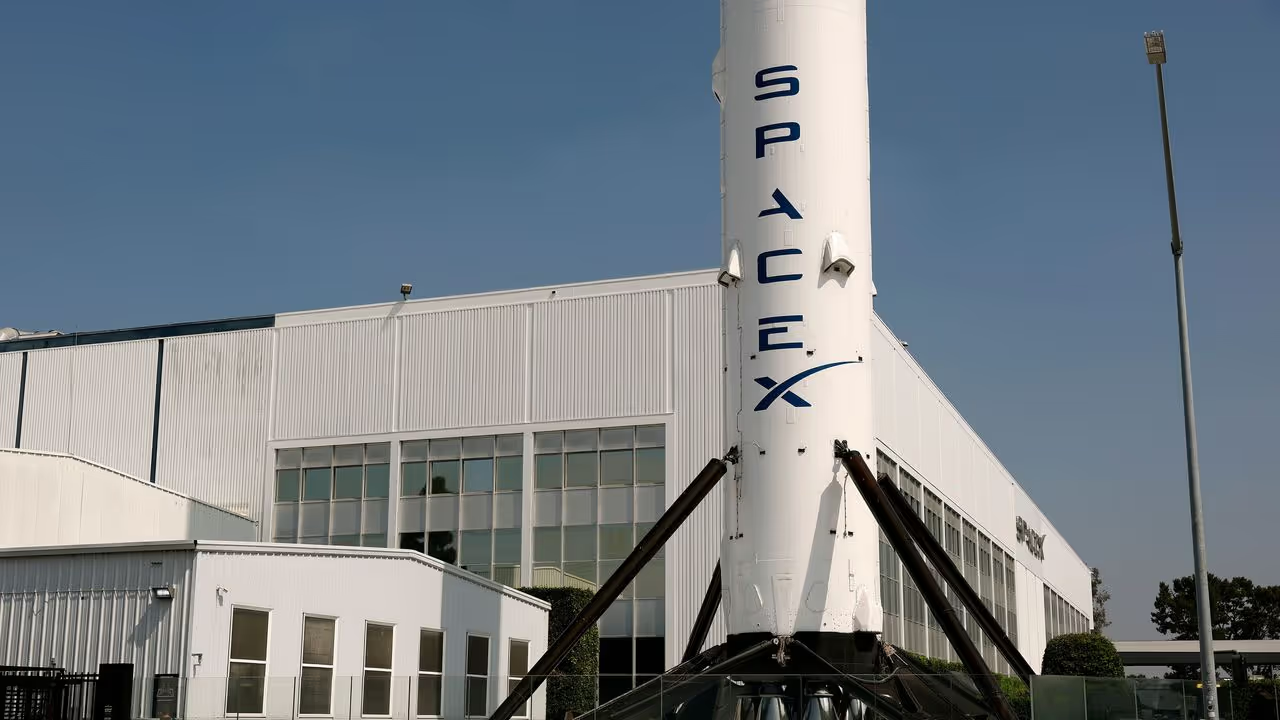
Falcon’s retirement could worsen a global launch-capacity shortage as rivals struggle to scale.
- Musk said resources could shift once Starship reliably flies several times weekly.
- SpaceX has reportedly stopped taking most new commercial Falcon bookings beyond late 2028.
- Musk expects a tower catch within months and Starship’s first reflight by early 2027.
Shares of SpaceX (SPCX) slipped 2% overnight late Sunday after CEO Elon Musk outlined a conditional plan to wind down the company’s Falcon rocket program and redirect scarce engineering and production resources toward turning Starship into a high-frequency launch system.
SPCX stock jumped 2% on Friday but still ended the week down 2%.
SpaceX Plans Falcon-To-Starship Shift
“Once Starship is flying reliably several times per week, it makes sense to shift super scarce SpaceX engineering and production resources to Starship to get launch rate to several times per day, which means winding down Falcon,” Musk said on X.
The wind-down would mark the eventual retirement of SpaceX’s highly successful Falcon rocket family. Falcon 9 and Falcon Heavy have become key to commercial, government and crewed spaceflight, with Falcon 9 completing a record 165 launches in 2025.
SpaceX has reportedly stopped taking most new dedicated commercial Falcon 9 and rideshare reservations beyond late 2028. Existing contracts remain in place, while critical NASA and U.S. defense missions are expected to receive support for longer.
However, a faster Falcon wind-down could deepen an emerging global launch-capacity shortage. Satellite operators continue to rely heavily on Falcon 9 as delays and limited availability constrain competing vehicles, including United Launch Alliance’s Vulcan, Blue Origin’s New Glenn and Europe’s Ariane 6. Russian launch services are also largely unavailable to Western customers.
SpaceX Pushes Starship Reusability
The economics behind Musk’s plan is based on full and rapid reusability. Unlike Falcon 9, which recovers its first stage but discards the upper stage, SpaceX intends to recover and reuse both parts of Starship. Achieving this goal could enable much faster turnaround times and much lower launch costs.
SpaceX is advancing the more powerful Starship V3, which is targeting payload capacity of around 100 metric tons. The company must still demonstrate operational reliability, orbital refueling and the cadence needed to support Starlink expansion, NASA’s Artemis lunar program and eventual Mars missions.
Musk said last week that SpaceX would “probably catch the ship with the tower in a few months.” The company has already caught Starship’s Super Heavy booster with its launch tower arms, but recovering the upper stage is considerably harder because it returns at greater speed and faces more intense heating. Musk also expects the first reflight of a Starship vehicle by the end of 2026 or early 2027, calling it “a fork in the road of history for consciousness reaching the stars.”
SpaceX Gets Rare ‘Sell’ Call From Wall Street
On Friday, DZ Bank initiated coverage with a ‘Sell’ rating and a $100 price target, implying a 27% downside from current levels. The bearish initiation stands out against broadly positive analyst sentiment around SpaceX.
Koyfin data shows an average 12-month target of $216.33, representing nearly 58% upside. Analyst targets range from $75 to $450. However, among 35 analysts covering SpaceX, six rate it ‘Strong Buy,’ 22 recommend ‘Buy,’ five have a ‘Hold’ rating and only two say ‘Sell.’ None rate the stock a ‘Strong Sell,’ making DZ Bank’s call one of the market’s few explicitly bearish views.
How Do Retail Traders Feel About SPCX?
On Stocktwits, retail sentiment for SpaceX slipped to ‘bearish’ from ‘neutral’ levels a day ago amid a 6% rise in 24-hour message volume.
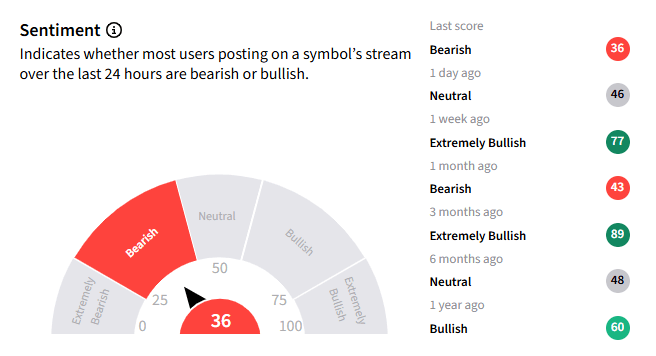
One user said, “$SPCX should see $90 in 2 months to load up”
View this Stocktwits post
Another user said, “$SPCX Nothing has changed. $70”
View this Stocktwits post
SPCX stock has declined 15% year-to-date.
For updates and corrections, email newsroom[at]stocktwits[dot]com.<
