

Musk expects 220,000 more GB300 chips online next week, another 220,000 in November and a possible third wave in late December.
- Colossus 2 currently has 110,000 Nvidia GB200 chips and 440,000 GB300 chips, Musk said.
- All three waves would add 660,000 GB300 chips by year-end if completed on schedule.
- SpaceX’s AI capacity serves outside customers, including Google and Anthropic, alongside its own AI products.
Shares of SpaceX (SPCX) climbed 0.4% in premarket trading on Friday as CEO Elon Musk mapped out a major Nvidia chip expansion at Colossus 2, the company’s AI supercomputer, while Google prepared to test its own AI chips in orbit aboard a SpaceX rocket.
SPCX stock slipped 0.2% on Thursday, bringing its weekly decline to 3% and putting it on track to snap a four-week winning streak.
Musk Details Colossus 2’s Nvidia Chip Buildout
Musk said on X that Colossus 2 has 110,000 Nvidia GB200 chips and 440,000 GB300 chips. He expects another 220,000 GB300 chips to be fully operational next week and a second batch of 220,000 in November. A third batch could follow by late December “if we get lucky,” he said. This would amount to as many as 660,000 additional GB300 chips by year-end if all three waves arrive on schedule.
He also listed 150,000 H100 chips, 50,000 H200 chips and 30,000 GB200 chips at Colossus 1. The repeated 110,000-chip increments reflect “the number of fiber optic cables that can be plugged into a central switch,” Musk said.
Tesla investor and influencer Sawyer Merritt estimated that the chips across the two sites represent more than $100 billion in GPUs and over two gigawatts of compute.
SpaceX’s AI Contracts Raise Stakes For Chip Ramp
The Colossus systems became part of SpaceX after its acquisition of Musk’s xAI business earlier this year. Alongside developing its own AI products, SpaceX has signed agreements to provide computing capacity to outside customers.
This makes the timing of new hardware commercially significant. Google has a separate cloud-services agreement with SpaceX, under which payments are set to rise to $920 million a month in October as capacity ramps up. Anthropic has also agreed to use Colossus 1.
SpaceX To Carry Google’s Project Suncatcher Satellite
On the launch side of SpaceX’s business, Google said its first Project Suncatcher prototype satellite is scheduled to fly next week on the company’s Transporter-18 rideshare mission. Developed with Planet Labs (PL), the satellite will test how Google’s Tensor Processing Units (TPUs) withstand launch and perform amid the radiation and temperature extremes of orbit.
“Can our TPUs survive and operate in space? Well, we’re going to find out,” Google CEO Sundar Pichai said on X. Musk replied with two rocket emojis.
Google has tested the hardware against vibration and radiation on the ground. The orbital mission is intended to answer questions that those tests cannot settle, including how its cooling system works in a vacuum. Google says a later experiment, planned for 2027, will test laser links between two satellites, marking a step toward its longer-term idea of connecting spacecraft to handle AI workloads.
How Do Retail Traders Feel About SPCX?
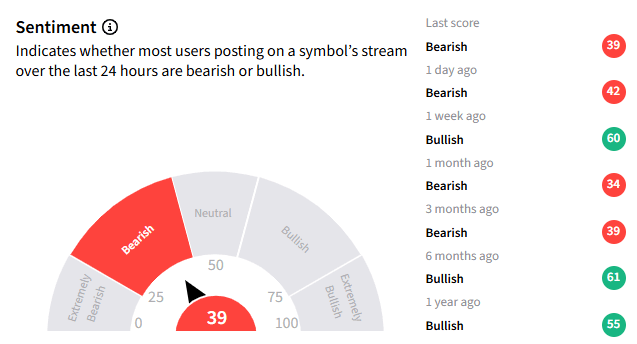
On Stocktwits, retail sentiment for SPCX fell to ‘bearish’ from ‘bullish’ over the past week amid a 74% jump in 24-hour message volumes.
One user said, “$SPCX ahhh google wants a ride to space only bus the valuation makes sense! Let’s go Elon”
View this Stocktwits post
Another bullish user said, “$SPCX To those who mock the idea of orbital datacenter…Google disagrees”
View this Stocktwits post
SPCX stock has declined 8% over the past three months.
For updates and corrections, email newsroom[at]stocktwits[dot]com.<
