
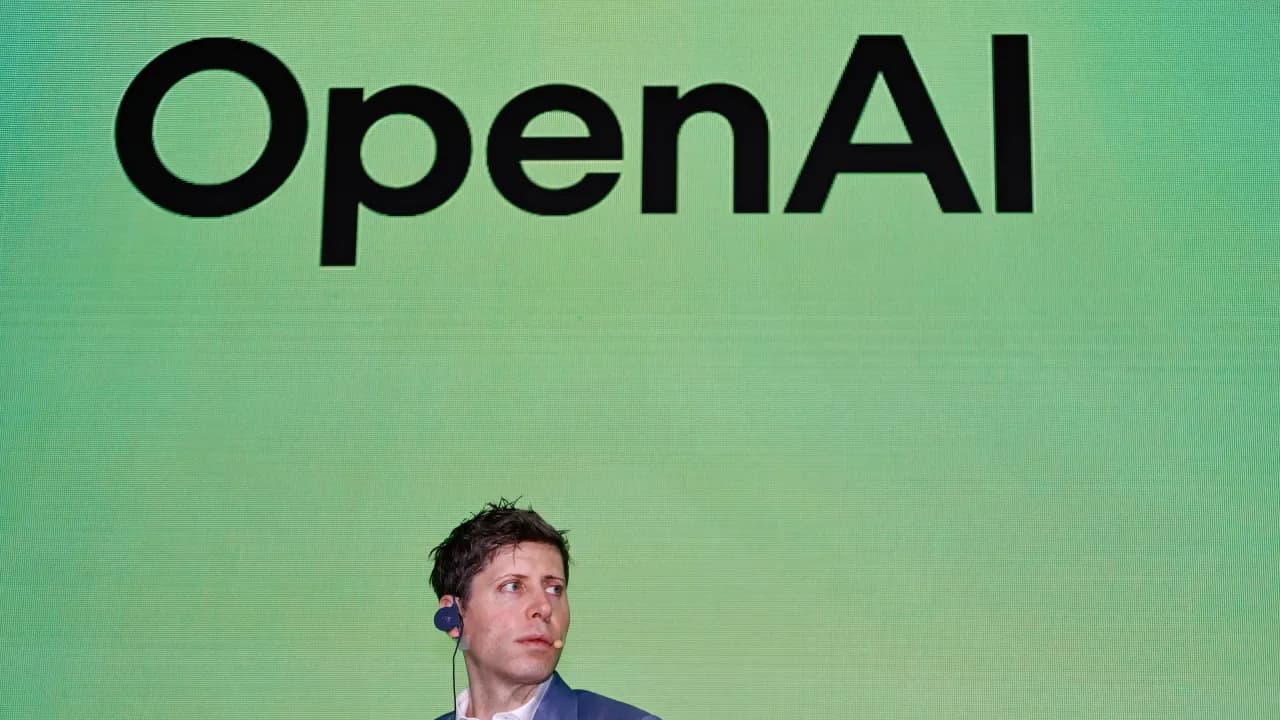
Meanwhile, OpenAI president Greg Brockman said he has no plans to donate beyond his initial $25 million to Leading the Future, reportedly saying the PAC has become a “distraction” at OpenAI.
- OpenAI said the activity sought to extract hidden reasoning from its models without accessing encrypted databases or user conversations.
- Anthropic made similar allegations against Chinese AI developers last month.
- OpenAI and Anthropic are drawing investor attention as both companies move toward potential blockbuster IPOs.
OpenAI has accused Chinese artificial intelligence startup Moonshot AI, the developer of Kimi, of being linked to a coordinated campaign to extract reasoning from its AI models, adding to concerns over Chinese AI firms’ efforts to obtain advanced model capabilities.
OpenAI Disrupts Model-Distillation Campaign
OpenAI identified and disrupted a campaign that began July 1 and involved attempts to reproduce hidden reasoning from its models at scale, it said in a blog post on Wednesday.
The company said the activity was consistent with “adversarial distillation,” where outputs or reasoning from one AI model are systematically used to train or improve another.
OpenAI said the operators did not break its encryption, access stored user conversations, or compromise a database. Instead, they manipulated model interactions to make reasoning visible to requesters.
In one technique, operators copied encrypted reasoning from one conversation and asked another model interaction to decrypt and transcribe it. The activity initially occurred at low volumes before surging in late July.
The company said it could not determine whether all operators were part of one actor, but attributed a “core cluster” to individuals associated with Moonshot AI.
China AI Training Scrutiny Intensifies
The disclosure comes months after Anthropic accused several Chinese AI developers, including Moonshot AI and Alibaba, of using its Claude models to help train their own systems. Anthropic said the activity involved large-scale distillation attempts designed to extract capabilities from Claude.
OpenAI said adversarial distillation represents a broader security and national-security concern because extracted reasoning could potentially be used to reproduce advanced capabilities without maintaining the safeguards. The company said it shared its findings through the Frontier Model Forum and government information-sharing channels.
Brockman Pulls Back From $50M PAC Commitment
Separately, OpenAI co-founder and President Greg Brockman said he has no plans to contribute more than the initial $25 million he and his wife donated to the AI advocacy super PAC Leading the Future.
Leading the Future is a super PAC backed by tech-industry donors that advocates for policies and candidates aligned with the AI sector's interests.
In a June Slack message obtained by The New York Times, Brockman said the PAC had become a “distraction” for OpenAI employees and wrote that the couple had donated $25 million and had “no plans to donate more at this time.”
OpenAI, Anthropic IPO Watch
Investors are closely watching the updates from OpenAI and Anthropic as both firms head towards initial public offerings (IPOs) that could rank among the largest ever.
Anthropic's IPO will likely come after the U.S. midterm elections in November, Reuters reported. OpenAI CEO Sam Altman said earlier this week that the company has no particular timeline, adding that safety work on its next-generation AI models is a bigger priority.
OpenAI's annual recurring revenue (ARR) is nearing $70 billion, as enterprise sales more than doubled since July, Axios reported, citing people familiar with the company’s financials.
Anthropic's revenue grew twelvefold to nearly $4.6 billion in 2025, according to an IPO prospectus Reuters reviewed. OpenAI’s current private market valuation is $922.09 billion, while Anthropic’s is $1.27 trillion, according to Nasdaq Private Market.
For updates and corrections, email newsroom[at]stocktwits[dot]com.<
