
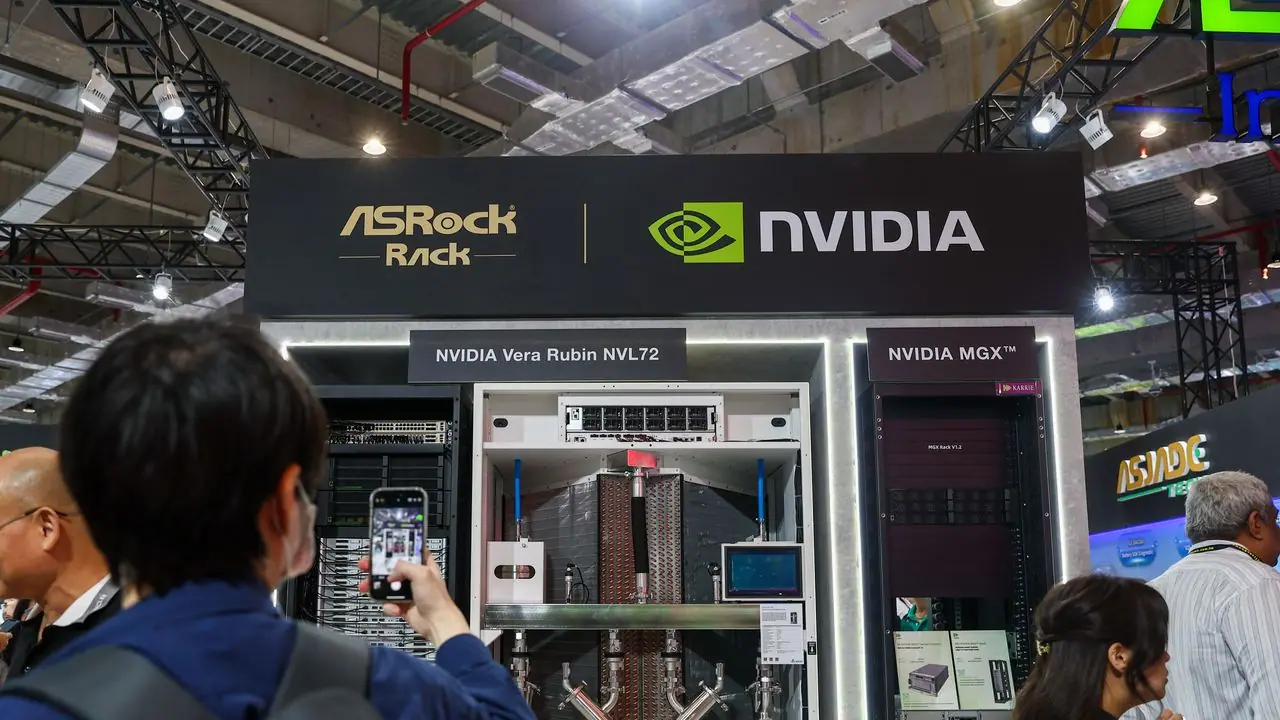
Nvidia’s next-generation AI platform targets a key hyperscaler bottleneck: getting more AI output from every unit of power.
- Rubin NVL72 is modeled to generate 39% more annual revenue and 42% more profit per gigawatt than the strongest GB300 setup, according to SemiAnalysis.
- SemiAnalysis credits Nvidia’s integrated compute, networking, and interconnect design for Rubin’s performance.
- The stats come as investors reassess the pace of AI infrastructure spending and Nvidia’s recent stock pullback.
Nvidia’s Vera Rubin platform could materially improve the economics of AI inference, according to a new analysis from SemiAnalysis, which estimates that it can generate more than twice the profit per gigawatt of power compared with the prior-generation Blackwell platform on key agentic workloads.
Performance matters as AI infrastructure increasingly runs into power constraints: higher tokens per megawatt lets cloud providers and hyperscalers serve more workloads from the same electricity allocation, potentially increasing revenue and margins.
Nvidia shares rose 0.7% in premarket trading on Wednesday.
Nvidia Vera Rubin’s Performance
SemiAnalysis’ latest AgentX benchmark found that Rubin NVL72 delivered about 39% more annual revenue and 42% more modeled profit per gigawatt than the strongest GB300 configuration.
The analysis also highlights Rubin’s performance-per-dollar advantage, with the platform delivering up to 67x the total throughput per Total Cost of Ownership (TCO) of GB300 in a 170 tokens-per-second (TPS) configuration.
SemiAnalysis attributed the gains to Nvidia’s “extreme co-design” of the Rubin GPU, Vera CPU, NVLink 6, ConnectX-9, BlueField-4 and Spectrum-6 networking stack, which is designed around agentic workloads involving long context and repeated turns.
Power efficiency is particularly important because AI data centers are increasingly constrained by available electricity rather than simply the number of accelerators that can be purchased.
Vera Rubin Timeline
Nvidia announced the Vera Rubin platform in March, saying Rubin-based products would become available through partners in the second half of 2026.
By July, Nvidia said NVL72 production was ramping, with racks running at CoreWeave, Google Cloud, Microsoft Azure, Oracle Cloud Infrastructure and Nebius across a supply chain spanning more than 350 factory sites in 30 countries.
Retail View On NVDA
On Stocktwits, the retail sentiment for NVDA remained ‘bearish’ unchanged over the past week. Shares have pulled back over the past couple of weeks, including a 3.4% drop on Monday.
The recent weakness reflects a broader AI trade pullback: investors are questioning the pace and sustainability of AI spending after prominent AI executives called for greater caution.
For updates and corrections, email newsroom[at]stocktwits[dot]com.<
