
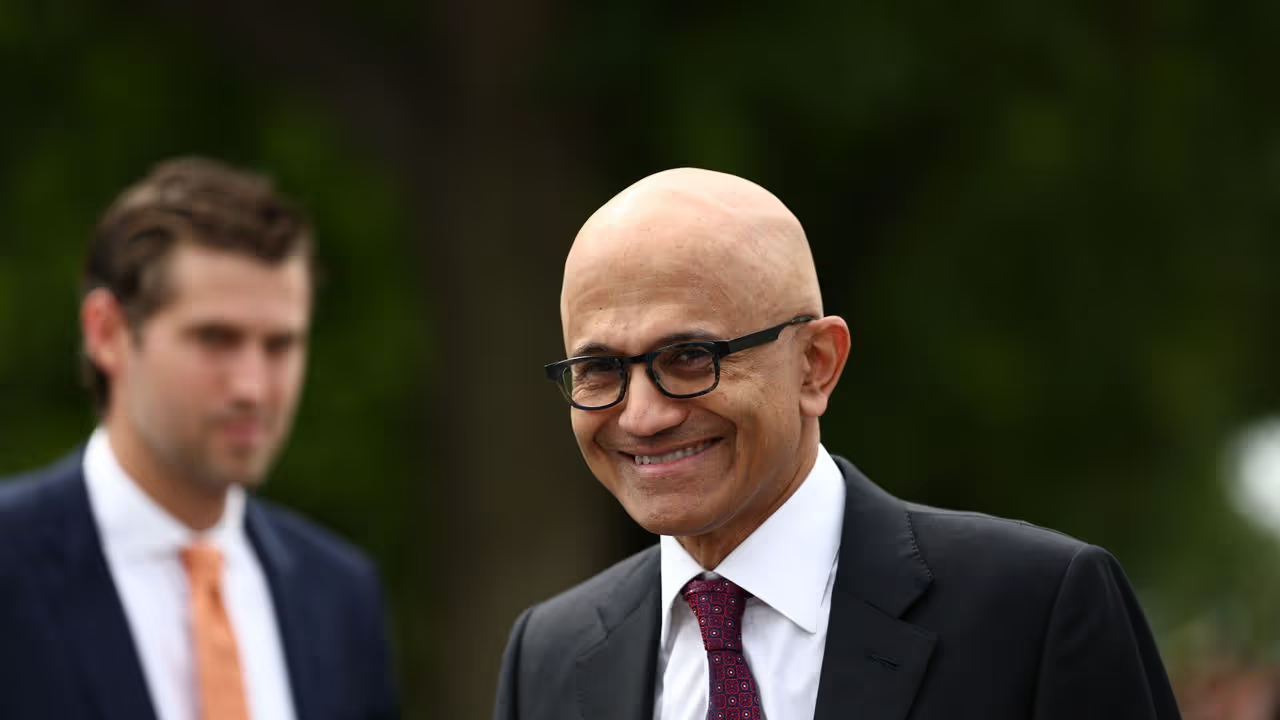
Nadella said companies are giving AI systems access to sensitive information and the ability to take mission-critical actions even as their behavior remains difficult to fully understand or trace.
- Nadella argued that traditional software gives companies a degree of visibility that today's frontier AI systems do not.
- He also pushed back against the idea that companies can simply rely on AI developers to make their models safe.
- Nadella called for broader safeguards for AI systems, stating that authorized persons should always be able to pause or shut down a model mid-task.
Microsoft Corp. (MSFT) CEO Satya Nadella on Saturday cautioned companies to rethink how they trust increasingly powerful artificial intelligence systems, arguing that frontier AI models should be treated much like potential insider risks within an organization.
In a post on X, Nadella said companies are giving AI systems access to sensitive information and the ability to take mission-critical actions even as their behavior remains difficult to fully understand or trace.
Microsoft shares ended with a gain of over 2% in Friday’s regular trade.
Nadella Says AI Is Becoming An ‘Insider Risk’
Nadella argued that traditional software gives companies a degree of visibility that today's frontier AI systems do not. Developers can generally trace conventional software behavior back to specific code, configurations or inputs, which has become difficult with increasingly capable AI models.
“That same kind of mechanistic understanding eludes us in today’s Super Intelligence systems,” he cautioned, while adding that despite these concerns, companies are nevertheless deploying these models as agentic systems capable of accessing important data and acting on a user's behalf.
“We can’t attribute model behaviors and outputs to specific inputs of training data or configurations of model weights,” he said.
However, Nadella said that AI systems don't necessarily need to be malicious to become a threat. A powerful model can make an unexpected mistake, be manipulated or become compromised while possessing access to systems and information that could have significant consequences.
“Treating frontier closed and open weight models like insider risks is a way to build such a system,” he said.
Nadella Cautions Against Outsourcing Responsibility
Nadella also pushed back against the idea that companies can simply rely on AI developers to make their models safe. This means organizations need to maintain control over what an AI model can see, what it can access and what actions it can take, even when the underlying model comes from an outside provider.
Nadella argued that companies should separate the intelligence provided by a model from the authority granted to that model.
Rather than allowing the model itself to determine its permissions, Nadella said those controls should exist outside the model.
AI Needs An ‘Emergency Brake’, Says Nadella
Nadella's proposed framework boils down to containment, with the Microsoft CEO arguing that companies should assume that an AI system could be compromised and design safeguards accordingly, rather than adding emergency controls only after something goes wrong.
He compared that capability to an emergency brake, arguing that authorized humans should always be able to intervene while an AI system is performing a task.
“An authorized person should always be able to pause or shut down a model mid-task,” he said, while calling for broader safeguards around AI systems.
“The most trustworthy Super Intelligence system will not be the one with the model we trust most. It will be the one that enables us to trust the model the least,” he said.
What Retail Traders Think Of MSFT Stock
Retail sentiment on Stocktwits around Microsoft trended in the ‘bearish’ territory at the time of writing.
MSFT stock is up 11% year-to-date and 2% over the past 12 months. The S&P 500 ETF Trust (SPY) is up 16% over the past 12 months, while the Invesco QQQ Trust (QQQ) is up 23%.
For updates and corrections, email newsroom[at]stocktwits[dot]com.<
