
Investors and market observers continue to debate whether AI-linked cloud and infrastructure demand is durable.
- Burry sees hyperscalers building toward a dominant market position.
- Ed Zitron argues cloud growth is increasingly reliant on a small number of AI customers.
- Hyperscaler capex is expected to approach $800 billion in 2026, intensifying debate over whether AI demand can support the spending.
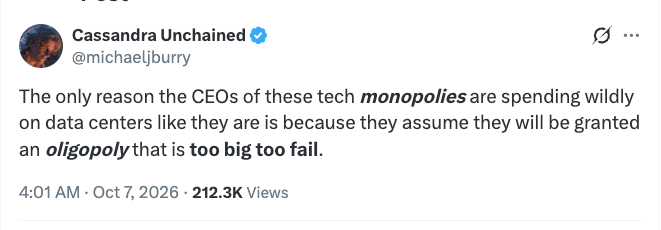
"The Big Short" investor Michael Burry said on Tuesday that Big Tech's heavy data center spending rests on its CEOs' assumption that they will be allowed to form an "oligopoly" that is "too big to fail."
“The only reason the CEOs of these tech monopolies are spending wildly on data centers like they are is because they assume they will be granted an oligopoly that is too big too fail,” Burry said in a post on X.
An oligopoly is a market dominated by a small number of companies, where limited competition can give them pricing power.
Ed Zitron Pushes Back On Cloud Resilience Narrative
EZ Primary Research CEO and AI critic Ed Zitron rejected Burry’s reasoning, arguing that the spending is instead a consequence of hyperscalers running out of other major avenues for growth.
“No? It’s because they have no hypergrowth ideas left and know that once this era ends they’ve got nothing else for investors to look forward to,” Zitron said in a reply.
Zitron added that the underlying demand for AI compute is not broad enough and that a disproportionate share of the demand is coming from OpenAI and Anthropic.
Burry’s assumption “makes the mistake of assuming that the underlying demand for AI compute isn’t heavily concentrated w/ Anthropic and OpenAI,” he said.
In a separate post, Zitron said, “This is not remotely true man; the revenues aren’t there for cloud compute outside of OpenAI and Anthropic,” he said.
The contrasting views underscore the long-running debate over whether today’s AI infrastructure boom will translate into durable cloud and AI revenue growth or leave hyperscalers increasingly dependent on a narrow pool of AI customers.
Hyperscalers Bet Big On AI Infrastructure
The comments come as Microsoft (MSFT), Amazon (AMZN), Alphabet (GOOGL) and Meta Platforms (META) continue to ramp up capital spending to build the computing capacity needed for AI.
Hyperscaler capital spending is expected to approach $800 billion in 2026 and could top $1 trillion in 2027, as Big Tech pours money into data centers, chips and power infrastructure to meet AI demand.
That spending has created a powerful multiplier effect for semiconductor and networking companies, with hyperscaler capex increasingly driving demand across the broader technology hardware ecosystem.
Burry’s Bearish On AI Infrastructure Boom
Burry currently has bearish put positions in Nvidia, Palantir, Oracle, Micron, Nebius, the iShares Semiconductor ETF and the Nasdaq 100.
In a recent comment, Burry said that the stock market is repeating patterns seen before the 2000 dot-com bust and the 2008 financial crisis, with investors still in the “denial” phase despite historically high valuations.
He said the “AI boom” would eventually turn into a bust, saying he has moved up his bearish timelines and positioning for a “2000-2003 style value revival” as the AI trade unwinds.
On Stocktwits, the retail sentiment was ‘neutral’ for AMZN and MSFT, ‘bullish’ for GOOGL, and ‘bearish’ for META and ORCL as of early Wednesday.
For updates and corrections, email newsroom[at]stocktwits[dot]com.<
