
Meta introduced Muse earlier this month as a personal AI agent designed to work toward longer-term goals rather than simply respond to individual prompts. Muse for Small Business extends that same model into commercial workflows.
- Muse can connect to 15 third-party business apps, along with Facebook and Instagram accounts.
- Owners can give the agent broader goals such as finding customers or helping run the business.
- Publishing, sending messages and spending money still require explicit user approval.
Meta Platforms Inc. (META) is pushing its Muse AI agent beyond personal assistance and into day-to-day small-business operations, giving it access to the software companies already use for payments, accounting, commerce, marketing and workplace collaboration.
With this expansion, Meta is positioning Muse to work toward broader business goals across those connected services rather than requiring owners to handle each task separately.
A business owner could, for example, give Muse a goal such as finding new customers or helping run the business. Once connected to the company’s tools, Muse can use information already available across those services as context for its work.
One Agent Across A Fragmented Software Stack
Muse for Small Business supports 15 third-party integrations, including Shopify (SHOP) and Stripe for commerce and payments, Intuit QuickBooks (INTU) for accounting, Klaviyo for marketing, Canva and Figma (FIG) for design and Slack, Asana and Notion for workplace tasks.
It can also connect to a company’s Facebook and Instagram business accounts.
Meta said Muse begins with an understanding of the business based on those connected tools, reducing the need for owners to repeatedly supply the same information.
That gives Muse a broader operating view across the different services a small company may already rely on.
Meta Keeps A Human Approval Layer
Meta is also drawing a clear line around what the agent can do on its own. “Nothing publishes, sends, or spends without your approval,” the company said.
That means Muse can work toward a task using connected business information, but outward-facing actions such as publishing content, sending communications or spending money still require the owner to sign off.
Muse Moves Beyond Personal Use
Meta introduced Muse earlier this month as a personal AI agent designed to work toward longer-term goals rather than simply respond to individual prompts.
Muse for Small Business extends that same model into commercial workflows, where the agent can now operate across tools covering accounting, commerce, payments, marketing and productivity.
Retail Sentiment Around META Stock
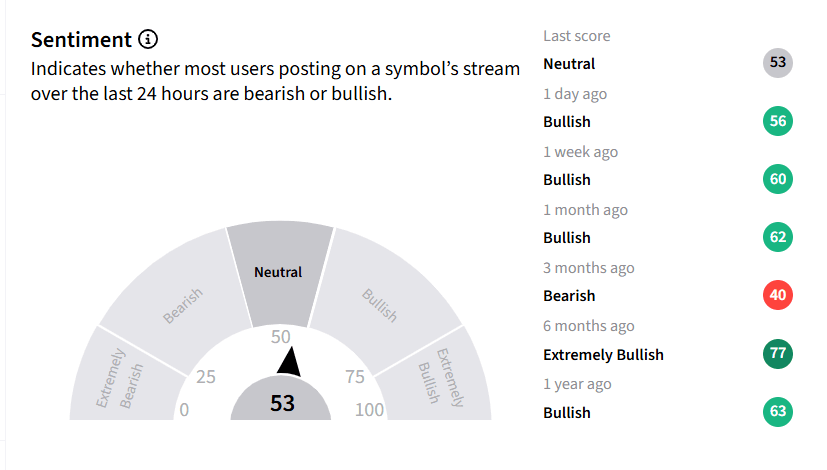
On Stocktwits, retail sentiment around META stock turned ‘neutral’ amid high message volume.
So far this year, the stock has rallied around 10%. In comparison, the Roundhill Magnificent Seven ETF (MAGS), which holds META stock, has risen nearly 10%, while the Vanguard Communication Services ETF (VOX) has fallen over 1% over the same period.
See Also: NFLX Stock Drops Over 14% This Month, Nears This Crucial Level From July — Here’s A Look At Some Key Street Takes
For updates and corrections, email newsroom[at]stocktwits[dot]com.<
