
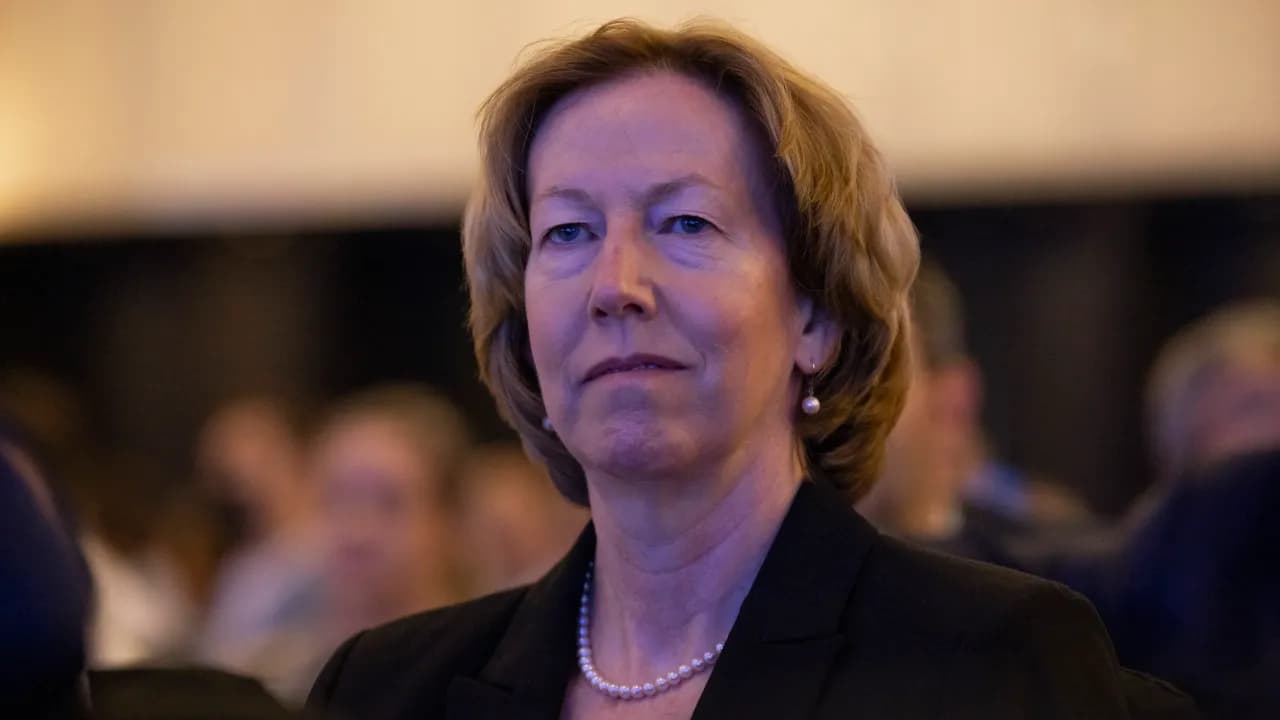
BP seems to be creating history by naming its first woman CEO and also the first among the big oil companies, setting a precedent for a changing oil and gas landscape.
- O’Neill currently serves as CEO of Woodside Energy and was previously at ExxonMobil.
- In July, BP, which has been struggling to improve its stock price, named Albert Manifold as the chairman of the company’s board.
- Earlier this year, under CEO Murray Auchincloss, BP said it plans to cut its investment in renewable energy and increase its annual oil and gas spending to $10 billion.
BP CEO Murray Auchincloss is leaving the company abruptly, just two years into his tenure. His successor will be the first woman CEO of a major oil company and the British multinational’s fourth chief executive in only six years.
The relatively sudden change at the top comes as BP has seen its profits and revenue lag those of rivals U.S.-based ExxonMobil and UK-based Shell. And as competition heats up among energy firms, BP is betting that Meg O’Neill will lead the journey back to its traditional oil-and-gas roots, away from renewable energy initiatives amid a Donald Trump-led regulatory environment that’s turned hostile to any green initiatives.
Who Is Meg O’Neill?
O’Neill currently serves as CEO of Woodside Energy and, since becoming head of the company in 2021, has grown it into the largest energy company listed on the Australian Securities Exchange. Among her many accomplishments at Woodside
Under her leadership, Woodside Energy went ahead with the acquisition of BHP Petroleum International to create a geographically diverse business with a portfolio of high-quality oil and gas assets.
And well before joining Woodside, where would one expect O’Neill to have spent her time? At BP’s competitor and the one it is trying to outperform: ExxonMobil. She held technical, operational, and senior leadership positions for ExxonMobil in Houston, New Orleans, Indonesia, Canada, and Norway, as well as regional and global leadership positions.
She is also the chair of the Australian oil and gas industry peak body, Australian Energy Producers (AEP), and serves on the boards of the Business Council of Australia and the American Petroleum Institute.
The Board’s Push
In July, BP, which has been struggling to improve its stock price, named Albert Manifold, a former executive of building materials producer CRH, as chairman of its board. As soon as Manifold was named chair, one of its largest shareholders, Elliott Management, reportedly called on him to “urgently address BP's shortcomings” and ensure a “decisive and effective leadership” at the company.
On Thursday, BP said that the appointment of O’Neill followed a search process overseen by a board search committee and is part of the board’s long-term succession planning.
“The departure of Murray Auchincloss as BP CEO probably can’t be chalked up as a major surprise, but the timing and suddenness of it can be,” AJ Bell investment director Russ Mould said.
Mould noted that the appointment of a new chair a few months ago helped tee up this change. “Reportedly, the choice of Meg O’Neill from Australia’s Woodside Energy as Auchincloss’ replacement has Elliott’s blessing,” Mould said. He added that this should help give her some breathing space as she looks to implement her strategy when she starts in the role next April.
The Strategy Shift At BP
Earlier this year, under Auchincloss, BP said it plans to cut its investment in renewable energy and increase its annual oil and gas spending to $10 billion. BP joined several companies that are shifting focus back to oil and gas production, as the move to transition to renewables has pushed them behind ExxonMobil and Chevron.
Mould noted that Auchincloss has walked back on BP’s green push but has had his feet to the fire ever since activist investor Elliott joined the shareholder register earlier this year. “The ultimate arbiter – the share price – doesn’t speak in Auchincloss’ favour, with a total return of just 5% under his tenure compared with 39% over the same period for the FTSE 100 and 19% for its main rival Shell,” he added.
How Are Stocktwits Users Reacting?
Retail sentiment on BP improved to ‘bullish’ territory from ‘bearish’ compared to a day ago, with message volumes at ‘high’ levels, according to data from Stocktwits. The stock has seen an over 230% jump in users on Stocktwits, adding it to their watchlist.
Retail sentiment on ExxonMobil was in the ‘bullish’ territory compared to ‘extremely bullish’ a week ago, while Chevron’s sentiment remained unchanged in the ‘bullish’ region compared to a week earlier.
U.S.-listed shares of BP have gained 16% so far this year, while ExxonMobil’s stock has jumped over 9% and Chevron’s shares have risen 3% year-to-date.
For updates and corrections, email newsroom[at]stocktwits[dot]com.<
