
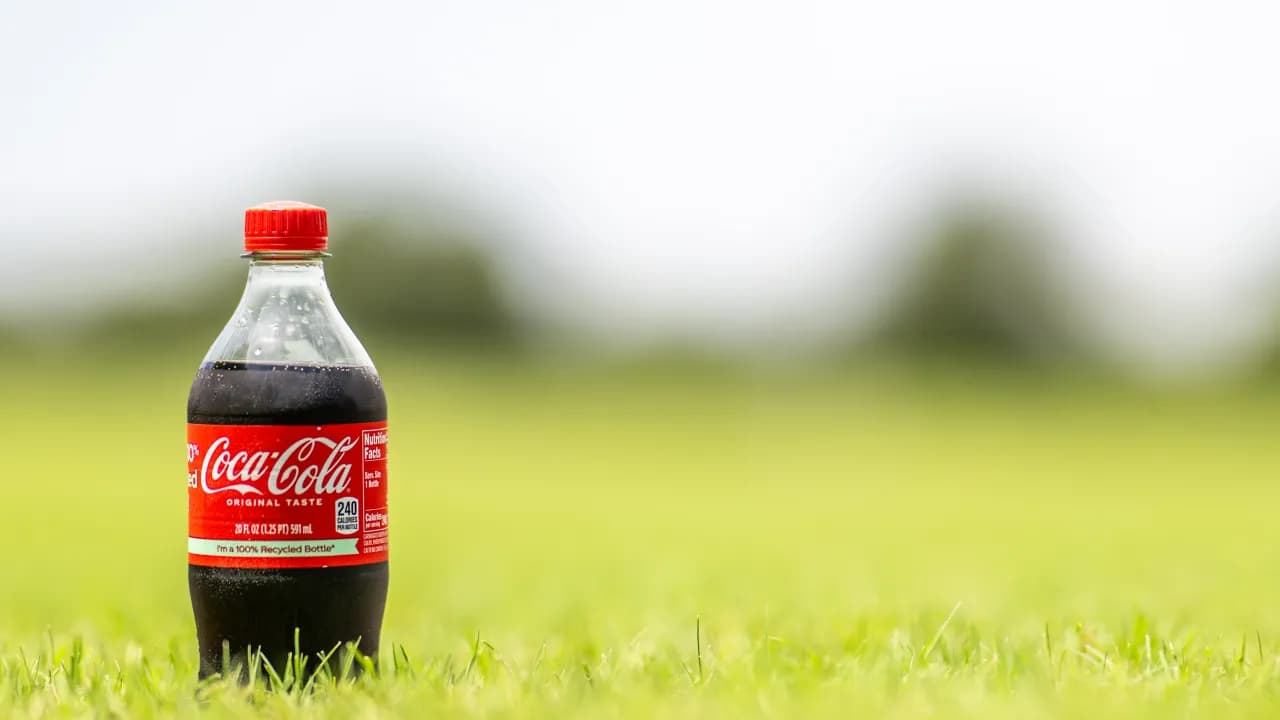
Right now, Trump's tariffs are prompting Coca-Cola to rethink its costs and strategize as it continues its move toward a more sustainable packaging strategy.
- In February, CEO James Quincey said that the company’s strategies to ensure affordability and consumer demand are that if one packaging solution suffers a rise in input costs, other packaging offerings will allow it to compete.
- He then highlighted that the tariffs on aluminum were a manageable problem in the context of the U.S. economy as a whole.
- DS Smith, a fibre-based packaging company, and Coca-Cola HBC Austria have collaborated to replace the plastic shrink wraps.
U.S. President Donald Trump’s tariffs pushed soda giant Coca-Cola to lean into more plastic packaging earlier this year to shave costs, a move that now coexists with the company’s efforts to be a more sustainable packaging partner.
The company’s bottler, Coca-Cola HBC Austria, has been testing a strategy for the Coca-Cola, Fanta, Sprite, and Mezzo Mix brands, replacing plastic shrink wraps for 1.5 litre PET soft drink multi-packs with cardboard-based outer packaging over the last couple of years.
Tariffs & Plastic Bottles Go Hand In Hand
When Trump decided to levy duties on aluminum imports in the first few months of his second term, it left soda giants and major packaged food companies in a fix on how to turn to affordable packaging.
It meant using more of what costs less, and for Coca-Cola, the idea was to use plastic bottles, a form of packaging it has been trying to reduce as part of its sustainability move.
Last year, Coca-Cola was reportedly accused of abandoning its promise of achieving a 25% reusable packaging target by 2030. According to The Guardian, researchers have previously noted that Coca-Cola is among the world’s most polluting brands when it comes to plastic waste.
Right before Trump took office, in December of 2024, Coca-Cola said that its 2035 environmental goals replace previous goals. The company then said it would aim to use 35% to 40% recycled material in primary packaging such as plastic, glass and aluminum, including increasing recycled plastic use to 30% to 35% globally. That was a change from its previous goal of “use 50% recycled material in our packaging by 2030.
What Coca-Cola's CEO Thinks
CEO James Quincey, in February, said that the company’s strategies to ensure affordability and consumer demand are that if one packaging solution experiences an increase in input costs, other packaging offerings will allow it to compete in the affordability space.
“So, for example, if aluminum cans become more expensive, we can put more emphasis on PET bottles, etcetera, etcetera. So ,we will adapt the packaging strategy in function of changes in the relative input costs of what goes into that,” Quincey said.
He then highlighted that the tariffs on aluminum were a manageable problem in the context of the U.S. economy as a whole. “And I don't think we should conclude that this is some huge swing factor in the U.S. business. It's a cost, it'll have to be managed, it would be better not to have it relative to the U. S. business, but we are going to manage our way through,” Quincey added.
Coca-Cola Bottler Doesn't Waver
DS Smith, a fibre-based packaging company, and Coca-Cola HBC Austria have collaborated to replace plastic shrink wrap. DS Smith said the packaging solution is a 100% recyclable corrugated handle that improves consumer carry functionality.
It helps to reduce around 200 tonnes of plastic each year for Coca-Cola HBC Austria, according to the companies.
Marcel Martin, Coca-Cola HBC’s Chief Corporate Affairs and Sustainability Officer, said the packaging, known as LitePac Top, is an important milestone for the company, which aims to be “NetZeroBy40.”
Coca-Cola has said that the company and its bottling partners have taken, and continue to take, actions to reduce the Coca-Cola system’s carbon footprint, for example, by increasing our use of recycled packaging materials, expanding our renewable energy usage, and participating in environmental and sustainability programs.
But Is Sustainability A Costly Affair?
In the company’s annual filing from February this year, Coca-Cola said that increasing focus on sustainability matters has resulted in, and is expected to continue to result in, evolving legal and regulatory requirements. “We have incurred, and are likely to continue to incur, increased costs complying with such standards and regulations, particularly given the lack of convergence among standards,” Coca-Cola said.
Retail Traders Don't Feel Too Good About $KO
Retail sentiment on Coca-Cola dipped to ‘bearish’ from ‘neutral’ territory a day ago, with message volumes at ‘normal’ levels, according to data from Stocktwits. Only 8% of Stocktwits users have added the stock to their watchlists over the past year.
Shares of Coca-Cola, however, have jumped by more than 12% this year, riding on better-than-expected quarterly results so far, as well as efforts to expand into offering more fitness and lifestyle products, as traditional sodas face a slowdown.
For updates and corrections, email newsroom[at]stocktwits[dot]com.<
