
Google's eighth-generation TPU lineup now includes four specialized systems, as its AI accelerator business expands to nearly 100 customers.
- Google's TPU 8tx protects sensitive data during AI processing and delivers up to 2x lower latency than TPU 8t.
- TPU 8i Max doubles computing power, on-chip memory capacity, and high-bandwidth memory bandwidth compared with TPU 8i.
- Google is also expanding software support to make its TPUs easier to use.
Alphabet's (GOOG, GOOGL) Google on Monday introduced two new Tensor Processing Unit (TPU) systems, expanding its artificial intelligence (AI) hardware portfolio to address growing demand for secure computing and increasingly complex AI applications.
The company said TPU 8tx and TPU 8i Max bring its eighth-generation lineup to four systems introduced this year, as its TPU business now serves nearly 100 customers, including AI research labs, trading firms and retailers.
Google's expanding AI chip portfolio intensifies competition with Nvidia (NVDA), which faces scrutiny after CEO Jensen Huang acknowledged an extramarital affair and its board launched an investigation into reports of a foreign intelligence effort targeting him.
At the time of this writing, GOOG Stock was up over 2% in early morning trade.
Google's TPU 8tx Targets Secure AI Computing
According to Google, TPU 8tx is designed for government agencies and regulated enterprises that need to run AI models while protecting sensitive information.
Built on existing TPU 8t silicon and paired with AMD EPYC processors, the system uses hardware-level security to protect private data and AI models even while processing.
Google said TPU 8tx delivers up to 2x lower latency than TPU 8t by using a faster network designed for AI reasoning tasks. The system also allows organizations to fine-tune and train AI models using private data without transferring sensitive information between separate computing clusters.
TPU 8i Max Doubles Compute And Memory Bandwidth
TPU 8i Max addresses a different challenge: the growing memory demands of AI agents processing extensive documents, software codebases and lengthy videos.
Google combines two TPU 8i chips into a single package, doubling computing power, static random-access memory (SRAM) capacity and high-bandwidth memory (HBM) bandwidth compared with TPU 8i.
The configuration also fits twice the silicon into the same rack space, allowing data centers to increase computing density without expanding their physical footprint.
Google Expands TPU Software Support
Google is also expanding software support to make its TPUs easier to use.
In October, Google open-sourced TorchTPU, allowing developers to run existing PyTorch code and Hugging Face models natively on its accelerators without rewriting code.
The company also said its new dynamic slicing technology can reduce computing job startup times by up to five times and accelerate recovery from hardware failures by up to 4.5 times.
What Retail Thinks About Google Stock
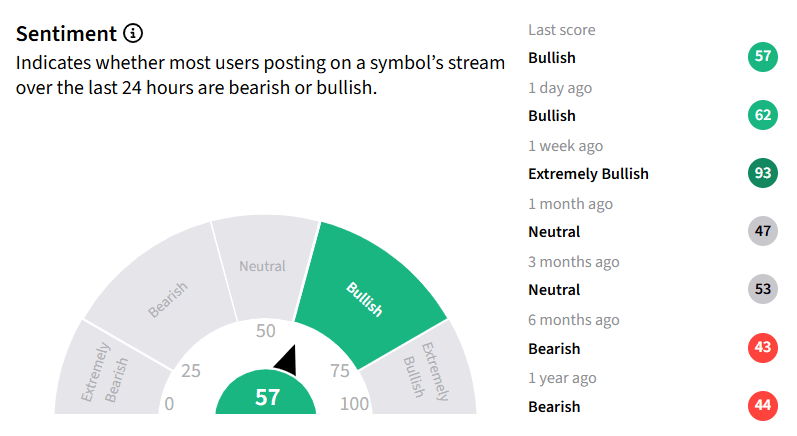
On Stocktwits, retail investors’ sentiment around GOOG stock remained ‘bullish’.
So far this year, GOOG stock has tumbled nearly 10%. In comparison, the Invesco NASDAQ 100 ETF (QQQM), which holds the stock, has risen more than 7% over the same period.
See Also: AKAM Stock Slides: Akamai Plans $2.2B Convertible Debt Offering To Fund Cloud Expansion, Repay Debt
For updates and corrections, email newsroom[at]stocktwits[dot]com.<










