
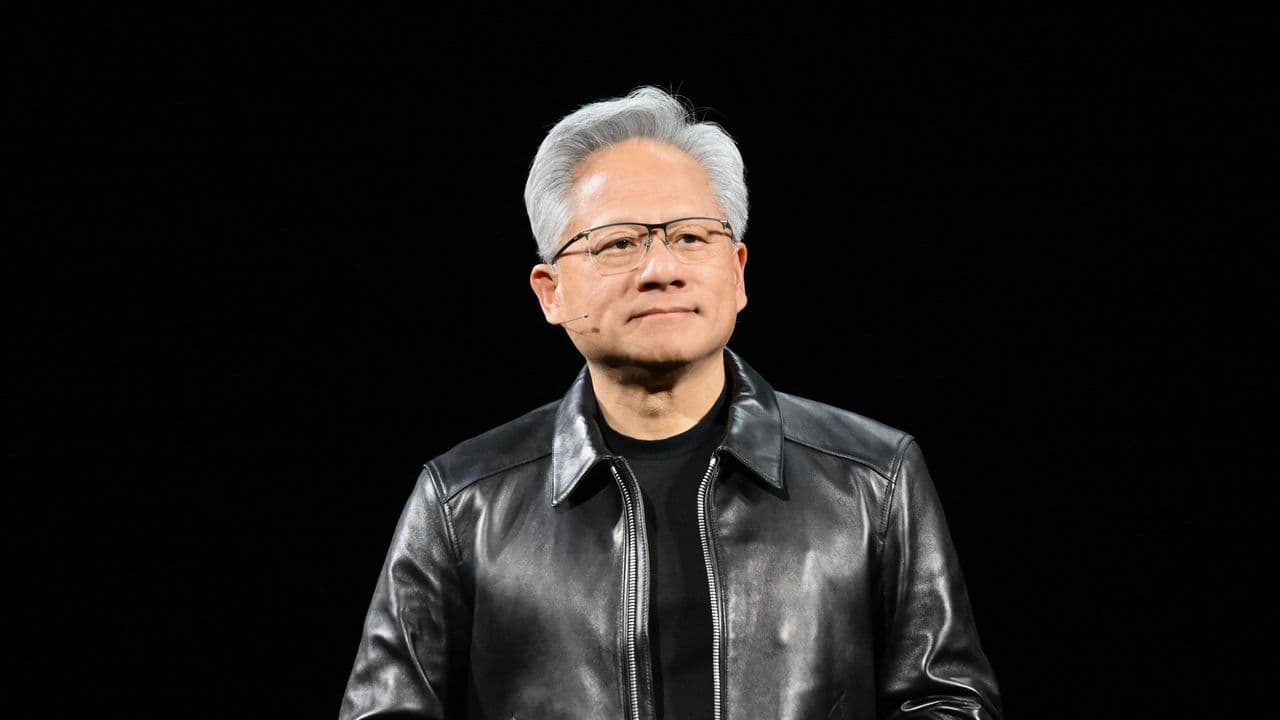
The board is investigating the allegations pertaining to Huang’s romantic relationship with an alleged Chinese spy, and regulators will review the matter, after which investors can better assess sentiment, he said.
- Solomon reiterated that AI infrastructure growth “will not be a straight line.”
- The CEO argued the U.S. must build compute capacity thoughtfully, in the right places and with appropriate protections.
- Demand for AI infrastructure and related technology remains strong, he said, even as the market calibrates risks differently than a few months ago.
Goldman Sachs CEO David Solomon on Monday dismissed concerns that the unfolding controversy around Nvidia CEO Jensen Huang poses meaningful distraction or concentration risk to the AI ecosystem, while reiterating confidence in the long-term trajectory of AI infrastructure investment.
Solomon Rejects Single-Individual Risk
“I don't think the ecosystem is centered around one individual. I obviously know Jensen. I think highly of Jensen. I think Nvidia is a great American company, and I think no matter how this plays out, Nvidia will continue to be a great and important American company,” Solomon said in an interview with CNBC, while adding that he is not aware of the facts pertaining to the allegations.
The board is investigating the allegations pertaining to Huang’s romantic relationship with an alleged Chinese spy, and regulators will review the matter, after which investors can better assess sentiment, he said. He declined to speculate on distraction or concentration risks, stating only that Nvidia is a large, important company that will continue to play a major role under any circumstances.
Recalibrations, Not A Reversal
Solomon reiterated that AI infrastructure growth “will not be a straight line.” Earlier this year, he had characterized the environment as having more greed than fear. Recent price swings, he said, reflect normal investor recalibration as understanding of demand, political conditions, and the application layer evolves.
“I still deeply believe in the long-term trajectory of the power of AI in our economy to drive productivity, and you know I don't think the base for that has changed, but investors will constantly recalibrate,” he added.
Political Noise Versus Policy
Addressing anti-AI sentiment and talk of data-center moratoriums, Solomon separated political noise from substantive policy. Opposition is not uniform; some states also recognize the economic benefits of the infrastructure, he noted.
“I'm optimistic there'll still be a significant amount of investment in data centers and compute capacity in the United States, and I think we want that. I think if we really prevented that, we'd look back 10-20 years from now and not like that as a strategic decision for the U.S.,” he said.
Solomon argued the U.S. must build compute capacity thoughtfully, in the right places and with appropriate protections. Blocking it domestically would simply push investment overseas, an outcome he believes the country would later regret.
Demand for AI infrastructure and related technology remains strong, Solomon said, even as the market calibrates risks differently than a few months ago. Capital markets are open, transactions are occurring, and significant flows into the sector are expected to persist, he said.
Nvidia Launches Probe Into CEO
Solomon’s comments come on the heels of Nvidia’s board initiating a probe into reports that Huang was the target of a foreign intelligence effort. Huang separately said in an email to employees over the weekend that he had an extramarital affair and pledged full cooperation with the probe. The board, however, said it has no reason to believe national security or Nvidia’s secrets were compromised. NVDA shares, however, traded 5% lower at the time of writing, making it the only constituent of the PHLX Semiconductor Sector index(SOX) to be trading in the red, and the top loser in the S&P 500.
The New York Times reported last month that U.S. intelligence officials believed the woman, Alice Huang – a former executive at Nvidia customer and Singapore-based data-center firm Megaspeed – may have acted as an intelligence asset for China. China, meanwhile, has rejected the espionage claims as groundless.
On Stocktwits, retail sentiment around NVDA was within the ‘extremely bullish’ territory at the time of writing, coupled with ‘extremely high’ retail chatter.
For updates and corrections, email newsroom[at]stocktwits[dot]com.








