

Bessent has referenced estimates that stablecoin market capitalization could reach almost $4 trillion, although the market currently stands at $300 billion.
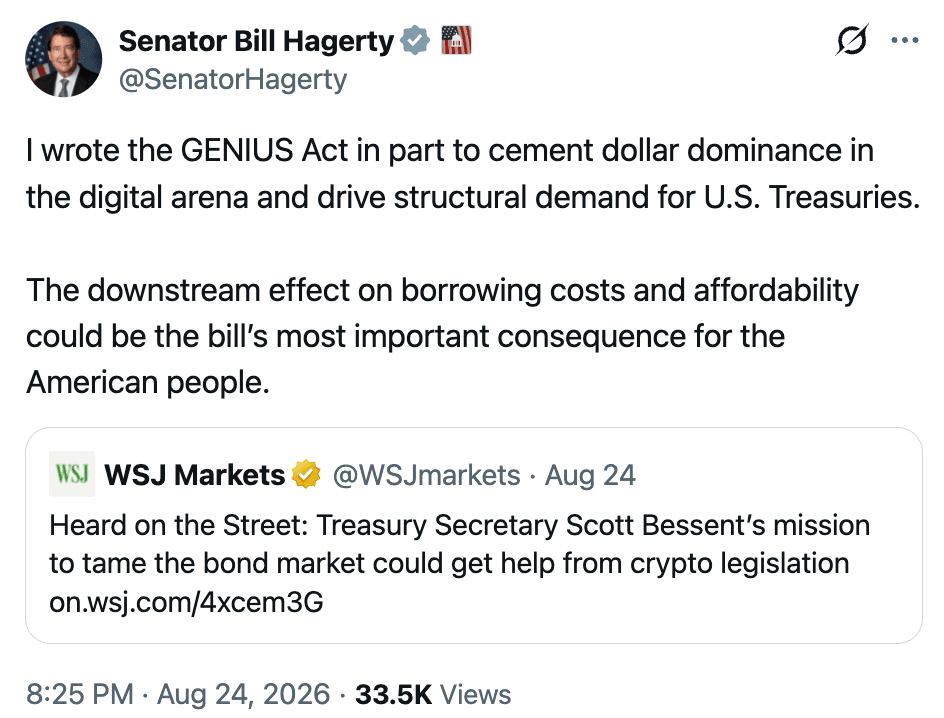
- Senator Bill Hagerty said he wrote the GENIUS Act in part to solidify dollar dominance in digital currencies and to create structural demand for U.S. Treasuries.
- The downstream effect on borrowing costs and affordability could be the law’s most important legacy for Americans, he added.
- The law requires stablecoins that are pegged to the U.S. dollar to hold reserves in assets like Treasuries with maturities of 93 days or less, making them a natural buyer of short-dated bills.
Senator Bill Hagerty (R-TN) said on Monday that he drafted the GENIUS Act in part to guarantee dollar dominance over digital currencies and create structural demand for U.S. Treasuries, adding that the impact on borrowing costs and affordability could be the law’s most consequential impact on Americans.
The Tennessee Republican, who authored the stablecoin law signed last year, made the comments on X, sharing a Wall Street Journal (WSJ) column that linked the Trump administration’s efforts on crypto to Treasury Secretary Scott Bessent’s efforts to soothe the bond market.
How GENIUS Act Could Boost US Treasury Bill Demand
The reserve guidelines under the Guiding and Establishing National Innovation for U.S. Stablecoins Act (GENIUS Act) requires U.S.-issued dollar-pegged stablecoins to be backed by approved assets, including Treasuries of 93 days or less maturity.
Treasury's decision to buy more long-dated bonds could lead to increased issuance of short-term Treasury bills, boosting the supply for stablecoin issuers to purchase. Stablecoin firms are required to hold eligible short-term Treasuries as reserves and could become an important source of demand.
The stablecoin market could balloon to nearly $4 trillion, Treasury Secretary Scott Bessent has previously cited estimates as saying, according to a Wall Street Journal report. “That could lower the cost for governments to borrow money,” Bessent wrote.
An August study from the Hutchins Center on Fiscal and Monetary Policy at the Brookings Institution and the Aspen Economic Strategy Group found that stablecoins could increase the demand for Treasury bills by $400 billion to $2.3 trillion by 2030, depending on how fast they grow and where they come from.
Currently, the stablecoin market is valued at around $300 billion, compared to nearly $8 trillion in U.S. money-market funds. The overall market has plateaued, little changed from last October.
CLARITY Act On Hold
Earlier this month, Hagerty called for a Senate floor vote on the CLARITY Act, urging lawmakers to test where Democrats stand and warning that U.S. leadership on digital asset standards was at risk. The CLARITY Act, he said, should build on the stablecoin framework created by the GENIUS Act. Midterm elections would slow the passage of the bill, he said.
Shares of Circle Internet Group (CRCL), the biggest issuer of stablecoins in the U.S., the USD Coin (USDC), rallied more than 20% last week in anticipation of the legislation coming together. Despite the temporary stall in the legislation, Bernstein kept an ‘Outperform’ rating and a $140 target on Circle.
On Tuesday, CRCL stock was down over 2% in morning trade. Wolfe Research raised its price target on Circle to $65 from $50, but with an ‘Underperform’ rating. On Stocktwits, the retail sentiment around CRCL shifted to ‘extremely bullish’ from the ‘bullish’ zone, while chatter around it stayed at ‘ high’ levels over the past day.
In the larger crypto market, Bitcoin’s price was up by 0.9% over the past 24 hours. On Stocktwits, the retail sentiment around BTC remained in the ‘extremely bullish’ zone, while chatter around it stayed at ‘extremely high’ levels over the past day.
Read also: Arthur Hayes Says ‘Back Up The Truck And Buy Crypto’ As Bessent's Treasury Buybacks Could Boost Dollar Liquidity
For updates and corrections, email newsroom[at]stocktwits[dot]com.<
