
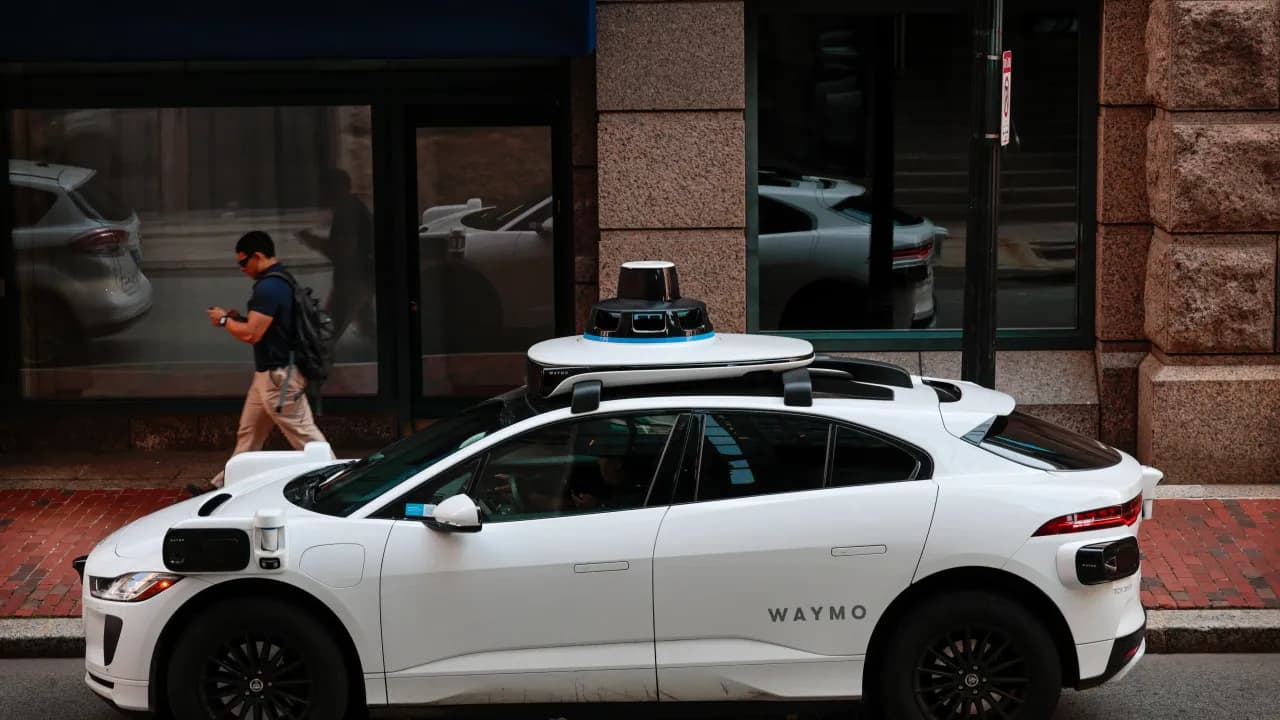
Progress in autonomous driving has been gradual, partly because the systems need massive driving data to improve, and regulators maintain a high safety bar for real-world deployment.
- Elon Musk indicated in an X post that Tesla’s autonomous driving technology is better than Waymo’s.
- Musk has been rallying behind the Tesla FSD (Full Self-Driving) system for years, which is core to his vision for the EV company.
- Waymo is the world’s leading autonomous taxi company, with a presence in five U.S. cities and expanding rapidly.
Elon Musk has once again boasted that Tesla’s self-driving Robotaxi will stand the test of time better than its biggest competitor right now.
The Tesla CEO said, “Waymo never really had a chance against Tesla,” in response to an X post by Google DeepMind Chief Scientist Jeff Dean about Alphabet, Inc.-backed Waymo’s autonomous driving technology. “This will be obvious in hindsight.”
To be sure, Dean first referenced Tesla in the discussion, saying that he believes Tesla does not have “anywhere near the volume of rider-only autonomous miles that Waymo has (96M for Waymo, as of today).”
Even as AI dominates the tech conversation, leading companies are pressing ahead in another frontier: autonomous driving. Progress has been steady rather than swift, in part because these systems rely on vast amounts of driving data to improve. And with real cars on real roads carrying real safety risks, regulators have set a high bar for deployment.
Tesla FSD Vs Waymo
For Musk, the Tesla FSD (Full Self-Driving) system is core to his vision for the electric vehicle company. He regularly shares updates and milestones about FSD, which is currently available in Tesla cars in the U.S., Canada, China, Mexico, Puerto Rico, Australia, and New Zealand.
Although Tesla currently offers a “supervised” version, which means a person must be at the steering wheel when the system is deployed, Musk recently said, “FSD Unsupervised is pretty much solved at this point.” He has also said China is set to approve Tesla’s unsupervised FSD early next year.
Waymo, on the other hand, has had fully autonomous taxis out on the roads since 2020. The first public launch took place in Phoenix, Arizona, and Waymo has since expanded to San Francisco, Los Angeles, Austin, and Atlanta. It is set to launch in London next year.
Waymo started as an internal project at Google in 2009 and became an independent entity in 2016. It’s currently valued at over $45 billion.
So, back to the Dean’s and Musk’s claims, which one is better?
The Jury Is Out … Sort Of
To be sure, it’s not an apples-to-apples comparison. For one, a Waymo car (Jaguar I-PACE) has more cameras, including an umbrella camera, than a Tesla with FSD, making them two distinct autonomous driving systems.
Tesla initially partnered with Mobileye on an autonomous system in 2014. That partnership ended, and Tesla unveiled its in-house FSD in 2016.
In terms of data, Tesla claims its cars have driven over 6.7 billion miles with FSD enabled. In comparison, Waymo says its autonomous taxis have clocked 96 million miles. To be sure, there are only 2,500 Waymo cars on the roads, while there are millions of Tesla cars, but not all of them are Robotaxis … yet.
Availability? Consumers, of course, have better access to Tesla FSD, which is available in several countries, compared to Waymo taxis, which are available in only five cities.
Even though these are unique offerings, the price still matters. Reports say a Waymo is typically 30% to 40% pricier than a regular Uber ride. To use the FSD feature in a Tesla, users can either pay a one-time fee of $8,000 or subscribe for $99 per month.
All these aside, safety is the most significant consideration for autonomous cars.
Waymo has reported about 700 road incidents between 2021 and 2025, but not fatalities. In contrast, Tesla has reported hundreds of crashes overall, and the U.S. road safety regulator is investigating at least two confirmed fatalities linked to Tesla FSD.
For updates and corrections, email newsroom[at]stocktwits[dot]com.<
