
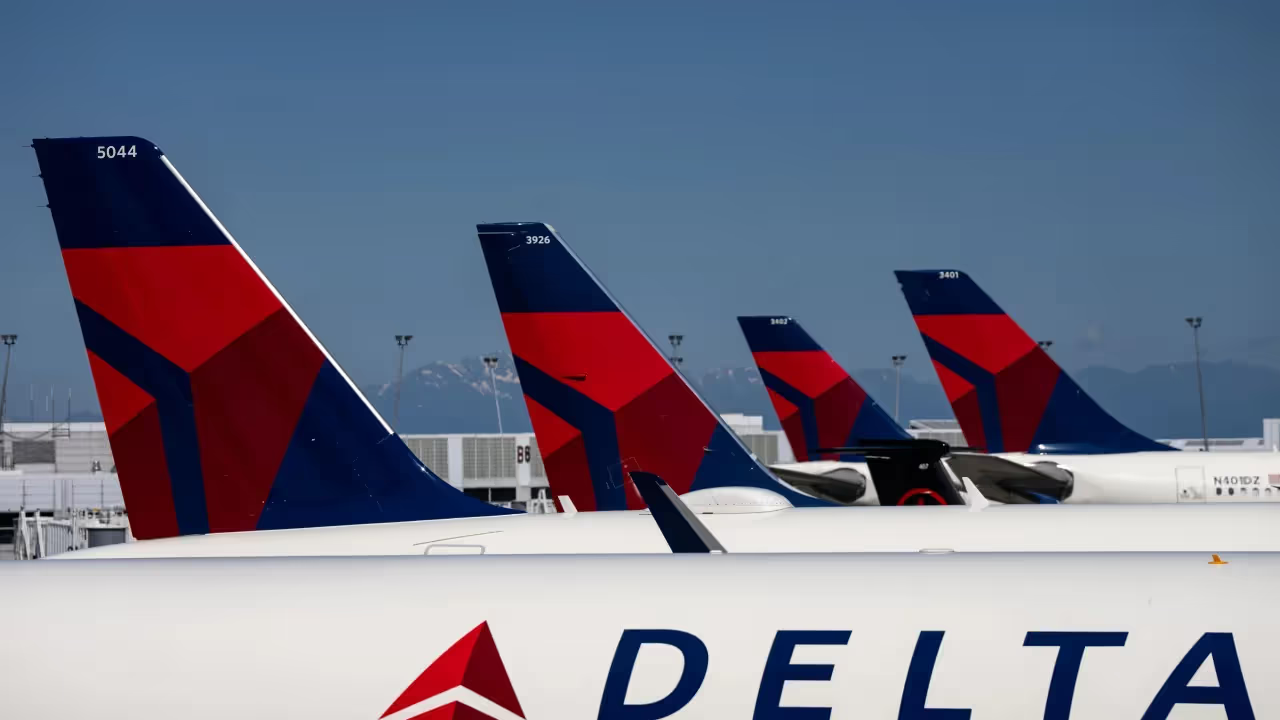
Delta uses Viasat today and has chosen Amazon’s Leo network as its next-generation Wi-Fi provider.
- SpaceX has asked the Federal Communications Commission to block, or tightly limit, U.S. use of Viasat’s new ViaSat-3 F2 satellite.
- American Airlines, United Airlines, and Southwest Airlines have already picked SpaceX’s Starlink for next-gen cabin internet.
- Kahyaoglu sees the ongoing dispute between Viasat and SpaceX as impacting cabin experience in the gap before Amazon Leo arrives.
Shares of Delta Air Lines (DAL) slipped on Tuesday after Jefferies tied the carrier’s cabin Wi-Fi roadmap to SpaceX’s latest filing against Viasat.
A Bridge Before Amazon Arrives
Jefferies analyst Sheila Kahyaoglu said SpaceX has asked the Federal Communications Commission to block, or tightly limit, U.S. use of Viasat’s new ViaSat-3 F2 satellite. The filing targets Viasat, not any airline. Kahyaoglu still sees a possible snag for Delta. The carrier uses Viasat today and has chosen Amazon’s Leo network as its next-generation Wi-Fi provider, with service slated to begin on about 500 aircraft in 2028. F2 was meant to add capacity over the Americas in the years before that rollout. If the satellite’s U.S. service is delayed or constrained, passengers may wait longer for a noticeable upgrade.
American Airlines, United Airlines, and Southwest Airlines have already picked SpaceX’s Starlink for next-gen cabin internet. Kahyaoglu sees the ongoing dispute between Viasat and SpaceX as impacting cabin experience in the gap before Amazon Leo arrives.
Years Of Fighting Over The Same Airwaves
SpaceX’s late-August petition states that Viasat has not finished the coordination the FCC required before F2 can use certain shared frequencies that Starlink also relies on. David Goldman, SpaceX’s vice president of satellite policy, wrote that Viasat has had more than five years to complete that work and has not done so. He said Viasat’s own analysis points to a real risk of interference with Starlink customers. The FCC approved U.S. market access for F2 in late July, but only on the condition that those sharing rules be met first. Viasat has not issued a detailed public response.
F2 launched in November 2025 to cover the Americas and had been pointed toward commercial service around September 2026. The fight is not over whether the satellite can fly. It is over how freely it can operate in the United States on airwaves both companies want. The two firms have been trading FCC filings for years over how older high-orbit satellites and newer low-orbit networks should share spectrum. Each side has tried to slow the other at the commission.
Other Analysts Weigh In On SPCX
Earlier on Tuesday, Pivotal Research analyst Jeffrey Wlodarczak initiated coverage of SpaceX with a Buy rating and $220 price target, implying a potential upside of about 49% from Friday’s close. If SpaceX can solve Starship reusability, it would open up an “unarguably massive opportunity," the analyst told investors. Pivotal believes Starlink could capture a material share of the current $1.7 trillion terrestrial and wireless total addressable market.
Separately, Wells Fargo cut its SpaceX price target to $212 from $215 and left an Overweight rating. Analyst Ken Gawrelski said investors should treat SpaceX’s push into U.S. mobile phone service as a real plan, not a slogan. He expects the company to lean on partners and existing assets rather than build a traditional network from scratch.
That stance, the firm said, is a problem for AT&T, Verizon, and T-Mobile if SpaceX steals new customers and drives up wireless license prices. Tower owners and cable companies could benefit if they help SpaceX reach phones on the ground.
How Did DAL And SPCX Retail Traders React?
On Stocktwits, retail sentiment around DAL stayed ‘bullish,’ with ‘normal’ message volume. Meanwhile, sentiment around SPCX was ‘bearish.’
DAL stock has gained 14% year-to-date, while SPCX is trading at about $153, above its IPO price of $135 but below its all-time high of around $225.
For updates and corrections, email newsroom[at]stocktwits[dot]com.
