

Glassnode said the current stretch represents the longest period of Bitcoin underperformance relative to the S&P 500 in its six-year history of data.
- Bitcoin has outperformed the S&P 500 on only about one-third of trading days over the past three months, according to Glassnode.
- Rising oil prices and Treasury yields are putting pressure on high-beta crypto equities, even as Bitcoin remains relatively stable.
- MSTR stock underperformed Bitcoin, falling nearly twice as much as the cryptocurrency over the past 12 months.
Crypto-linked stocks fell in pre-market trading on Tuesday, even as Bitcoin (BTC) held steady amid flaring tensions in the Middle East.
Bitcoin’s price rose 1.2% in the last 24 hours to around $64,000, a rebound after dipping below $63,000 over the weekend. The apex cryptocurrency has stayed largely range-bound over the past several sessions. On Stocktwits, retail sentiment around BTC remained in ‘bearish’ territory even as it outperformed the broader equities market.
The SPDR S&P 500 ETF (SPY) was down 0.5%, the SPDR Dow Jones Industrial Average ETF (DIA) was flat, and the Nasdaq-100 tracking Invesco QQQ Trust (QQQ) dropped 1.23%. QQQ was among the top trending tickers on Stocktwits at the time of writing, with retail sentiment trending in ‘neutral’ territory over the past day.
Circle (CRCL) was the worst hit among large-cap crypto-linked equities, down more than 3% in pre-market trade, followed by Robinhood (HOOD), which fell around 2%. Digital asset treasuries like Strategy (MSTR) and Bitmine Immersion Technologies (BMNR) dropped around 1.5% alongside cryptocurrency exchanges Coinbase (COIN) and Bullish (BLSH), which fell around 2% in pre-market trade.
Can Bitcoin Outperform The S&P 500?
According to Glassnode, Bitcoin has underperformed the S&P 500 in two of the last three trading sessions and has outperformed the index on only about one-third of trading days over the past three months.
Bitcoin did outperform the S&P 500 on Monday, gaining 2.3% while the S&P 500 edged 0.4% lower. “This has become a less common occurrence lately,” Glassnode said in a post on X.
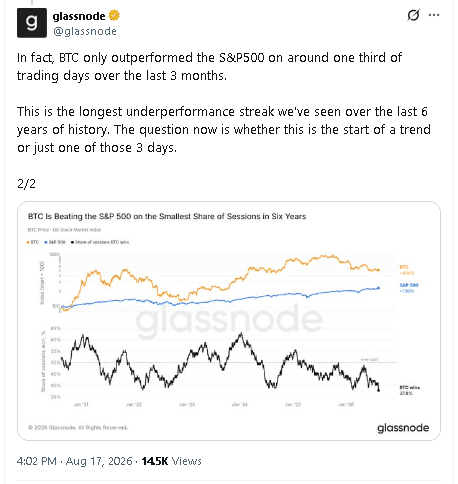
The firm noted that when Bitcoin does outperform equities, the excess returns tend to be significantly larger. However, those excess returns have also been gradually declining over the years.
Glassnode described the current stretch as the longest period of Bitcoin underperformance relative to the S&P 500 in its six-year history of data, asking whether the recent divergence marks a change in the relationship between Bitcoin and equities or is simply a short-term shift in market leadership.
A Rough Year for Crypto, An Even Rougher One For MSTR
Bitcoin and crypto-linked stocks often move in the same direction, but the relationship is not always immediate, as seen in the historical performance of Bitcoin and Strategy.
Bitcoin’s price is down nearly 27% year-to-date and 45% over the past 12 months, according to Koyfin data. Strategy, meanwhile, has fallen nearly 36% year-to-date and 73% over the same 12-month period. That means MSTR has declined roughly 1.6 times as much as Bitcoin this year and nearly twice as much over the past year.
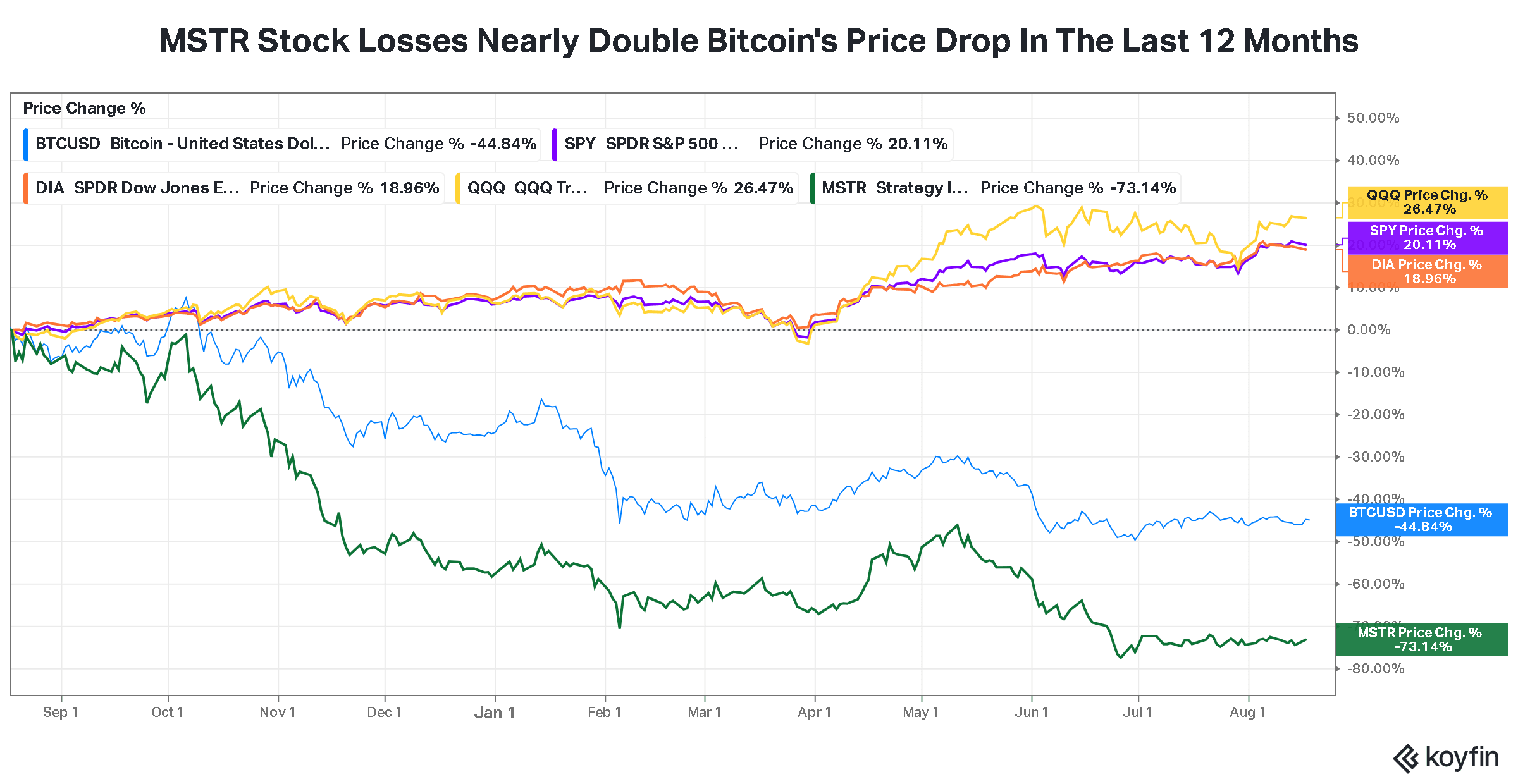
The gap matters because Strategy's investment case is closely tied to its Bitcoin holdings. Investors often view MSTR as a leveraged way to gain exposure to Bitcoin, which means the stock can amplify both gains and losses in the cryptocurrency.
The contrast with the broader market is also significant. Over the past year, the SPDR S&P 500 ETF is up over 20%, the SPDR Dow Jones Industrial Average ETF is up nearly 19%, and QQQ has gained over 26%.
Why Are Crypto Equities Falling Anyway?
Tuesday's specific move ties to broader market pressure rather than crypto-specific news. Oil prices have climbed as prospects for a Middle East resolution have dimmed, with President Trump saying he isn't interested in extending the expiring Iran agreement and fighting flaring anew in Lebanon.
Treasury yields rose alongside oil, a combination that tends to hit high-beta, sentiment-driven stocks like crypto treasuries harder than the broader market.
Markets are also digesting Friday’s weaker-than-expected retail sales report and awaiting Fed meeting minutes and retailer earnings later this week.
When oil prices rise and Treasury yields move higher, investors often reduce exposure to growth-oriented and high-beta stocks driven by concerns of higher inflation. Crypto-linked companies can face an additional layer of volatility as investors assess both the outlook for digital assets and the broader equity market.
Read also: Cathie Wood's ARK Adds Nvidia Stake, Sells AMD Stock Across Four ETFs
For updates and corrections, email newsroom[at]stocktwits[dot]com.<
