

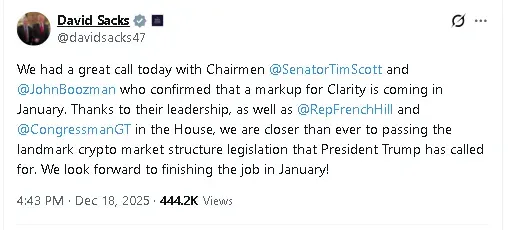
The update followed discussions with Senate Banking Committee Chairman Tim Scott and Senator John Boozman, according to Sacks’ post on X.
- Crypto markets were largely unmoved by the news, with total market capitalization slipping below $3 trillion over the past 24 hours.
- The CLARITY Act would draw a regulatory line between digital commodities and securities, placing Bitcoin and Ethereum under CFTC oversight.
- Institutional investors are closely watching the bill’s progress, viewing regulatory clarity as a prerequisite for broader capital allocation.
David Sacks, the Trump administration’s AI and crypto policy lead, said Thursday night that the long-awaited CLARITY Act is on track for a markup in January, signaling renewed momentum for U.S. crypto market structure legislation.
In a post on X, Sacks said he had spoken with Senate Banking Committee Chairman Tim Scott and Senator John Boozman, who confirmed that a markup of the CLARITY Act is expected early next year. “We are closer than ever to passing the landmark crypto market structure legislation that President Trump has called for,” Sacks wrote.
The overall cryptocurrency slipped under the $3 trillion mark on Thursday night, down 1.7% in the last 24 hours. Bitcoin (BTC) dropped to around $85,200, with retail sentiment around the cryptocurrency on Stocktwits trending in the ‘extremely bearish’ territory over the past day, accompanied by ‘low’ levels of chatter.
Institutional Capital Watches The Outcome
The CLARITY Act aims to establish a clearer regulatory framework for digital assets by drawing a clearer distinction between commodities and securities. Under the proposal, Bitcoin and Ethereum (ETH) would be designated as “digital commodities” overseen by the Commodity Futures Trading Commission (CFTC), while the Securities and Exchange Commission (SEC) would retain authority over tokens deemed securities.
Canadian businessman and Shark Tank Judge Kevin O’Leary reportedly said he has sold all the cryptocurrencies in his portfolio except Bitcoin and Ethereum, citing that the upcoming U.S. regulatory clarity will concentrate institutional capital into the two largest tokens. “The CLARITY Act is the turning point. That’s when the meaningful capital comes in,” he said.
In a recent report, K33 Research also predicted that the CLARITY Act’s passage would force concentration within Bitcoin and Ethereum.
Ethereum’s price traded flat in the last 24 hours, trading at around $2,800 on Thursday night. Retail sentiment around the leading altcoin on Stocktwits trended in ‘extremely bearish’ territory, amid ‘low’ levels of chatter.
Concerns Remain
Earlier this year, Congress passed the GENIUS Act, which restricts permitted stablecoin issuers from paying interest directly to holders.
Banking groups have since warned that the provision is too narrow, arguing that reward programs, third-party yield, or alternative structures could still offer returns indirectly. Any expansion would influence how stablecoins compete with traditional bank deposits, which remains a central concern for the banking lobby.
The Trump family’s involvement in crypto-related ventures has also drawn scrutiny from some lawmakers, including Senator Elizabeth Warren, who have argued that stronger safeguards are needed to prevent elected officials or their relatives from participating in businesses that could benefit from regulatory decisions.
While the CLARITY Act is primarily designed for centralized intermediaries, including exchanges, brokers, and custodial platforms, the rapid growth of decentralized finance (DeFi) also continues to raise unresolved policy questions.
Coinbase (COIN) CEO Brian Armstrong has been among the most visible advocates for the bill, meeting with lawmakers throughout 2025 and publicly campaigning for its passage. Armstrong had previously predicted the legislation would be finalized before year-end.
Read also: Bitcoin Santa Rally Looks Unlikely With Analysts Flagging Range-Bound Finish To 2025
For updates and corrections, email newsroom[at]stocktwits[dot]com.<
