
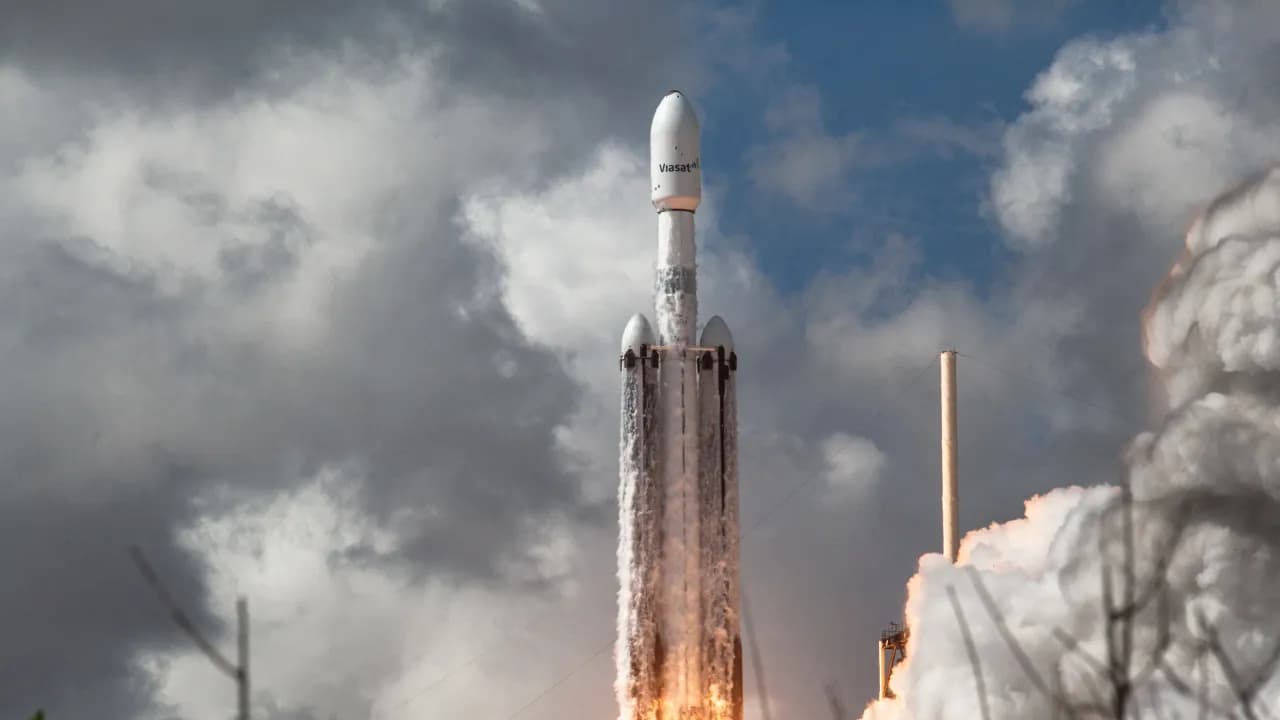
Tim Farrar questioned whether SpaceX can dominate rocket launches while still facing strong competition in satellite communications and other space-based businesses.
- Farrar said companies relying on SpaceX to deploy satellites and missions could face long-term competitive risks if their launch provider is also a direct rival.
- The analysis came after Bill Ackman reiterated SpaceX's leadership in low-cost launches.
- Farrar argued that high launch costs could make it difficult for rivals to compete in downstream markets.
Space stocks extended their sell-off overnight heading into Monday, as debate over SpaceX's dominance in the commercial space industry prompted investors to reassess risks across the sector.
The decline came after a sharp selloff on Friday, when shares of space companies including AST SpaceMobile (ASTS), Rocket Lab (RKLB), Intuitive Machine (LUNR), and Redwire (RDW) dropped between 8% and nearly 14%. The weakness continued overnight, with ASTS, LUNR and RDW each slipping over 1%, while LUNR edged 0.6% lower.
SpaceX Launch Access Seen As Critical Risk
A debate about the future of the space industry gained attention after satellite analyst Tim Farrar questioned whether SpaceX can dominate rocket launches while still facing strong competition in satellite communications and other space infrastructure businesses.
In a post on X platform, Farrar argued that if investors believe SpaceX can preserve a long-term advantage in rocket launches, they should also consider whether that advantage could extend to businesses that depend on affordable access to orbit, including Starlink and orbital data center projects.
“There is a plausible scenario that SpaceX monopolizes everything in space, then you focus on how big the Starlink/ODC market is in the face of terrestrial competition. Another scenario is competition across the board, likely vertically integrated within a launch provider,” Farrar said.
His remark comes after billionaire investor Bill Ackman highlighted SpaceX's dominant position in affordable orbital transportation in a chat at the All-In Liquidity Summit.
Many emerging space ventures depend on SpaceX rockets to deploy satellites, scientific payloads and lunar missions. This reliance creates a potential vulnerability if launch schedules, pricing structures or capacity allocations become less favorable for outside customers.
Farrar argued that companies relying on a competitor for access to space may face long-term strategic disadvantages.
ASTS Faces Direct Competitive Overlap
The issue appears particularly relevant for AST SpaceMobile, which is building a satellite network designed to connect mobile phones directly from space. The company relies on Falcon 9 launches to place its BlueBird satellites into orbit, while SpaceX continues to expand Starlink's direct-to-cell capabilities.
Hence, relying on a direct competitor for launches could create challenges over time. Intuitive Machines depends on SpaceX vehicles for key NASA lunar missions, while Redwire's hardware and manufacturing businesses ultimately rely on consistent launch activity across the sector.
Rocket Lab operates its own Electron rocket, but its larger Neutron vehicle will compete against Falcon 9 in a market where SpaceX already enjoys substantial scale advantages.
Why Launch Costs Matter
According to Farrar, a major challenge to the idea of strong downstream competition is the cost of reaching orbit. If launch expenses continue to account for a major portion of overall investment requirements, a company with a significant pricing and scale advantage in launches could gain an edge in adjacent businesses that depend on frequent access to space.
“I'm not convinced there's a viable scenario where SpaceX dominates launch but still has lots of effective competition downstream of that in connectivity & ODCs,” Farrar said.
SpaceX plans to sell about 556 million shares at $135 each, aiming to raise $75 billion and giving the company a valuation of roughly $1.77 trillion. The company has planned the share sale for June 11, and trading is set to begin the following day.
So far this year, RDW stock has jumped 142%, while LUNR, RKLB, and ASTS stocks have surged by over 80%, 57%, and 28%, respectively.
For updates and corrections, email newsroom[at]stocktwits[dot]com.<
