
SpaceX’s vertically integrated strategy increases pressure on AST, which serves 60 carrier partners covering about three billion subscribers.
- The FCC authorized SpaceX to provide global facilities-based and resale telecommunications services supporting Starlink Mobile.
- SpaceX is considering direct consumer mobile plans and targets a 5G-class Starlink Mobile service in the first half of 2028.
- AST retains FCC approval for satellite-to-phone services through AT&T, Verizon and FirstNet and aims to have about 45 satellites in orbit by early 2027.
Retail sentiment around AST SpaceMobile (ASTS) neared a one-year low after SpaceX secured regulatory approval to support Starlink Mobile services internationally, advancing Elon Musk’s global cellular ambitions in a market both companies target.
ASTS stock jumped 6% on Thursday, bringing its weekly gain to 5%.
SpaceX Secures Global Telecom Approval
The Federal Communications Commission (FCC) on Thursday granted SpaceX authority to provide global facilities-based and resale telecommunications services in support of Starlink Mobile.
SpaceX filed its amended application on Aug.25, the FCC accepted it for streamlined review on Aug. 28, and granted the authority on Thursday. The authorization permits SpaceX to provide telecommunications services between the U.S. and international markets but does not award additional spectrum or automatically authorize operations in foreign countries.
Speaking at Goldman Sachs’ Communacopia + Technology Conference in earlier this month, SpaceX CFO Bret Johnsen identified dead-zone coverage and “global roaming” as key differentiators for Starlink Mobile.
Starlink Moves Beyond T-Mobile
Starlink currently reaches ordinary U.S. phones mainly through T-Mobile’s T-Satellite service, which provides supplemental coverage in terrestrial dead zones. However, SpaceX’s longer-term ambitions are broader. During its June IPO roadshow, President Gwynne Shotwell reportedly told investors that the company was considering selling mobile plans directly to consumers and potentially building a terrestrial U.S. network.
Shotwell said she expected SpaceX to capture “quite a few” customers from the three largest U.S. carriers. SpaceX has also reportedly discussed using Charter Communications’ terrestrial network to carry some mobile traffic.
The company controls about 65 megahertz of nationwide mid-band spectrum following its $17 billion EchoStar deal. Shotwell has said next-gen direct-to-cell satellites using that spectrum could deliver “more than 100 times” the capacity of the current service.
SpaceX is targeting the first half of 2028 for a 5G-class Starlink Mobile product, with V3 satellites expected to begin launching aboard Starship in 2027.
SpaceX Raises Pressure On AST
SpaceX and AST are pursuing the same market: connecting standard smartphones directly to satellites when terrestrial coverage is unavailable. But their business models differ. SpaceX is moving toward a vertically integrated service that could compete directly for subscribers. AST plans to remain a wholesale satellite provider for existing carriers.
AST’s partners include AT&T, Verizon, FirstNet, Vodafone, Orange and Rakuten. Its 60 mobile-network partners collectively serve about three billion subscribers. SpaceX’s retail ambitions could pressure AST by targeting customers within its partners’ markets.
AST Retains Regulatory Advantage
In April, the FCC authorized AST SpaceMobile to provide commercial satellite-to-phone coverage using spectrum controlled by its U.S. carrier partners, including AT&T, Verizon and FirstNet. The authorization covers up to 248 satellites and allows operations using partner-controlled 700-megahertz and 800-megahertz spectrum coordinated with AT&T, Verizon and FirstNet.
The FCC granted AST’s request despite objections from SpaceX and T-Mobile. The companies may compete more directly for 800-megahertz spectrum being sold by Grain Management. AST has told the FCC that its existing satellites can already use the frequencies.
AST Races To Expand Its Fleet
AST had 13 satellites in orbit after launching BlueBirds 8 through 13 in two batches 50 days apart. As of its August update, BlueBirds 14 through 16 were ready for shipment and satellites 17 through 46 were in production.
The company is targeting about 45 satellites in orbit by early 2027 to support continuous coverage. Its Block 2 satellites feature about 2,400-square-foot arrays and are designed for peak speeds approaching 200 megabits per second to standard smartphones.
How Do Retail Traders Feel About ASTS And SPCX?
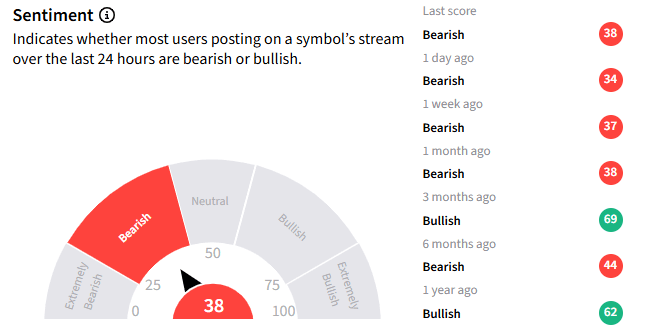
On Stocktwits, retail sentiment was ‘neutral’ for SPCX and ‘bearish’ for ASTS amid ‘normal’ message volumes for both tickers. Sentiment for ASTS stands at 38 out of 100, just six points above its one-year low of 32. However, the ticker’s follower count has risen 5% over the past three months, signaling sustained retail interest.
One user said, “$ASTS around $59 now after being over $130 at the 52-week high… and somehow the board is still never quiet Satellites are going up, commercial rollout is getting closer, but this stock makes you pay emotionally for every bit of progress.”
View this Stocktwits post
Another user said, “$ASTS Dead cat bounce because guess what?!? No news, which means BB11 is still toast and they still have no more launches in 2026”
View this Stocktwits post
Over the past year, ASTS stock has risen 52%, while SPCX has declined 4% ove the same period.
For updates and corrections, email newsroom[at]stocktwits[dot]com.<
