
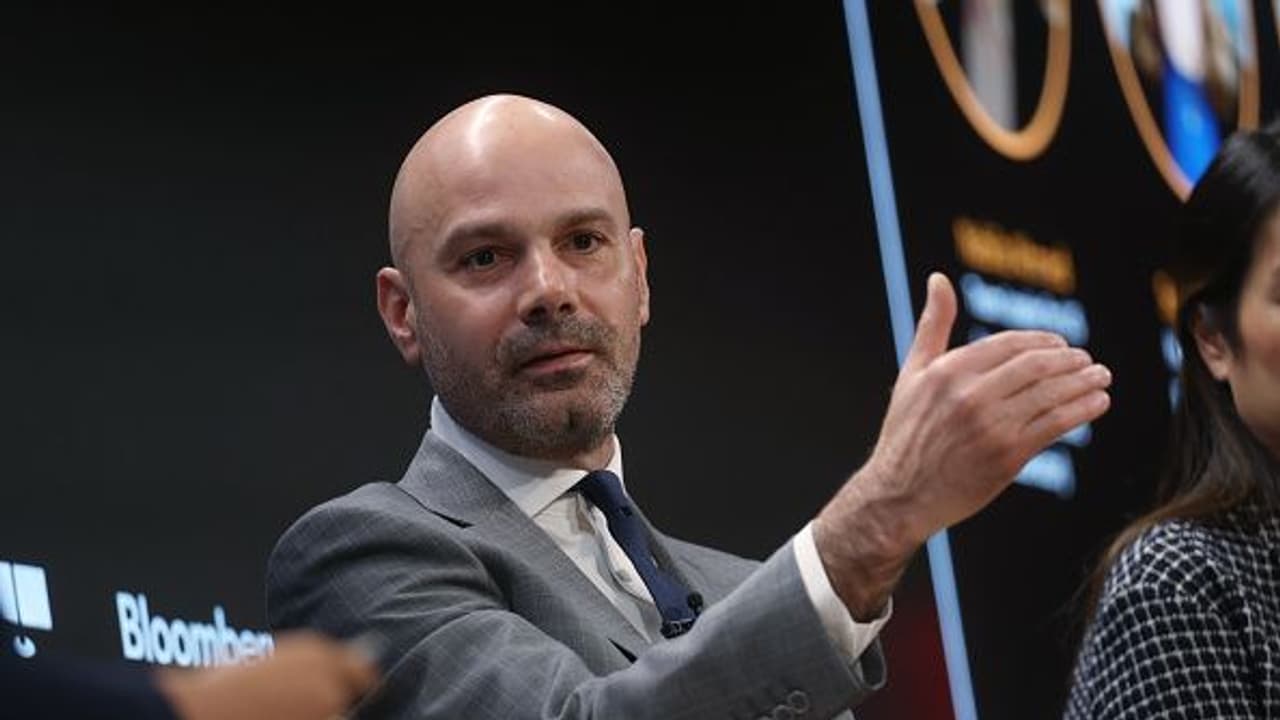
Karoui told Bloomberg that the unprecedented scale of the AI investment cycle is affecting real yields through a broader macro channel, while higher rates could put more pressure on lower-quality borrowers.
- Karoui called the AI capex cycle “completely unprecedented,” saying it is helping push real yields higher.
- Consensus points to roughly $500 billion of additional AI-related credit supply over the next 12 months, Karoui told Bloomberg.
- Higher yields are pressuring lower-quality credits and could make refinancing more difficult.
PIMCO Managing Director and Multi-Asset Credit Strategist Lotfi Karoui reportedly said Friday that the sheer scale of the artificial intelligence (AI) capital spending cycle is helping push real yields higher.
Karoui’s comments to Bloomberg come as Treasury yields remain near multi-decade highs. The benchmark 10-year Treasury yield hovered around 5.18% Friday, after reaching its highest level since June 2007 on Thursday.
The 30-year yield was near 5.463% after climbing to its highest level since 2004.
AI Spending Works Through A Broader Macro Channel
According to Karoui, it does not matter whether the current capex cycle is funded by retained earnings, equity, or debt, as each route raises the overall level of investment.
With a finite global pool of capital, he said supply and demand must clear through higher real yields.
From a credit perspective, Karoui said PIMCO has never treated AI as one broad trade. The firm has been selective and underweight in aggregate, assessing opportunities on a deal-by-deal basis.
According to Karoui, if consensus estimates are right, another roughly $500 billion of AI-related credit supply could come to market over the next 12 months. He said this would likely bring more variety and differentiation.
Higher Yields Put Pressure On Weaker Credit
Karoui said he is not seeing signs of crowding out on the pricing side of the broader corporate credit market.
Spreads for non-financial companies, excluding hyperscalers, are tighter this year and have remained “remarkably resilient” even as yields rose this week, he told Bloomberg, adding that, however, “a little bit” of crowding out is showing up on the quantity side.
The reset in yields is “good news for investors” because it improves the value proposition of fixed income, but it also puts pressure on lower-quality credits, particularly capital structures built when rates were near zero, Karoui added.
According to the PIMCO strategist, refinancing the “marginal dollar” in leveraged finance will become more difficult, though that pressure has not yet fully materialized.
That is partly because the maturity wall is “by design always benign,” meaning investors may have to wait for more borrowers to return to market before the strain becomes clearer, he said.
Economy Still ‘Remarkably Healthy’
Karoui said the rise in yields is happening from a “position of strength,” with the economy still “remarkably healthy.” He added that risk assets have absorbed the move “remarkably well,” aside from the past two sessions.
On inflation, Karoui said the Federal Reserve will have to rely on “natural forces” to help bring inflation back to its 2% target.
How are Markets Reacting Today
As of 9:00 a.m. ET, Nasdaq futures were up 0.36%, while S&P 500 futures were up 0.20% and Dow futures were up 0.28%. Overall, the Dow is on track for a fourth straight weekly decline, while the S&P 500 and Nasdaq Composite are poised to end the week higher.
However, on Stocktwits, retail sentiment for the SPDR S&P 500 ETF (SPY), an exchange-traded fund that tracks the S&P 500 Index, flipped to ‘extremely bullish,’ and Invesco QQQ Trust (QQQ), which tracks the Nasdaq-100 Index, remained ‘bullish.
See Also: Akamai-Anthropic Deal’s Magnitude Is Impressive, Says Piper Sandler – Sees It Shift From Being A Value Asset To A Hypergrowth One
For updates and corrections, email newsroom[at]stocktwits[dot]com.<
