
We all burn Ravana effigies during Dussehra. But do you know how the King of Lanka actually got his ten heads? He was not born with them. Here is the fascinating mythological story behind Dashanana.
The fascinating story of Dashanana Ravana
We all know the King of Lanka by names like Dashanana and Dashakantha. Dashanana literally translates to someone with ten faces. You have probably seen those massive ten-headed Ravana effigies during Dussehra. But how did one person get ten heads? Ravana was actually not born with ten heads. Mythological texts reveal that he performed severe penance to get them. These ten heads also hold a deep symbolic meaning.
How did Ravana get his ten heads?
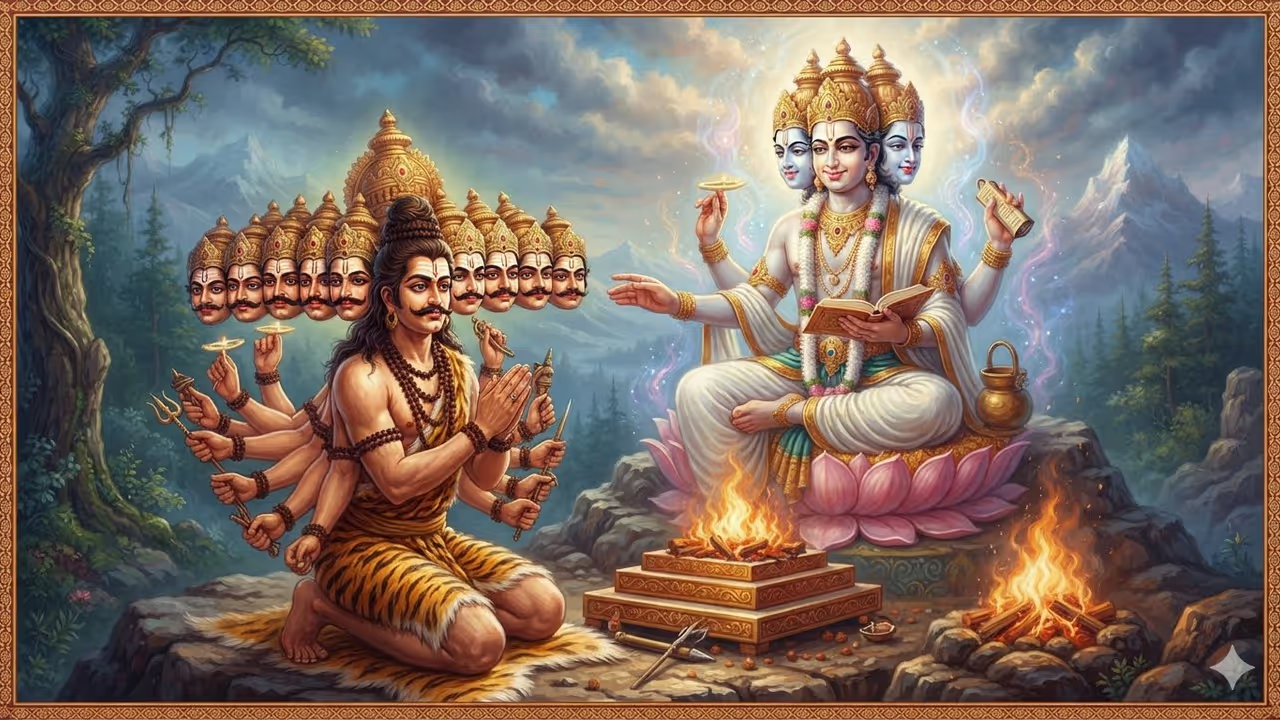
Ancient texts like the Valmiki Ramayana, Ramcharitmanas, and Shrimad Bhagavata Purana document the story of Ravana's ten heads. The 10th Sarga of the Uttara Kanda in the Valmiki Ramayana states that Ravana performed severe penance for 10,000 years at Gokarna Tirtha to please Lord Brahma. Lord Brahma did not appear even after Ravana prayed continuously for 1,000 years. Ravana then chopped off his own head and offered it to the fire pit. Mythological accounts say Lord Brahma restored his head right away. Ravana continued this intense penance for 9,000 years. He would cut off his head and offer it to the holy fire after every 1,000 years of prayer. He received his head back every single time.
The 10,000th year and the boon of nectar
Lord Brahma finally appeared when Ravana prepared to cut his last head in the 10,000th year. The creator was highly impressed with Ravana's dedication. Lord Brahma granted him ten heads and a special boon of nectar in his navel. Ravana earned the famous title of Dashanana after receiving these ten heads. Later during the epic Lanka war, Vibhishana informed Lord Rama about this hidden nectar in Ravana's navel. Vibhishana explained that Lord Rama could defeat Ravana only by shooting an arrow directly at his navel. The Ramayana describes how Lord Rama shot an arrow right into Ravana's navel and ended his life.
Tulsidas also highlights this severe penance and the offering of heads to the fire in the Uttara Kanda of Ramcharitmanas. The 10th Adhyaya of the 7th Skandha in the Shrimad Bhagavata Purana also records this exact same story.
What do the ten heads of Ravana mean?
Mythological stories describe Ravana as a complex figure who possessed the qualities of both Brahmins and demons. His father was a Brahmin, while his mother belonged to a demon clan. Ravana was a great scholar, a learned pandit, and a massive devotee of Lord Shiva. But he also carried strong demonic tendencies. Experts view Ravana's ten heads as a direct symbol of his ten flaws and bad qualities. These ten negative traits are lust, anger, attachment, greed, pride, jealousy, fickleness, wrong intellect, an egoistic mind, and pure ego.
The Dussehra festival is clearly not just about burning Ravana effigies. The festival gives us a strong message to leave our bad qualities behind and walk on the path of truth, duty, and goodness. Let us remove all negative qualities like lust, anger, attachment, greed, and ego from within us this Vijayadashami. Let us actively adopt the great ideals of Lord Rama in our daily lives.
