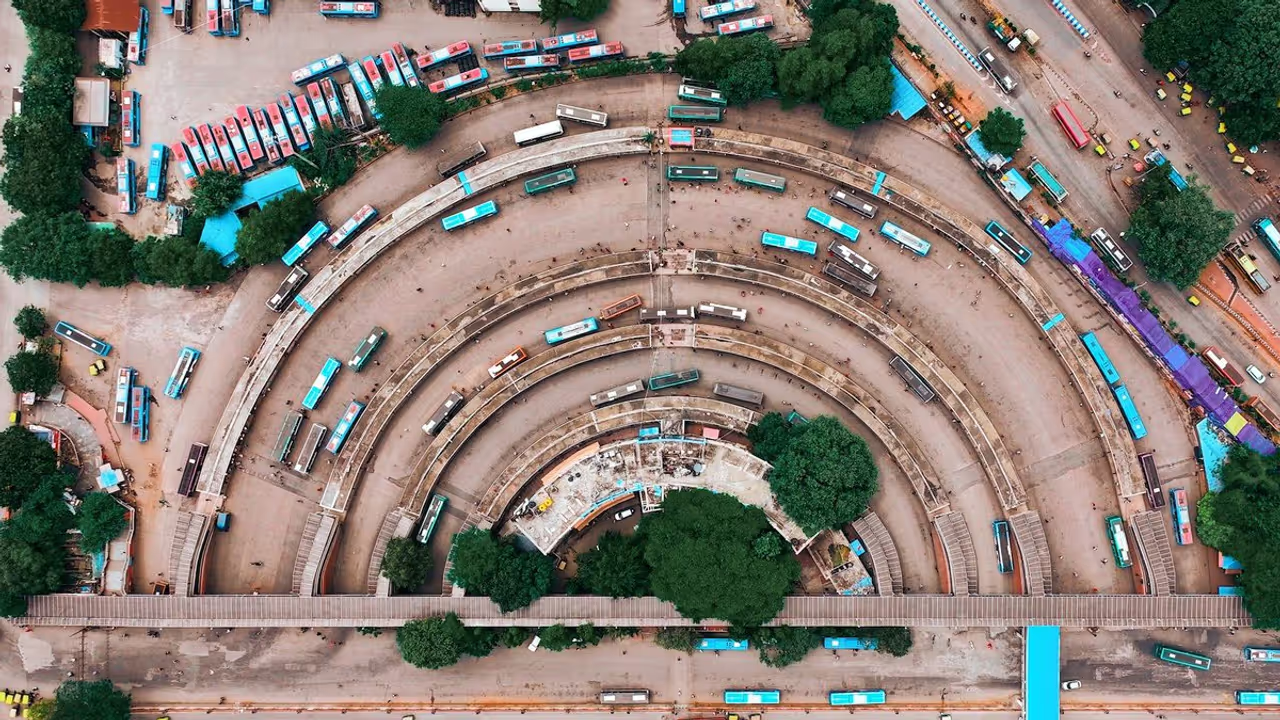
Why is Bengaluru's Kempegowda Bus Station popularly called Majestic? The name traces back to Majestic Theatre, a cinema that once stood nearby. Over time, the theatre's name became associated with the neighbourhood and eventually became synonymous with KBS.
For many people arriving in Bengaluru for the first time, Majestic is where the city begins. It is often the first place they set foot in after arriving by bus or train, where they ask for directions, catch their first city bus or take the Metro to another part of Bengaluru. For students, job seekers, migrants, tourists and generations of Bengaluru residents, Majestic has represented more than just a transport hub. For many, it has been a place of hope, opportunity and new beginnings. Yet, despite its official name being Kempegowda Bus Station (KBS), almost everyone continues to call it simply "Majestic". So, how did the name become so deeply embedded in Bengaluru's identity?
The Story Behind the Name Majestic
The answer lies not in the bus station itself, but in a cinema theatre that once stood in the neighbourhood.
Before KBS became one of Bengaluru's busiest transport hubs, the area around Gandhinagar, Subhash Nagar and K G Road was known as one of the city's major entertainment districts. The locality was once dotted with numerous single-screen theatres and was considered one of Bengaluru's prominent cinema hubs.
Related Articles

Among these theatres was Majestic Theatre, whose name eventually became synonymous with the entire neighbourhood.
According to history buff Dharmendra Kumar, buses entering the area would stop near the theatre before continuing towards the bus stand. Conductors would reportedly call out "Majestic" to passengers, referring to the theatre that served as a familiar landmark. Over time, the name became associated not just with the theatre, but with the surrounding area.
A Theatre That Became A Landmark
Historian Suresh Moona traces the origins of Majestic Theatre to the 1920s. Film critic K Puttaswamy has also recalled stories associated with the theatre, including claims that personalities such as CV Raman and K P Puttanna Chetty attended screenings there.
Heritage enthusiast Shyam Kodavarthi of Bengaluru Prayana has suggested that the theatre may earlier have been known as Olympia Cinema.
There are also differing memories of the theatre's appearance. While Suresh Moona recalled that it had a grand, almost palatial appearance that suited the name "Majestic", others remembered it as a relatively ordinary structure.
The theatre also had a connection with Telugu cinema, according to some recollections. However, Puttaswamy fondly remembers watching the Kannada film Bhale Jodi there in the 1970s.
The film starred actor Rajkumar in a dual role, and the theatre reportedly displayed two cut-outs of the actor outside the building. Puttaswamy believes this was among the earliest instances of a local theatre using two cut-outs of the same actor as a promotional attraction.
When Majestic Theatre Disappeared
After decades of entertaining Bengaluru's moviegoers, Majestic Theatre was eventually demolished around 2010. Puneeth Rajkumar's Milana is believed to have been among the last films screened there.
Suresh Moona witnessed the demolition of the theatre, which was reportedly brought down manually with hammers.
The theatre may have disappeared, but its name had already become firmly attached to the locality. Today, the land where the theatre once stood remains caught in litigation and is largely overgrown.
The building is gone, but the name Majestic continues to live on across Bengaluru.
Before The Bus Station, There Was A Lake
The story of Majestic does not end with the theatre. The bus station itself stands on land with an equally fascinating history.
The area was once occupied by Dharmambudhi Lake, a large water body that gradually dried up in the early 20th century. Its former lake bed later became a public ground where theatre performances, circuses and fairs were held.
Jawaharlal Nehru is also said to have addressed a gathering at the grounds in 1931.
The area was later known as Subhash Nagar grounds, named in honour of Netaji Subhash Chandra Bose. According to Dharmendra Kumar, when the bus terminal was eventually established, it was initially known as Subhash Nagar Bus Station.
How KBS Became Bengaluru's Transport Hub
The present Kempegowda Bus Station, recognisable by its distinctive semi-circular design, came up in the 1980s. Over the decades, it grew into one of Bengaluru's most important transport points, connecting the city with several destinations across Karnataka and beyond.
Today, thousands of buses pass through the hub every day, making the area one of the most recognisable geographical reference points in Bengaluru.
But ask a Bengaluru resident where the bus station is, and chances are you will hear one word before "Kempegowda Bus Station": Majestic.
‘If You Get Lost, Come To Majestic’
For generations of Bengaluru residents, Majestic has been a simple answer to a complicated problem: finding your way around the city.
Parents have often passed down a familiar piece of advice to children and newcomers: "If you get lost, just come to Majestic."
Yet, amusingly, Majestic has also carried the opposite reputation. The same place that served as a reliable meeting point was sometimes accompanied by another parental warning: "Don't go to Majestic."
That contradiction is part of what makes the area so fascinating.
Majestic has long been associated with theatres, shopping and busy streets, while also earning a reputation for its lodges and the more shadowy side of Bengaluru's old commercial districts.
More Than Just A Name
Today, the word "Majestic" means much more to Bengaluru than the cinema theatre that gave the area its name.
It is a bus station, a Metro interchange, a neighbourhood, a meeting point and, for countless people, the first chapter of their Bengaluru story.
For someone arriving in the city with a suitcase, a job appointment, a college admission or simply a dream of starting afresh, Majestic can feel like the city's front door.
The theatre that once gave the area its name may have vanished, but the name itself has survived generations of change.
And perhaps that is why the old saying still feels appropriate: Majestic is not just a place in Bengaluru. For many, it is where Bengaluru begins.