
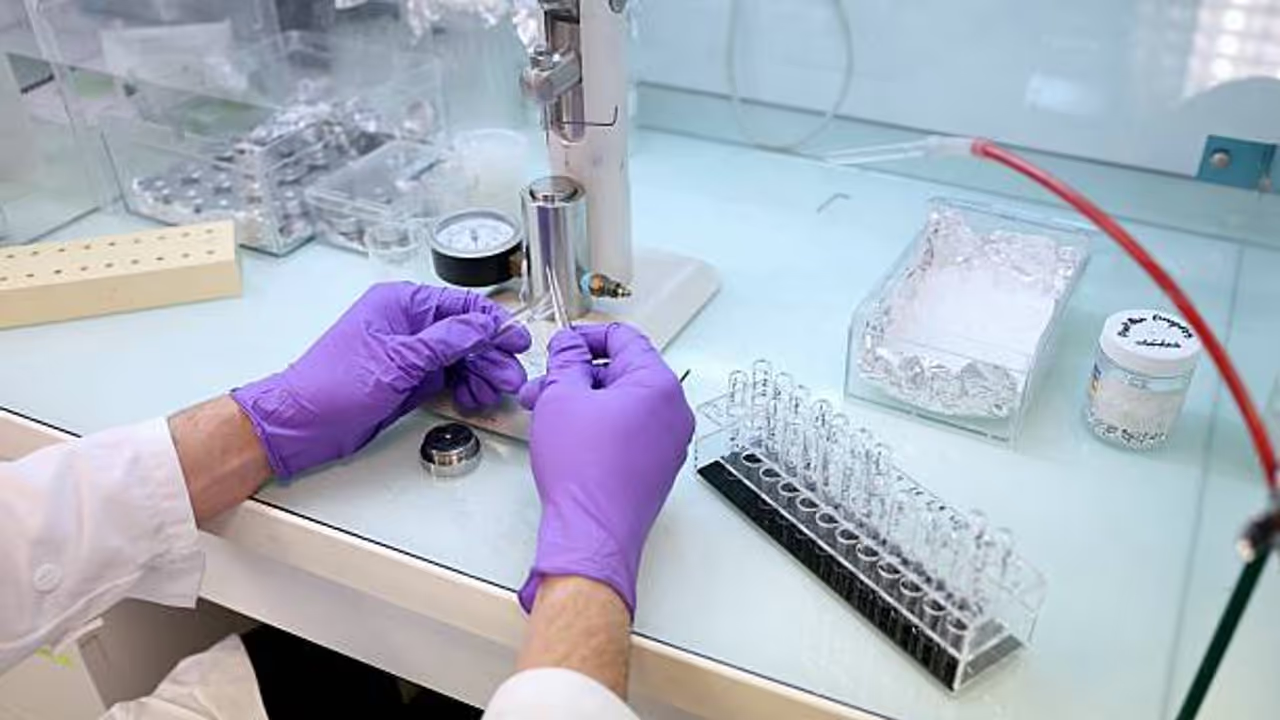
Lab-grown life has taken a dramatic leap forward after scientists used artificial intelligence to create a virus that has never existed in nature.
Lab-grown life has taken a dramatic leap forward after scientists used artificial intelligence to create a virus that has never existed in nature. The virus, named Evo–Φ2147, was built entirely from scratch using cutting-edge AI tools. Despite containing just 11 genes, compared to the 200,000 genes in the human genome, Evo–Φ2147 is one of the simplest biological entities ever designed. Its creation hints at the development of entirely new organisms or even the revival of long-extinct species.
The artificial virus was engineered to destroy E. coli, a bacterium responsible for dangerous and often drug-resistant infections.
Using a powerful AI system called Evo2, scientists generated 285 entirely new viruses based on a naturally occurring bacteriophage. Of these, only 16 successfully attacked E. coli, but the most effective versions killed bacteria 25 per cent faster than their natural counterparts.
The breakthrough comes from Genyro, a startup led by British scientists and entrepreneur Dr Adrian Woolfson, but it also revives serious concerns. Previous research has warned that AI-designed pathogens could themselves pose a grave threat to humanity.
Explaining the scale of the shift, Dr Woolfson told the Daily Mail: **'For the last 4 billion years, all life on Earth has evolved by the trial-and-error process of Darwinian evolution by natural selection, which lacks any foresight or intention.
'Natural evolution now has a co-author. That co-author, the emerging ability of AI-driven genome design and genome construction technologies, has the potential to exist alongside natural evolution.'**
This scientific leap was enabled by two parallel breakthroughs: AI capable of writing genetic code, and a revolutionary new method for assembling DNA in the lab.
Evo2 works much like chatbots such as ChatGPT or Grok—but instead of language, it was trained on genetic sequences. The system learned from nine trillion DNA base pairs, teaching it how genes are structured and how entirely new genomes can be designed to order.
Meanwhile, scientists also developed Sidewinder, a new genome assembly technique that solves one of biology’s biggest challenges.
Dr Kaihang Wang, the inventor of Sidewinder and an assistant professor at the California Institute of Technology, likened earlier genome construction to assembling torn pages of a book without page numbers.
Speaking to Pharmaphorum, Dr Wang said: **'In order to have a book, not only do we need to have the printed each individual page, you also need to arrange them into the correct order to form the book, right?
'And before us, DNA construction was kind of like in the era of you have the printing press, but you don't have the other thing called a page number to actually align and assemble the books in the right order.'**
Sidewinder dramatically improves accuracy—by 100,000 times—while making genome construction 1,000 times faster and cheaper. Together with Evo2, it allows scientists to design artificial life in days instead of months.
At present, Evo–Φ2147 represents the upper limit of what can be created. With just 5,386 DNA base pairs, compared to 3.2 billion in humans, the virus is so simple that some experts do not even classify it as living, since it cannot reproduce independently.
Still, the implications are enormous—especially in the fight against antibiotic resistance, a growing global crisis.
Dr Samuel King and Dr Brian Hie, co-creators of the virus, wrote in a blog post: **'Bacterial resistance to antibiotics represents one of the most pressing challenges in modern medicine, with resistant infections killing hundreds of thousands or more annually.
'We wanted to see if we could one day design phage therapies that could be resilient against bacterial evolution.'**
Looking ahead, researchers believe the technology could transform antibacterial treatments, accelerate vaccine development, and even revolutionise cancer care.
Dr Woolfson added: 'This has immediate utility in the production of so-called personalised cancer vaccines. These typically take eight to 12 weeks to manufacture, but with the Sidewinder technology that we have developed, we anticipate being able to do this in two to three days'
However, the same tools raise alarming ethical and security questions. Studies published last year showed AI could design proteins resembling deadly toxins such as ricin, botulinum, and Shiga, many of which could evade existing DNA screening safeguards.
Experts warn that AI-designed bioweapons represent one of the most dangerous future threats. The Existential Risk Observatory has even classified an AI-created plague among the top five risks to humanity’s survival.
To prevent misuse, the creators of Evo2 deliberately removed genetic data related to human pathogens from its training set.
Dr King and Dr Hie emphasised: 'Evo cannot generate human viral sequences due to deliberate training data exclusions, preventing both accidental and intentional misuse for pathogen design.'
