Omar Yaghi, Nobel chemistry laureate born to Palestinian refugees, credits US public schools and federally funded research for his groundbreaking work on MOFs and water-harvesting technology, calling science a global equalizer.
Nobel chemistry laureate Omar Yaghi was born to Palestinian refugees in Jordan, growing up in a large, rowdy family that shared a single room with the cattle they raised.
The news that Yaghi, a chemist at UC Berkeley, was among 2025’s Nobel winners was deeply emotional, highlighting the power of public education that he said enabled him to succeed.
Overcoming Early Hardships
Yaghi emphasized that publicly funded education and research were crucial to his career, especially at a time when US federal support for universities faces upheaval.
Related Articles

“This recognition is really a testament to the power of the public school system in the US, which allows people like me, from disadvantaged backgrounds, to work hard and distinguish themselves,” he said.
His parents, with little formal education, devoted themselves entirely to their children’s learning. Their home had no electricity or running water, but Yaghi recalls it as a place full of love and care.
Scientific Breakthroughs and MOFs
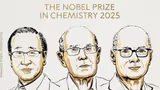
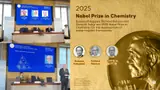
Yaghi shared the 2025 Nobel Prize with Susumu Kitagawa of Japan and UK-born Richard Robson for pioneering work on metal–organic frameworks (MOFs). These materials are useful for capturing carbon dioxide and harvesting water from desert air.
Born in 1965 in Amman, Jordan, Yaghi moved to the US at 15, inspired by his father to seize opportunities. His fascination with molecular structures began early, drawn to images in a book that he found “unintelligible but captivating.”
The Power of Opportunity and Public Support
Yaghi’s academic journey included community college in New York, followed by a degree at SUNY Albany, supporting himself through part-time work. He completed his PhD at the University of Illinois in 1990 and eventually joined UC Berkeley in 2012.
He stressed that federal grants enabled him to experiment and pursue groundbreaking research. “Science costs money, and it’s an investment in our future,” Yaghi said.
Yaghi’s work includes extracting water from desert air in Arizona, research that has garnered over 250,000 citations and demonstrates how science can unlock potential globally.
Science as the Great Equalizer
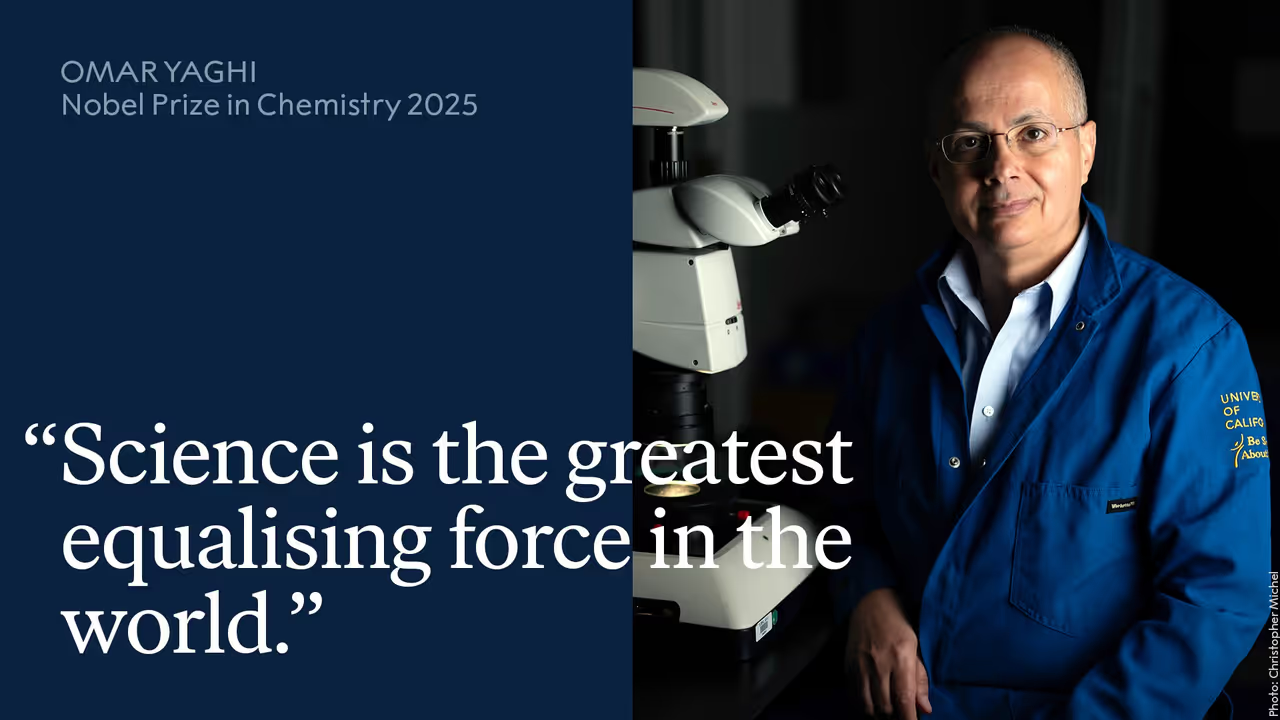
“Science is the great equalizing force in the world,” Yaghi told the Nobel Foundation. “Smart people, talented people, skilled people exist everywhere. We should focus on unleashing their potential through opportunity.”
Receiving the news en route to a chemistry conference in Brussels, Yaghi said the honor was “surprising and delightful.”
Disclaimer: Except for the headline, this story has not been edited by Asianet Newsable English staff and is published from a syndicated feed.