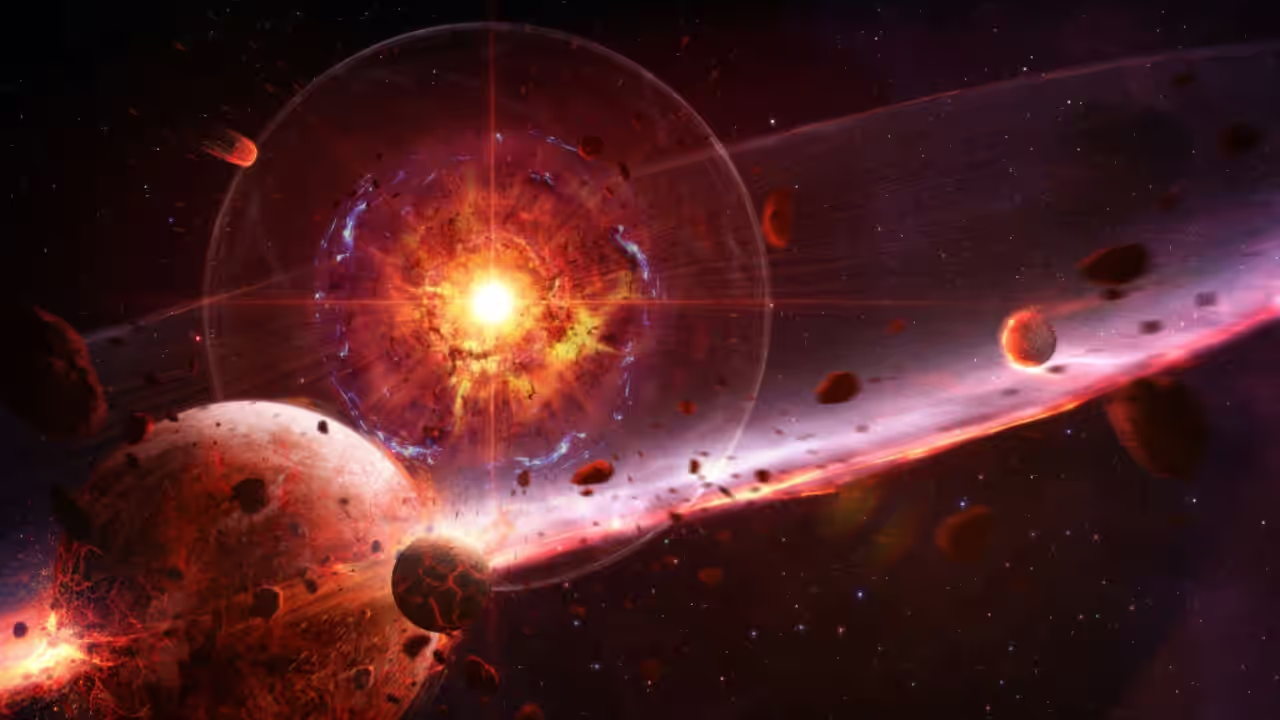
See exploding stars like never before. New close-up images of novae show complex eruptions with multiple outflows, challenging old theories. Find out how these stellar explosions work.
Astronomers have captured the clearest-ever close-up images of two exploding stars, events known as novae, within days of their eruption. These detailed images show that such explosions are far more complex than previously thought. Instead of a single burst of material, researchers found multiple streams being ejected in different directions, and in some cases, a surprising delay before material was released at all.
The study, published in Nature Astronomy, used an advanced technique called interferometry, carried out at the CHARA Array in California. This method uses several telescopes to act like a single, much larger telescope, giving scientists the sharp resolution needed to observe the rapidly changing explosions in unprecedented detail.
What Exactly Is a Nova?
A nova is not a star blowing itself apart completely, but rather a sudden, powerful eruption on the surface of a white dwarf. A white dwarf is the dense remnant of a star that has already burned most of its fuel. If the white dwarf is in a pair with another star, it can pull gas from its companion. Over time, this stolen gas builds up until it triggers a runaway nuclear reaction, causing the white dwarf to shine dramatically brighter for a short time.
Related Articles

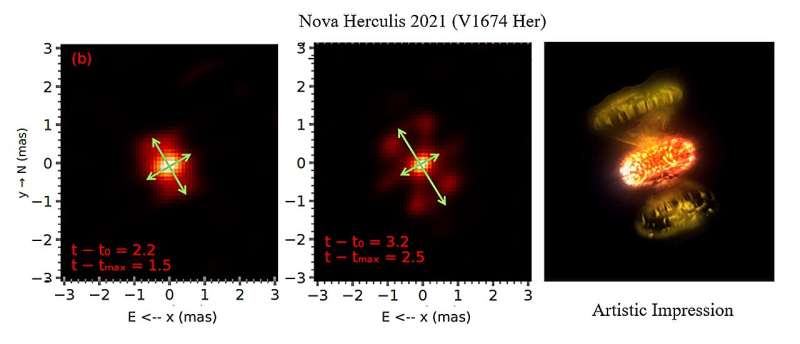
Image credit: The CHARA Array (Scientists at Georgia State's CHARA Array captured images of Nova V1674 Herculis). Image retrieved from Phys.org.
Until recently, the early stages of a nova were impossible to study clearly. When astronomers looked at them through telescopes, the expanding cloud of material appeared as a single point of light. Everything happening inside that bright dot had to be guessed from indirect clues.
Understanding how the material is thrown out is especially important because novae create powerful shock waves. These shocks were first detected by NASA’s Fermi Gamma-ray Space Telescope, which found high-energy gamma rays coming from more than 20 novae during its first 15 years of operation. This discovery showed that novae are complex events capable of producing some of the most extreme radiation in the galaxy.
The First Nova
The first, Nova V1674 Herculis, was one of the fastest novae ever recorded. It brightened and faded within only a few days. Images revealed two strong jets of gas shooting out in perpendicular directions, suggesting that the explosion involved several separate bursts of material. While these new streams of gas were appearing in the images, NASA’s Fermi telescope was also detecting gamma rays. This tied the high-energy radiation directly to the crashing and colliding flows of gas seen in the images.
Seeing Hidden Structures for the First Time
Interferometry is the key to achieving this remarkable level of detail. It has already played a vital role in producing images such as the black hole at the centre of our galaxy. For this nova study, the interferometric images were paired with spectra, light measurements from observatories including Gemini. These spectra acted like chemical fingerprints, showing the speed, temperature, and movement of the expanding gas.
As new features appeared in the spectra, they matched the structures seen in the interferometric images. This one-to-one link gave researchers powerful confirmation of how the different gas flows were forming, shaping, and interacting.
Why It Matters for Our Understanding of Stars
The findings show that novae are not simple, single eruptions. Instead, they involve a variety of processes, multiple outflows, collisions between streams of gas, and even long delays before material is expelled. These details help explain how shock waves form and why novae produce such energetic radiation.
The researchers say this is only the beginning. With more high-resolution observations, astronomers can start answering larger questions about how stars live, how they die, and how they shape the space around them. Once thought to be simple bursts of light, novae are turning out to be far richer and more intricate than anyone imagined.