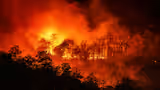
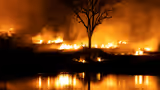
New research reveals wildfires release far more harmful air pollutants than previously thought. Uncover the dangerous chemicals in smoke and their impact on global health.
Wildfires are contributing significantly more pollution to the air than previously thought. As fires spread through forests, grasslands, and peatlands, they release large quantities of gases and microscopic particles into the atmosphere. Recent research, published in ACS' Environmental Science & Technology, shows that earlier assessments greatly underestimated the amount of pollution these fires produce, particularly from certain harmful chemicals that affect human health.
The study reveals that wildfires and controlled burns worldwide emit far more air-polluting gases than once believed. When researchers refined their calculations, they discovered that emissions of organic chemicals from forest fires are about 20% higher than previous estimates. This is significant because these chemicals are a major contributor to poor air quality, health issues, and climate change. The recent findings offer scientists and policy-makers a more accurate foundation for predicting pollution levels, evaluating health risks, and developing environmental policies.
Harmful Chemicals in the Air
Each year, wildfires burn large areas of land and release a complex mixture of substances into the air. This includes water vapour, ash, and numerous carbon-based chemicals. Some of these chemicals are classified as volatile organic compounds, which easily become gases. Others only become gases at higher temperatures and are known as intermediate- and semi-volatile organic compounds. Once in the air, these partially volatile chemicals are more likely to form fine particles. These fine particles can be especially dangerous as they can be inhaled deep into the lungs.
Related Articles

Until recently, most studies have largely overlooked these intermediate- and semi-volatile compounds. They are difficult to measure due to their large number and complex chemistry. As a result, earlier research primarily focused on the easier-to-measure volatile compounds. This new study aimed to include all these chemicals to provide a more accurate understanding of how wildfires impact air quality, human health, and the climate.
Studying Older Records
To achieve this, researchers examined global records of burned land from wildfires in forests, grasslands, and peatlands between 1997 and 2023. They gathered information on the types of chemicals released when different vegetation burns. When real-world measurements were unavailable, they used results from laboratory experiments to fill in the gaps.
The results show that wildland fires release approximately 143 million tonnes of organic air pollutants annually on average. This is much higher than earlier estimates and highlights that wildfires are a more significant source of air pollution than previously recognized, especially for the more harmful types of compounds.
A Global Problem
When comparing wildfire pollution with pollution from human activities like industry and transportation, researchers found that human sources still generate more pollution overall. However, both wildfires and human activities emit similar amounts of the most harmful organic compounds. The study also identified regions where pollution from fires and human sources overlap, such as parts of Africa, Southeast Asia, and Equatorial Asia. In these areas, air pollution is particularly challenging to manage and will require integrated solutions that address both wildfire smoke and human-made emissions.