
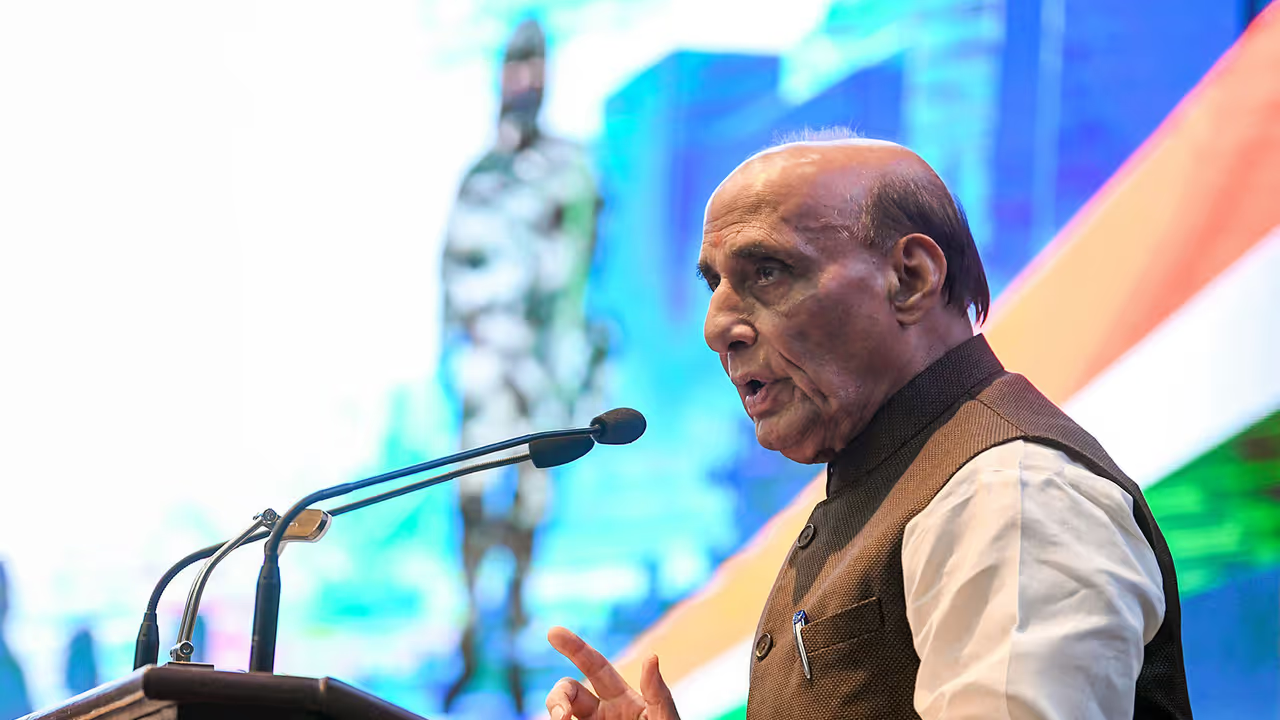
Defence Minister Rajnath Singh stated India's defence preparation is 'complete and strong,' citing the 'if you want peace, prepare for war' principle. He stressed building credible deterrence and enhancing capabilities for multi-domain future conflicts.
Defence Minister Rajnath Singh on Sunday said that preparation in the field of defence is both "complete and strong", quoting the principle that "if you want peace, prepare for war". He asserted that the country is building capabilities to ensure a credible deterrence against threats.
Addressing the NDTV Defence Conclave, Singh said preparations made during peacetime help limit losses during conflict and added that India's defence readiness was being continuously enhanced in line with changing security requirements. "There are two sayings in English. The first is, if you want peace, prepare for war. That is, for war not to happen, it is necessary that preparations for war are complete. And the second saying is that the more you sweat in peace, the less you bleed in war," Singh said.
"We have kept both things in mind. Our preparation in the field of defence is both complete and strong. And we will make it even stronger. We are continuously working to increase our capabilities along with changing times," he added.
Focus on Future-Ready, Multi-Domain Warfare
Singh said modern warfare is no longer limited to conventional domains and is becoming increasingly technology-driven, involving multiple areas including land, air, sea, space, cyber and information warfare. "Today's war is not just soldier versus soldier. Today's war is multi-domain. Land, air, sea, space, cyber, electronic warfare, information warfare, artificial intelligence, drones, autonomous systems, and precision weapons," he said.
He said the country that remains ahead in technology will have an advantage on the battlefield, adding that India's focus was on developing capabilities for future conflicts. "The country that is ahead in technology will naturally have the advantage on the battlefield. That is why we have emphasised making India's defence strategy future-ready," Singh said.
"Our focus is not only on today's weapons. Keeping the warfare of the next 10, 20, 25 years in mind, we are trying to develop our capabilities," he added.
Emphasis on 'Made in India' and Self-Reliance
Highlighting the government's focus on defence self-reliance, Singh said India should move from importing technology to developing and defining its own military technologies. "India should not just import technology. India should be in a position where India defines technology. India should not just use other countries' military technology. India should make its own military technology," he said.
The Defence Minister said India was working towards reducing vulnerabilities in critical sectors such as technology, energy, data and supply chains. "In the last 12 years, we have worked to eliminate all such vulnerabilities that could become a threat to our defence and national security," he said.
He said efforts were underway to develop domestic semiconductor supply chains and reduce import dependency in critical minerals through initiatives such as the National Critical Mineral Mission. Singh also highlighted diversification of energy resources through renewable energy, nuclear energy and green hydrogen, along with the creation of strategic petroleum reserves.
Increased Defence Budget to Boost Domestic Industry
On defence spending, Singh said the Defence Ministry received the highest-ever allocation of Rs 7.85 lakh crore in 2026-27, compared to around Rs 2.53 lakh crore in 2013-14. He said around 75 per cent of the capital acquisition budget, approximately Rs 1.39 lakh crore, has been earmarked for procurement from the domestic defence industry.
"When our army is modernised, India's factories will also be modernised. When our soldiers have new weapons in their hands, India's engineers will get new opportunities. When a new platform is built for our armed forces, the supply chain of thousands of MSMEs will also develop behind it," Singh said.
Progress in Defence Indigenisation
Highlighting progress in defence indigenisation, Singh said five positive indigenisation lists have been issued by the armed forces covering around 509 defence equipment, weapon systems and platforms for production in India. He added that six lists have also been issued by Defence Public Sector Undertakings (DPSUs), with the latest list containing 405 items issued recently.
He said around 5,417 strategically important line replacement units (LRUs), subsystems, spares and components have been identified, of which around 3,300 have already been indigenised. "Our philosophy is very simple. What can be made in India, why should we buy it from outside? And what cannot be made yet, why can't it be made in India? We should work on this," Singh said.
"From chips to ships, from screw to complete weapon systems, India must be self-reliant in defence," he added.
Record Growth in Defence Exports
Singh also highlighted India's defence export growth, saying exports reached a record level of around Rs 38,424 crore in 2025-26 compared to Rs 686 crore in 2013-14. "We had set this target last year that our defence exports should be Rs 30,000 crore, and we have achieved it in a very wonderful way. Now our goal is that by the end of 2029, our defence exports should be approximately Rs 50,000 crore," he said.
He said Indian defence products are now reaching more than 100 countries across Asia, Africa, Latin America and Europe. "This is not just an economic statistic. This is India's changing global image. Because when a country buys defence products made in India, it does not just buy a missile, radar, ammunition, or platform. It trusts India's technology, quality, delivery capability," Singh said.
"Made in India is now not just a manufacturing label. It is slowly becoming a symbol of Trust in India," he added.
Building a Credible Deterrent
Singh said India's aim was not only to prepare for war but to create a defence ecosystem that acts as a credible deterrent. "India's approach is not just about being ready for war. Our effort is to build such defence capability and ecosystem that is a credible deterrent to stop war. And if a challenge comes, we are also capable of giving an effective response," he said. (ANI)
(Except for the headline, this story has not been edited by Asianet Newsable English staff and is published from a syndicated feed.)
