
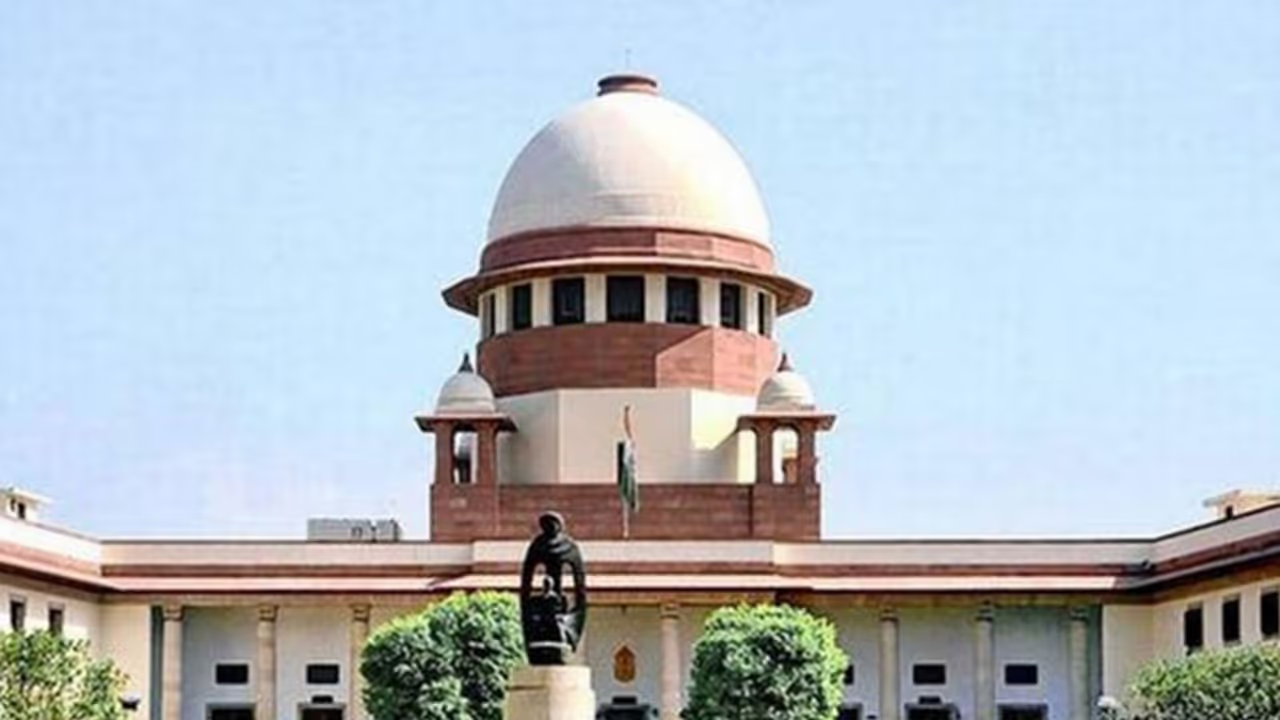
The Supreme Court junked a plea for a CBI probe into alleged horse-trading by the ruling TVK in Tamil Nadu. Describing the petition as "vague, wild, and casual allegations without any material," the court refused to entertain the petition.
The Supreme Court on Friday dismissed a writ petition filed by Madurai resident KK Ramesh seeking a CBI probe into alleged horse-trading by the ruling Tamilaga Vettri Kazhagam (TVK) in Tamil Nadu. A bench comprising Chief Justice of India Surya Kant and Justice V Mohana refused to entertain the plea, describing it as "vague".
The petition sought the court's intervention over alleged political defections being orchestrated by ruling parties in states through corrupt practices such as bribes or coercion. After hearing the counsel for the petitioner, Advocate JR Sukin, the Court refused to entertain the plea.
"This writ petition is based on vague, wild, and casual allegations without any material. We see no ground to entertain this petition," the Court said.
Similar Plea Dismissed By Madras High Court
Earlier on Tuesday, the Madras High Court dismissed a public interest litigation (PIL) seeking a CBI probe into alleged horse-trading by functionaries of the TVK, which purportedly resulted in four AIADMK MLAs resigning from the party and joining the ruling outfit in Tamil Nadu.
A bench of Chief Justice Sushrut Arvind Dharmadhikari and Justice G Arul Murugan questioned the maintainability of the plea and observed that a CBI investigation could not be ordered into the issue without any material or evidence indicating foul play or corrupt practices behind the resignation of the four legislators.
The Court held that the petition was founded on mere suspicion and lacked the factual basis necessary to invoke its extraordinary jurisdiction. It observed, "at the threshold, we must observe that the entire edifice of the writ petition rests upon conjectures, suspicion and a total absence of foundational material facts."
The bench reiterated that a CBI investigation could be directed only in exceptional cases supported by evidence. It noted, "The extraordinary power to direct an investigation by the CBI is to be exercised sparingly, cautiously, and only in exceptional situations where a prima facie case of a clear cognizable offence is established by evidentiary facts."
Rejecting the allegations of corruption, the Court found that the plea contained no particulars of any alleged inducement or unlawful transaction. It said, "In the case at hand, the petition itself is based on the assumption of corruption, without giving any details about the transactions or source of such information and, therefore, in our firm view, this public interest litigation is nothing but a classic example of a fishing expedition."
The Court also clarified that political defections by themselves do not amount to criminal misconduct under the Prevention of Corruption Act. It observed, "While a sudden realignment of political loyalty by respondent Nos.12 to 15 may cause financial strain due to the necessities of conducting a bye-election, such political choices do not ipso facto translate into criminal misconduct under the Prevention of Corruption Act, in the complete absence of proof of an unlawful quid pro quo."
(Except for the headline, this story has not been edited by Asianet Newsable English staff and is published from a syndicated feed.)