
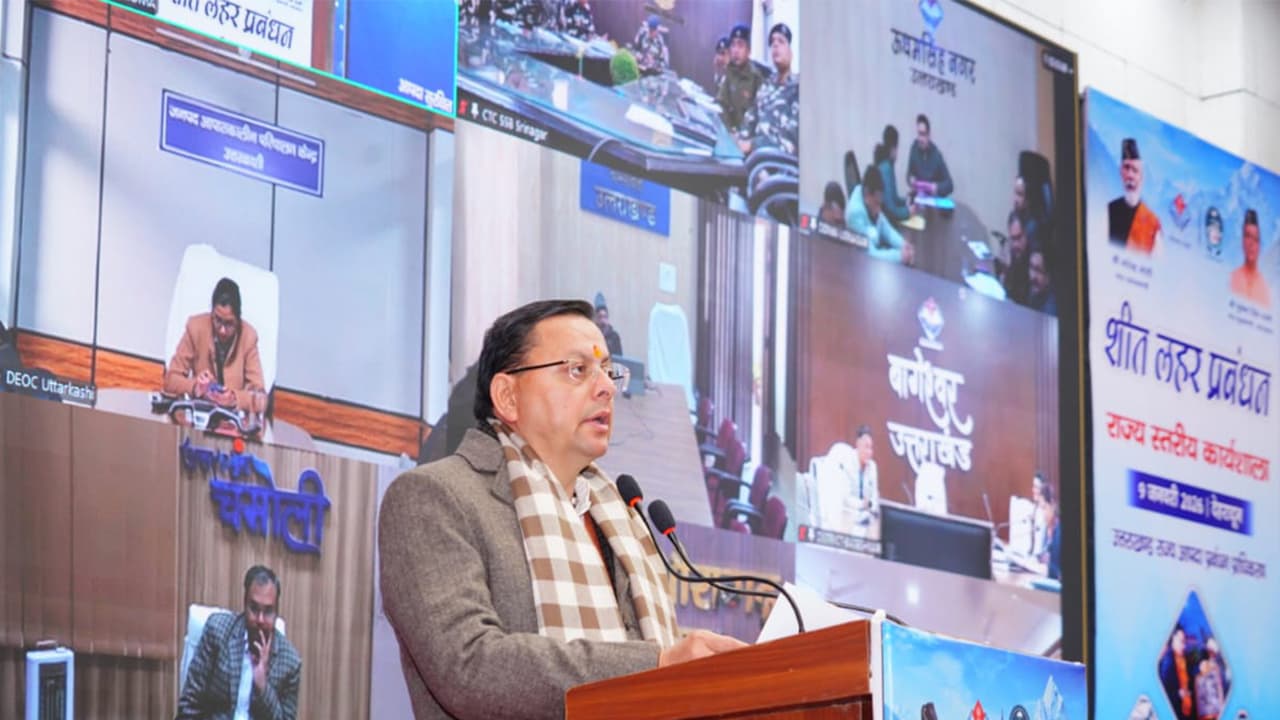
Uttarakhand CM Pushkar Singh Dhami inaugurated a cold wave preparedness workshop in Dehradun. He released new disaster management guidelines, honoured 'Aapda Mitras', and emphasized using modern technology for disaster risk reduction.
Uttarakhand Chief Minister Pushkar Singh Dhami inaugurated a one-day workshop on the theme "Cold Wave Preparedness" at the Survey of India Auditorium, Hathibadkala, Dehradun, an official statement said.
As per the statement, on this occasion on Friday, CM Dhami released guidelines related to cold waves, floods, mock drills, the SOP for aerial support, the Disaster Management Department's New Year Calendar 2026, and the Disaster Management Handbook.
During the programme, the Chief Minister also honoured Yuva Aapda Mitras and individuals who rendered commendable services in relief and rescue operations during disasters in 2025. He also flagged off four vehicles provided by the State Bank of India for disaster management purposes.
CM Stresses Collective Responsibility in Disaster Management
Addressing the gathering, Chief Minister Dhami said that disaster management is not the responsibility of a single department, but requires the collective participation of the entire administration, local bodies, voluntary organisations, and the general public.
Adopting Modern Technology
He said that under the visionary leadership of Prime Minister Narendra Modi, disaster risk reduction has been made a key national agenda. Guided by this vision, the Uttarakhand government is placing special emphasis on adopting modern technologies in disaster management. The state is strengthening drone surveillance, GIS mapping, satellite monitoring, and early warning systems. Measures such as installing sensors in high-altitude areas, digital monitoring systems, and the formation of modern rapid response teams are being implemented to reduce disaster risks.
Focus on Avalanche Safety and Tourism
The Chief Minister said that avalanches pose a serious natural hazard in a Himalayan state like Uttarakhand, with several regions being highly vulnerable. Ensuring the safety of tourism, pilgrimage, and mountaineering activities in these areas is a top priority for the government. He added that continuous efforts are being made to strengthen early warning systems, maximise the use of modern technology, deploy trained rescue forces, and further improve safe tourism protocols.
Measures to Combat Cold Waves and Snowfall
Several concrete and practical steps have also been taken to effectively address challenges arising from cold waves and heavy snowfall. All districts have been connected to the early warning system, and district magistrates have been directed to ensure adequate arrangements for bonfires, night shelters, and blankets.
Inter-Departmental Coordination
The Chief Minister emphasised the need for better coordination among the Meteorological Department, the Disaster Management Department, and the local administration, and for further strengthening early warning systems to ensure timely alerts and preparedness in cold wave- and snowfall-prone areas, a release said.
Health Preparedness and Medical Supplies
To address health issues such as hypothermia, cold, flu, and pneumonia during cold waves, all district hospitals, health centres, and mobile medical teams must remain active. He stressed the need to ensure the availability of essential medicines, heating equipment, and first-aid supplies, especially in border and high-altitude areas.
Community-Based Initiatives
He further stated that the state government is working to strengthen community-based disaster management through initiatives such as Yuva Aapda Mitra and Aapda Sakhi. The Chief Minister expressed hope that the workshop would help review preparedness for potential challenges during the winter season and strengthen inter-departmental coordination.
Chief Secretary Applauds Initiative
Chief Secretary Anand Bardhan said that the workshop is a commendable initiative towards strengthening the state's disaster management system. He noted that cold waves develop gradually but can have devastating impacts, particularly affecting public health services and the lives of vulnerable populations. Cold wave management should be viewed not merely as a seasonal challenge, but as an administrative and social responsibility. He added that under the Chief Minister's visionary leadership, continuous efforts are being made to make disaster management in the state more robust, organised, and policy-driven, a release stated. (ANI)
(Except for the headline, this story has not been edited by Asianet Newsable English staff and is published from a syndicated feed.)