
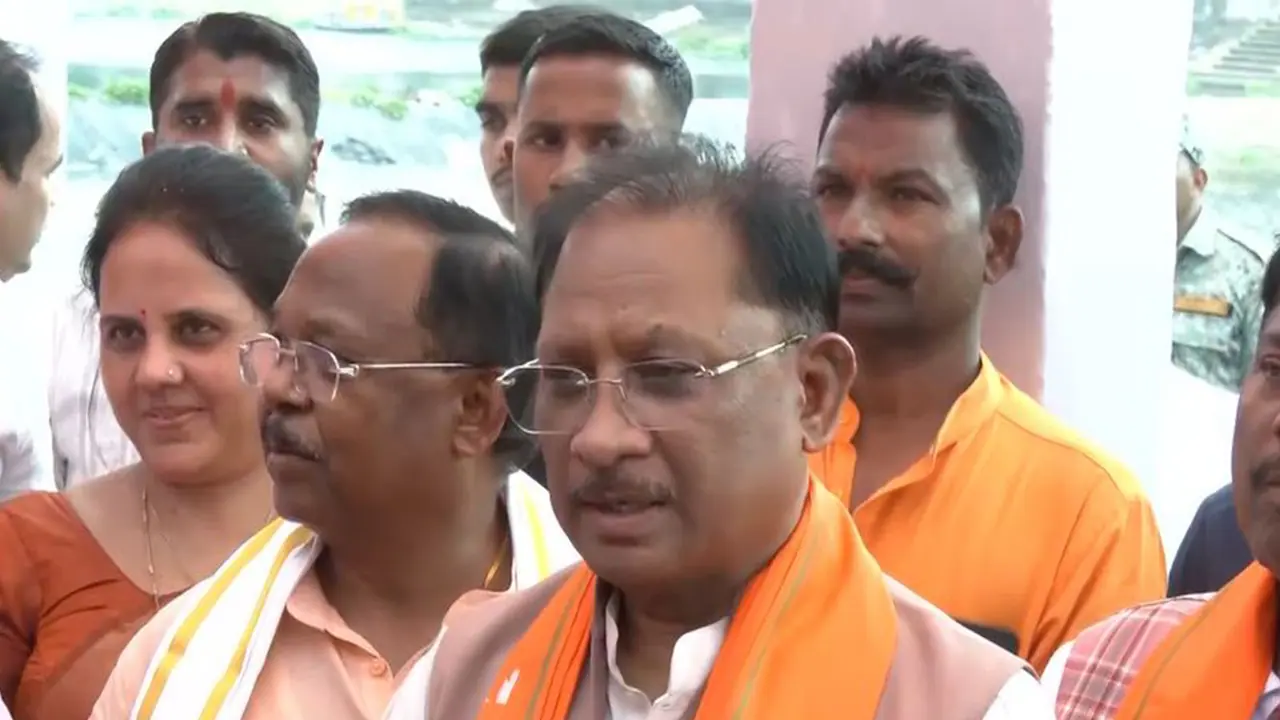
Chhattisgarh CM Vishnu Deo Sai linked Somnath Temple's 75th anniversary to national resilience and supported PM Modi's fuel conservation appeal. The call comes as India faces a massive fiscal burden to keep fuel prices stable amid global crises.
Chhattisgarh Chief Minister Vishnu Deo Sai on Monday attended the Somnath Swabhiman Parv celebrations, marking the 75th anniversary of the consecration of the iconic Somnath Temple. Speaking at the event, the Chief Minister linked the temple's historic restoration to India's modern resilience, while also addressing the pressing global energy challenges. Sai reflected on the temple's history as a symbol of national pride that withstood centuries of turmoil. He emphasised the roles of India's founding fathers in its revival. He noted that the temple had been attacked multiple times by the Mughals before its eventual restoration. Sai credited the resolve of India's first Home Minister, Sardar Vallabhbhai Patel, and the first President, Dr. Rajendra Prasad, for ensuring the temple was rebuilt in independent India. "75 years ago, on this day, the Somnath Temple was restored. Before that, it was attacked multiple times by the Mughals... the first Home Minister of independent India, Sardar Vallabhbhai Patel, with the first President, Dr Rajendra Prasad, resolved to restore it. After 75 years, PM Modi visited Somnath to offer prayers and wish for the nation's prosperity," he said.
Earlier in the day, Prime Minister Narendra Modi participated in 'Somnath Amrut Parv-2026', marking 75 years of the reconstruction of the Somnath Temple. Addressing the gathering at Sadbhavana Ground, the Prime Minister said that, Somnath Amrut Mahotsav" is not merely a celebration of the past, but a grand festival of inspiration that will guide and inspire India for the next thousand years, according to a release from Gujarat CMO. He said that today we are celebrating the reconstruction of the sacred abode from which creation originates and into which it ultimately dissolves. Referring to Lord Shiva, who consumed the deadly Halahala (poison) and came to be revered as Neelkanth, he said that celebrating the Somnath Amrut Mahotsav under his divine presence is itself a manifestation of Lord Sadashiv's divine play. He further said that the reconstruction of the Somnath Temple 75 years ago on this very day was not an ordinary event. India attained Independence in 1947, but the Pran Pratishtha ceremony of the Somnath Temple in 1951 became a powerful proclamation of India's awakened and free consciousness.
Addressing Global Energy Challenges
Shifting from cultural heritage to contemporary geopolitics, Chief Minister Sai voiced his strong support for Prime Minister Narendra Modi's seven appeals regarding fuel and energy conservation. As the West Asia crisis continues to disrupt global supply chains and inflate energy costs, Sai underscored the necessity of the Prime Minister's guidance. "The whole world is facing the consequences of the West Asia crisis. His advice was a wise one," said the Chhattisgarh CM.
Meanwhile, the 5th Informal Group of Ministers (IGoM), chaired by Defence Minister Rajnath Singh, met on Monday to finalise a strategy that blends military-grade strategic planning with a public appeal for mass participation, echoing the collective spirit of the COVID-19 pandemic.
India's Energy Security Robust
Despite international volatility, the IGoM confirmed that India's immediate energy security is robust. The government revealed a significant "rolling stock" of reserves to prevent any domestic panic. "The IGoM was informed that the country is secure, and there is no shortage of any petroleum product, even as most other nations have taken emergency measures to dramatically reduce domestic consumption. India has 60 days of crude oil, 60 days of Natural Gas and 45 days of LPG rolling stock. The foreign exchange reserves stand at a comfortable $703 billion. India is the world's third-largest oil refiner and fourth-largest exporter of petroleum products, exporting to over 150 countries and is meeting domestic demand in full," as per the Ministry of Defence press release.
The Financial Burden of Stable Fuel Prices
The financial stakes of this "collective effort" are immense. While the government has successfully shielded the Indian consumer from the immediate sticker shock at the petrol pump, the underlying economic math highlighted why Prime Minister Narendra Modi appealed to the people for collective participation to help the country deal with global economic disruptions, supply chain challenges and rising prices caused by international conflicts. "There is a huge cost being borne by the nation as international crude prices are continuing at very high levels. Fuel conservation can ease this burden. PM Modi emphasised prudence in the usage of petroleum products and reducing wasteful consumption, so that the fiscal burden on the nation is reduced in the present and into the future," read the release.
Moreover, India currently finds itself in a unique position where domestic fuel prices remain steady despite a 70-day global conflict. However, this stability is not "free," it is being financed by massive under-recoveries. ₹1,000 crore daily loss, the amount Indian Oil Marketing Companies (OMCs) are absorbing every single day to prevent inflation from hitting households. ₹2 Lakh Crore fiscal burden, the estimated total loss for the first quarter of 2026 alone. To put this in perspective, this is a significant portion of the national budget that would otherwise go toward infrastructure, education, or healthcare. (ANI)
(Except for the headline, this story has not been edited by Asianet Newsable English staff and is published from a syndicated feed.)