
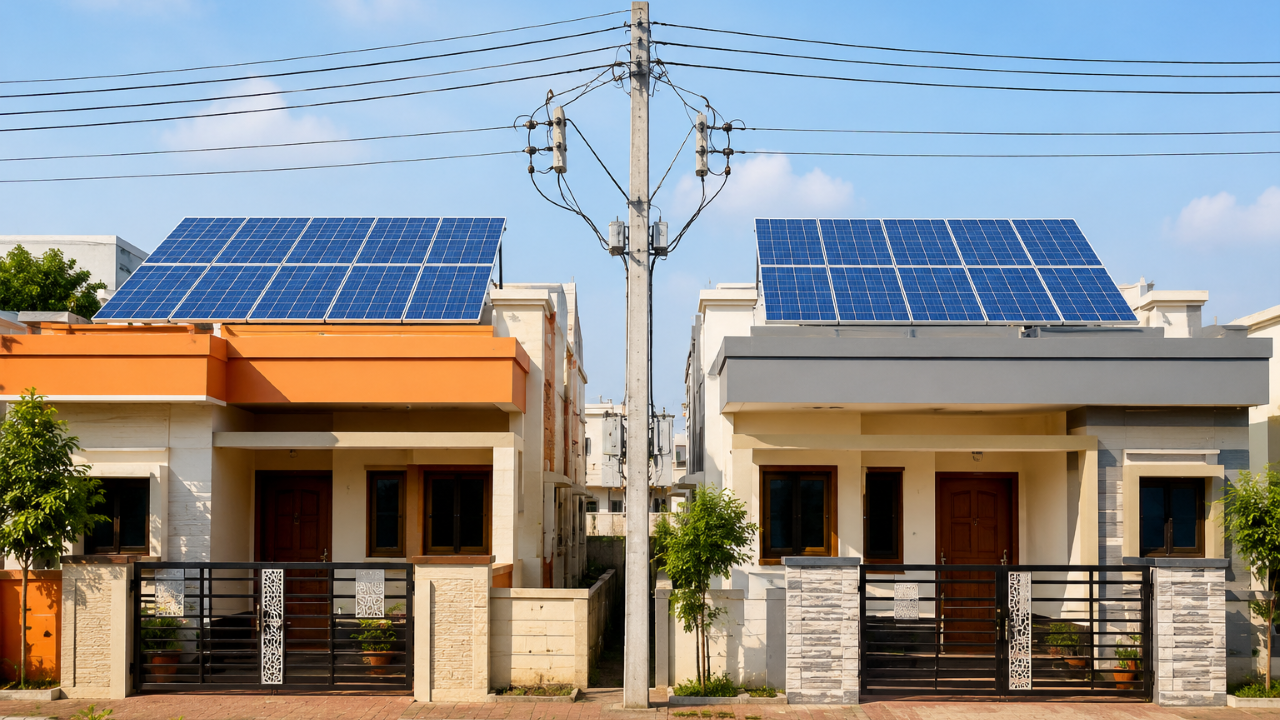
Farmers and women’s self-help groups in Odisha are turning to solar-powered motors and dryers to overcome unreliable electricity, reduce costs and increase earnings from crops and food processing.
For farmers in Bairagiput village in Odisha’s Koraput district, irrigation has long depended on monsoon rains or diesel motors. For women’s groups in Kalahandi, unreliable electricity has delayed food processing. Across these communities, decentralised renewable energy (DRE) is now helping bridge gaps in conventional power supply.
In Bairagiput, 35-year-old Amara Lakei cultivates ginger, cauliflower, chilli, millets, paddy and cabbage while working as an ASHA worker. She said electricity availability for irrigation has been a challenge. In 2024, a PRADAN and HDFC-supported intervention provided solar motors, sprinklers and pipes, along with solar fencing to protect crops.
Farmers See Higher Yields With Solar Motors
Madan Burud, 35, who farms two acres, previously relied on diesel motors. He received a solar-powered motor three months ago. A traditional motor consumes one litre of diesel per hour, with irrigation required two to three times a week. Burud’s household income rose to Rs 70,000 in the 2026 season, compared to Rs 40,000 from ginger the previous year.
Similarly, 26-year-old Gopinath Sisha reported that his fuel expenditure was around Rs 20,000 earlier. After installing a solar motor in 2023, his bean sales rose from Rs 1 lakh to Rs 1.5 lakh, while ginger fetched Rs 180 per kg compared to lower rates earlier. Sisha, who has farmed for a decade, grows beans, cabbage, tomato, brinjal, chilli, coriander and potato.
Women’s self-help groups (SHGs) in Nandapur block have also adopted solar drying for agricultural processing. In Kurji village, an SHG incorporated solar dryers to process ginger, reducing post-harvest losses.
Community resource person Ulash Khinbudi, 27, said small ginger that earlier sold for Rs 8-10 per kg now fetches Rs 40, while big ginger sells for Rs 140 compared to Rs 20-30 earlier. Around 40 women work in shifts at the unit.
PRADAN partnered with technology providers in 2018 to install seven drying units across three villages. Each unit included electric cutters, fan-based dryers and solar dryers. According to a 2026 study by WRI India, the units could process 50 kg batches of ginger in 3-4 hours.
Power Gaps Persist In Remote Areas
Electricity interruptions of two to three hours daily have persisted for decades in Bairagiput. Farmers said electric poles are far from fields, making installation of motors difficult. Diesel procurement is also challenging, requiring travel to Nandapur or Sehliguda.
The irrigation system now includes four solar motors, sprinklers and pipelines, covering clusters across two villages. Around 20 people benefit from the intervention, with motors supporting 20–30 acres each.
In Thuamul Rampur block of Kalahandi district, Jai Durga SHG, a 10-member collective, uses solar panels and battery storage for food processing. The group supplies nutrition to Anganwadi centres across eight gram panchayats under ICDS.
Former president Sourajini Singh, 65, said the group’s electricity bill reduced after solar panels and batteries were installed. The SHG received four 200 Ah batteries, one 3.5 kilowatt inverter, four solar panels and a rice puff extruder.
“We no longer have to travel 40-45 kilometres to Bhawanipatna to get puffed rice and roasted ingredients,” Singh said. The group’s monthly electricity bill, however, has risen to Rs 650-800 due to packing and sealing machines not powered by solar.
Singh added that power outages lasting 2–6 hours are common, sometimes extending up to 15 days during monsoon. Reliable electricity remains a major concern despite solar interventions.
