
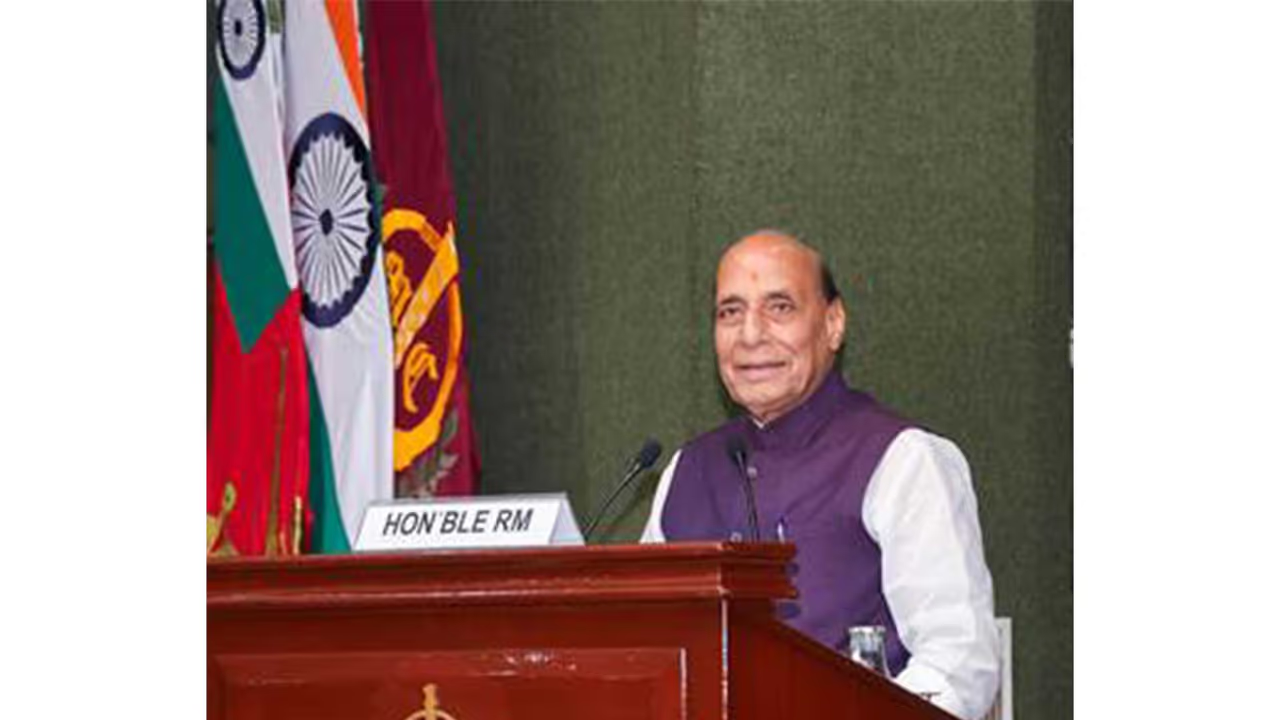
Defence Minister Rajnath Singh has directed the Army to develop a 20-30 year strategic vision, emphasizing the integration of modern technology, AI, and a robust, self-reliant defense manufacturing ecosystem to tackle future security challenges.
Defence Minister Calls for Strategic Long-Term Planning
Defence Minister Rajnath Singh has exhorted the Army Commanders to closely monitor geopolitical as well as regional developments and remain prepared for future challenges. Addressing the Army Commanders’ Conference in the national capital, he emphasised the need for a long-term strategic vision spanning the next 20-30 years, and called upon the senior leadership of the Indian Army to remain equally prepared to respond to immediate and emerging challenges. He stressed that strategies must remain dynamic and flexible, enabling timely adjustments to changing circumstances.
According to the Ministry of Defence, commending the Defence Forces for adapting to evolving operational circumstances, Rajnath Singh highlighted that innovative thinking, enhanced synergy and superior coordination, complemented by advanced weaponry, contributed to the success of Operation Sindoor. "The operation sent a clear message that India would not hesitate to take necessary measures to safeguard its national interests," he said.
Modernization and Technological Integration
The Defence Minister appreciated the military’s restructuring efforts, with a special focus on the use of drones and modern technology. He stressed the need to strengthen capabilities, continuously assess performance, and implement necessary improvements in line with evolving circumstances. He underscored the importance of accelerating efforts in areas such as artificial intelligence, autonomous systems, data analytics, cybersecurity, and secure communication networks.
The Role of Ground Forces in Modern Warfare
Rajnath Singh emphasised that despite the growing significance of challenges across the air, maritime, space and cyber domains, land warfare and ground forces would remain indispensable. He called for an integrated approach to modern warfare, stressing that success would depend on multi-domain capabilities and seamless coordination in joint operations.
Self-Reliance and Defence Reforms
Singh acknowledged the self-reliance efforts of the defence forces, stating that India’s growing defence manufacturing capabilities are a result of concerted efforts of all stakeholders. “Amidst the changing global landscape, Prime Minister Narendra Modi-led Government is prioritising Aatmanirbharta in defence. In the financial year 2025-26, defence production surged to a record Rs 1.78 lakh crore, with defence exports reaching an all-time high of approx. Rs 38,000 crore,” he said.
Referring to the ‘Year of Reforms - 2025’, Rajnath Singh stated that reform is a continuous process, the success of which depends on effective implementation. He urged the Commanders to drive these reforms forward within their respective commands and echelons, while ensuring that they translate into tangible benefits for operational capabilities.
Recognizing Service and Doctrine
He credited the valour, discipline, preparedness and restraint of the Defence Forces, along with the dynamic leadership and diplomatic efforts of Prime Minister Narendra Modi, for strengthening India’s global standing. He urged the Defence Forces to maintain their focus on self-reliance, effective implementation of reforms, improved manpower management, greater participation of women and an integrated approach to national security.
On the occasion, the Defence Minister also released the Land Warfare Doctrine, which provides an overarching framework to prepare the Indian Army to meet the challenges posed by the evolving character of warfare and future conflicts. He also unveiled the annual United Nations Journal and felicitated Indian Army personnel who have made notable contributions while serving as United Nations peacekeepers, recognising their exemplary service, professionalism and contribution to international peace and security.
Secretary of State for Defence Sanjay Seth, Chief of Defence Staff General NS Raja Subramani, Chief of the Army Staff General Dhiraj Seth, Defence Secretary Rajesh Kumar Singh and other senior officials were present on the occasion. With its comprehensive agenda, the conference has been organised to provide an important forum for the senior leadership of the Indian Army to review ongoing initiatives, identify future thrust areas and formulate appropriate policy directions towards building a progressive, adaptive, technologically enabled and future-ready Indian Army. (ANI)
(Except for the headline, this story has not been edited by Asianetnews Editorial staff and is published from a syndicated feed.)
