
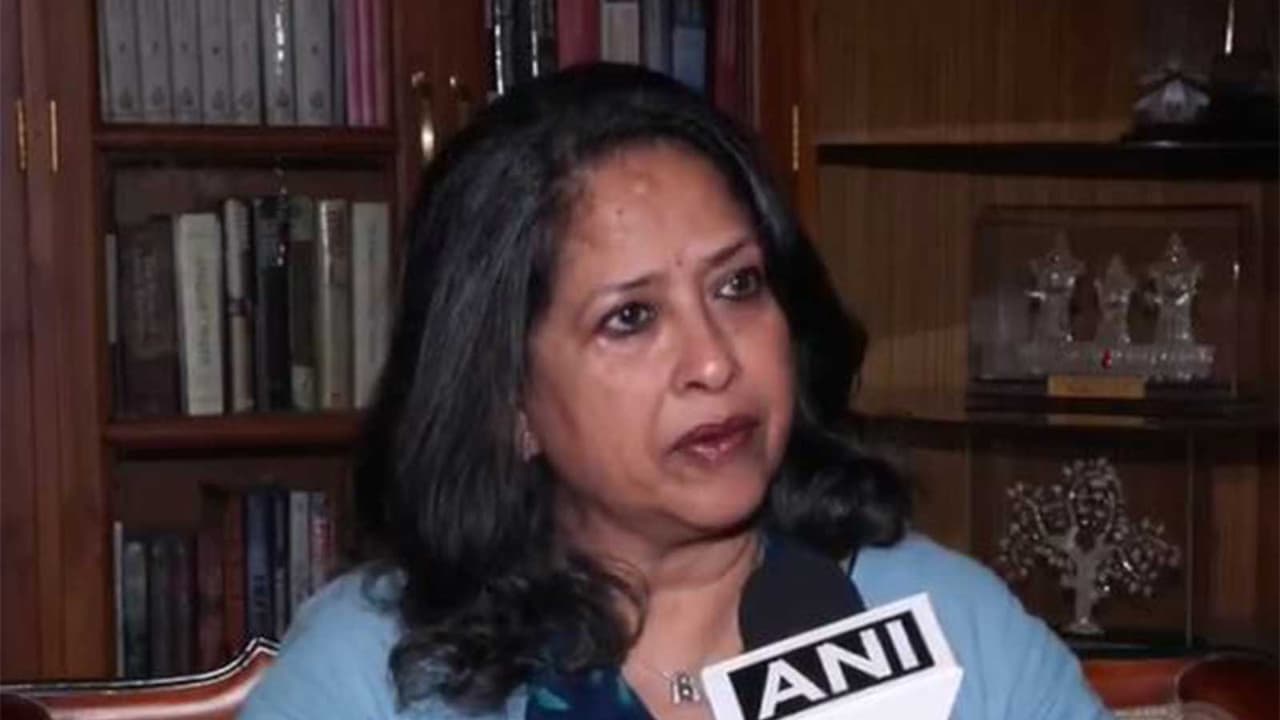
Sharmistha Mukherjee shared recollections from her father Pranab Mukherjee's diaries, where he wrote that after Indira Gandhi, PM Modi was the only prime minister who could 'read the pulse of the people so well,' a view formed after a J&K flood.
Author Sharmistha Mukherjee, daughter of former President Pranab Mukherjee, on Saturday shared several recollections from her father's diaries and personal interactions with Prime Minister Narendra Modi, saying Pranab Mukherjee had written that after former Prime Minister Indira Gandhi, Modi was the only Prime Minister who could "read the pulse of the people so well."
"My father wrote in his diary that after Indira Gandhi, he (PM Modi) is the only prime minister who can read the pulse of the people so well. And I remember this writing came in the context of there was this massive flood in Jammu and Kashmir. And Modi Ji went and spent Diwali, I think, first at Siachen and then with the people of Jammu and Kashmir...And secondly, he really appreciated the way Mr Modi very quickly grasped the nuances of foreign policy," Sharmistha Mukherjee said.
On Pranab's 2018 RSS Headquarters Visit
Speaking about her father's 2018 visit to the Rashtriya Swayamsevak Sangh (RSS) headquarters in Nagpur, she said Pranab Mukherjee believed dialogue was the cornerstone of democracy and rejected criticism that his visit lent legitimacy to the RSS.
"My father always said that the strength of democracy is in dialogue. So I remember that time I was fully involved in Congress politics, and I was very very upset with my father. So he kept quiet. One argument which was going on was that by going to RSS, Pranab Mukherjee is giving legitimacy to RSS. So I repeated that, that you are giving legitimacy to RSS. So then he lost his temper, and he said, who am I to give legitimacy to RSS? It's the people of the country, it's the people of India, who have given legitimacy to RSS by choosing one of their pracharak as the prime minister with a decisive mandate. And if you, that means as Congress, if you choose to ignore that, it is only at your own peril," she said.
'An Excellent Rapport' With PM Modi
Sharmistha Mukherjee also recalled the cordial relationship shared by her father and Prime Minister Modi, saying it predated Modi's tenure as Gujarat Chief Minister.
"My father and Narendra Modi ji shared an excellent rapport, and this was not just as President and Prime Minister; this was told to me by Mr Modi himself that they shared a very good rapport even before he became Gujarat Chief Minister. Whenever he used to visit Delhi, even as an ordinary RSS Karyakarta, sometimes they would bump across each other during a morning walk. He said, 'I always touched Dada's feet, and I don't know why I always had this strange respect for him."
She added, "And my father also wrote in his diary, which I have written in my book, that once Narendra Modi ji came to meet him as Gujarat Chief Minister when Baba was President, that Modi ji has been one of the most vocal critics of Congress and of the UPA governments. But I don't know why he has this strange soft corner for me because whenever he meets me in private, he always touches my feet and says that it gives me pleasure to do that..."
'Consensus Generator' on Parliament Functioning
Sharmistha Mukherjee said her father, Pranab Mukherjee, maintained cordial ties with leaders across political parties and believed Parliament should not be obstructed.
"My father was known as a consensus generator. And that is the reason he had a good relationship with leaders across party lines, whether it's CPI, CPIM, BJP...The opposition can't go on obstructing the parliament. So that relationship I think, between the government and opposition is missing today, and that is something which I don't think is good for a healthy democracy. Both parties to be blamed for this...My father advised Sonia Gandhi also when Congress was in opposition during Atal Bihariji's time, that do not obstruct, we must not obstruct parliament. The debate has to go on the discussion has to go on. So I think this is the responsibility of all the political leaders and the political party that in the interest of the nation, in the interest of the people who have elected them, to find out the middle path..." (ANI)
(Except for the headline, this story has not been edited by Asianet Newsable English staff and is published from a syndicated feed.)