
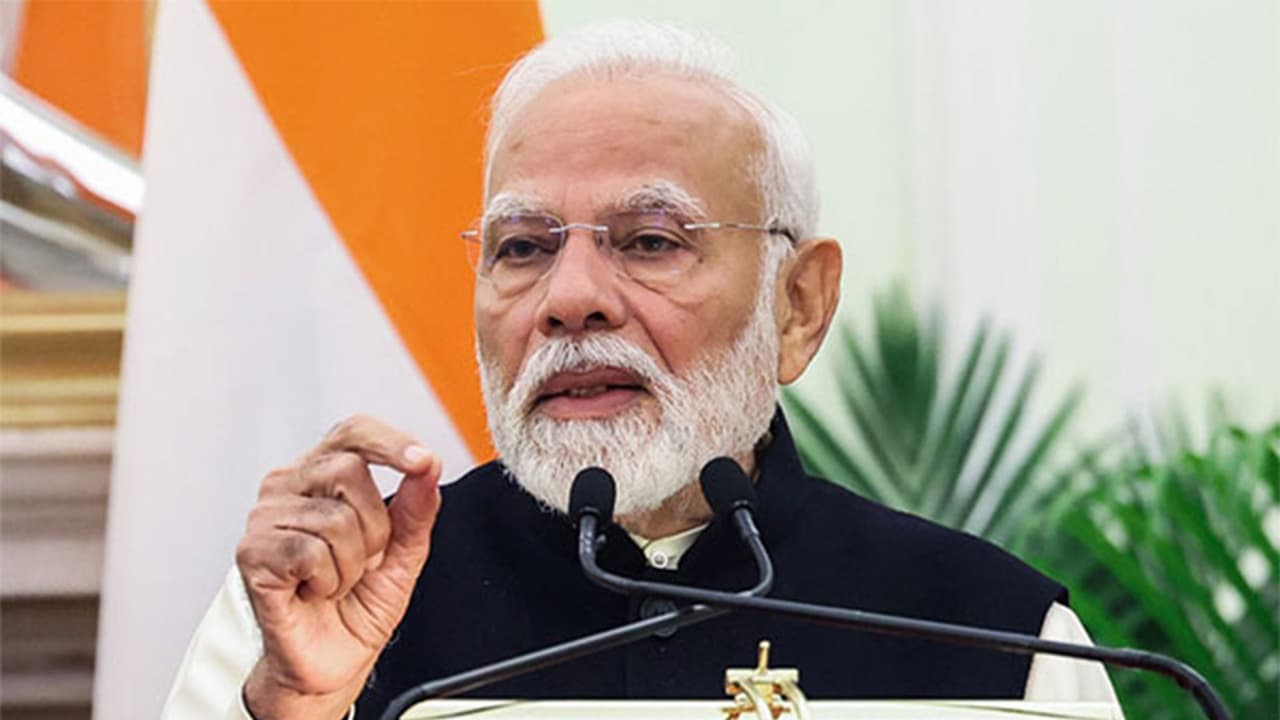
PM Modi made a personal appeal to MPs to pass the Nari Shakti Vandan Adhiniyam, a landmark bill for 33% women's reservation in legislatures, calling it a historic opportunity to ensure women receive their 'rightful due'.
PM Modi's Appeal for Nari Shakti Vandan Adhiniyam
Prime Minister Narendra Modi on Friday called on Members of Parliament to set aside partisan differences and pass the landmark legislation for women's reservation in legislative bodies in a direct and personal appeal to the nation's lawmakers. In a post on X, he called the upcoming vote on Nari Shakti Vandan Adhiniyam as a defining moment for Indian democracy and an essential step in securing the "rightful due" for the nation's women. He urged MPs to view the legislation through a personal lens rather than a political one. He asked lawmakers to reflect on the women in their own lives as they consider the constitutional amendment.
The Prime Minister emphasised that the bill--which seeks to reserve one-third of seats in the Lok Sabha and State Legislative Assemblies for women--is a historic opportunity to rectify long-standing imbalances in India's political landscape. Prime Minister Narendra Modi, in a post on X, wrote, "I would like to appeal to all Members of Parliament... Please reflect upon your conscience, remembering the women in your own families. The legislation to ensure women's reservation in legislative bodies is a significant opportunity to do justice to women of our nation. Please do not deprive our Nari Shakti of new opportunities. If this amendment is passed unanimously, it will further empower the women of our country and strengthen our democracy. Let us come together today to create history. Let us ensure that the women of India, who are half of the nation's population, receive their rightful due."
Key Bills Introduced for Delimitation and Reservation
The Union government has introduced three major Bills: the Constitution (One Hundred and Thirty-First Amendment) Bill, 2026, the Delimitation Bill, 2026, and the Union Territories Laws (Amendment) Bill, 2026, to enable fresh delimitation based on the latest available Census, expand the Lok Sabha, and operationalise 33% women's reservation in legislatures. The government has convened a special sitting of Parliament on April 16,17,18 to pass the amendment to the Nari Shakti Vandan Adhiniyam.
The government has introduced three Bills to enable fresh delimitation using recent Census data, expand the Lok Sabha to 850 seats, and implement 33% reservation for women. A new Delimitation Commission will redraw constituencies and allocate seats, with its decisions being final and legally binding, though subject to debate over fairness and federal balance. The move aims to uphold "one person, one vote, one value," but raises concerns about reduced representation of southern states and potential impact on federalism.
Details of the Constitution (131st Amendment) Bill
The Constitution (131st Amendment) Bill, 2026 amends Article 81 to increase the maximum strength of the Lok Sabha from 550 to 850 members (815 from States and 35 from Union Territories). Article 81 dictates the principle of equal representation; the ratio between a state's allocated seats and its population must be roughly the same across all states (with exceptions only for very small states under 6 million). The Bill also amends the marginal heading of Article 82 from "Readjustment after each Census" to "Readjustment of constituencies", and removes the requirement of readjusting the number of Lok Sabha seats in states after every Census. Similarly, it makes amendments to the Articles on state Assemblies (Article 170) and reservation for SCs and STs, changing the basis from the 2001 Census to "such Census" that Parliament decides by law to use.
Implementation Timeline and Delimitation Process
As of now, Article 81 (2) and (3) freeze the Lok Sabha seats as per the 1971 Census and the Assembly seats as per the 2001 Census, "until the relevant figures for the first census taken after the year 2026 have been published". By decoupling delimitation from the post-2026 Census, the government can now proceed with delimitation using data from the 2011 Census. It amends Article 334A to allow the immediate implementation of the 33% women's reservation in the Lok Sabha and State Assemblies (Nari Shakti Vandan Adhiniyam (Constitution 106th Amendment Act, 2023)) right after this new delimitation process is completed, targeting the 2029 elections.
Legislative Requirements for Passage
Constitution (131st Amendment) Bill, 2026 requires a special majority in Parliament and ratification by at least half of the States, as it amends the Constitution. (ANI)
(Except for the headline, this story has not been edited by Asianet Newsable English staff and is published from a syndicated feed.)