
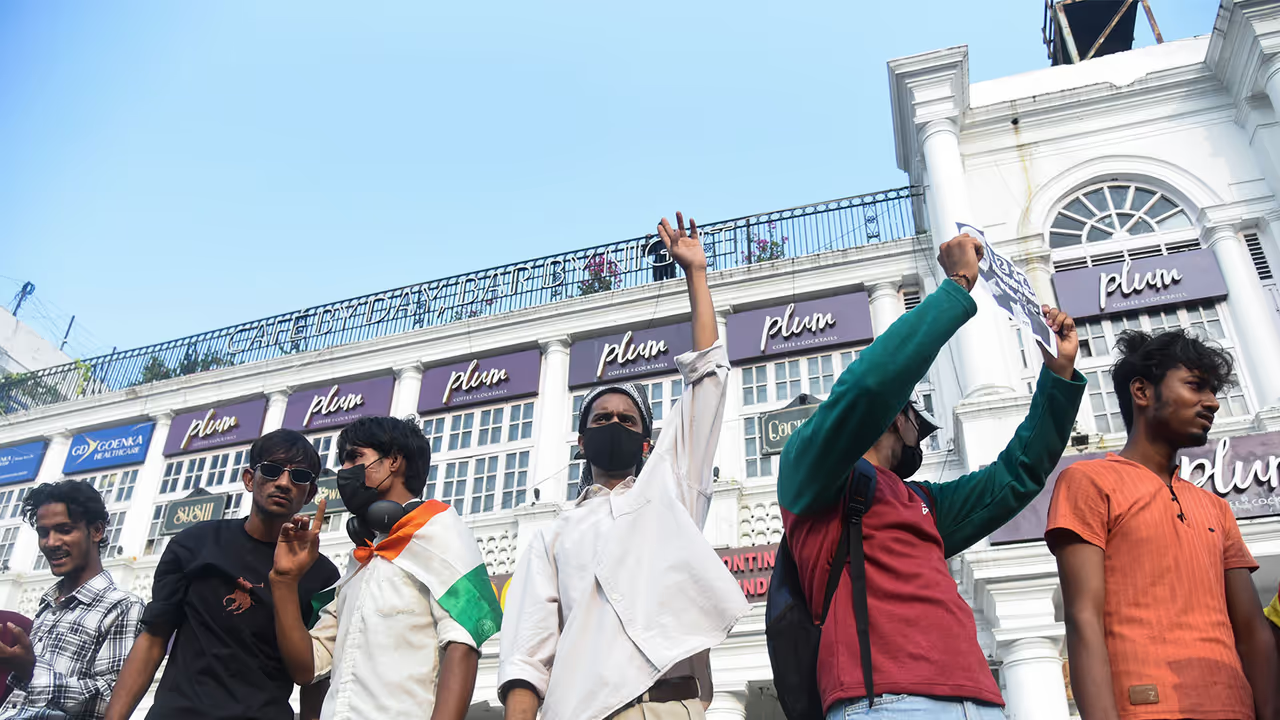
A Palika Bazar street vendor has filed a PIL in the Delhi High Court to stop a planned protest by the Cockroach Janta Party at Connaught Place, arguing such events harm the livelihood of small traders by disrupting business and access.
Vendor's Plea in High Court
A street vendor who has been selling garments at Palika Bazar for nearly three decades has approached the Delhi High Court seeking urgent intervention against the Cockroach Janta Party’s (CJP) proposed protest at Central Park, Connaught Place, arguing that such gatherings and the resulting traffic restrictions threaten the livelihood of small traders and daily-wage earners. The plea was mentioned before the High Court on Thursday.
“This protest has to be stopped,” Senior Advocate Sacchin Puri told the court. Acting Chief Justice Nitin Wasudeo Sambre asked the counsel to return at 2:30 pm, after the Supreme Court hears related protest matters, and said the High Court would consider the plea thereafter.
PIL Against CJP's Gathering
Filed by Anil Kumar Gupta, a licensed street vendor at Palika Bazar, the Public Interest Litigation (PIL) seeks to prevent the gathering announced for 5 pm on October 16 at Central Park in Connaught Place, which is situated directly above the underground market. The petition alleges that protests and prolonged traffic blockades in central Delhi have repeatedly disrupted access to markets, causing vendors and other small traders to lose their daily earnings. It urges the authorities to enforce existing restrictions on demonstrations and keep public roads and pedestrian pathways accessible.
The plea follows a social media call issued on October 14 by CJP founder Abhijeet Dipke for a gathering at Central Park under the banner “Lehra Do Tiranga”. The petitioner contends that Central Park is not among the venues designated for protests under the Delhi Police order issued on October 11, 2026, which de-notified Jantar Mantar as a designated protest site.
Legal Precedents and Past Disruptions Cited
The petitioner has argued that the authorities have repeatedly failed to enforce restrictions governing demonstrations at Jantar Mantar, resulting in road blockades and disruption of commercial activity in the surrounding areas. The petition cites two Supreme Court judgements, Mazdoor Kisan Shakti Sangathan v. Union of India (2018) and Amit Sahni v. Commissioner of Police (2020), to contend that the right to protest must be exercised at designated places and in a manner that does not obstruct public roads indefinitely.
It refers to the Delhi Police Standing Order dated November 22, 2018, which prescribed conditions for protests at Jantar Mantar, including limits on the number of participants, timings, and restrictions on marches, structures, and obstruction of traffic. According to the petition, several demonstrations continued for extended periods despite these restrictions. It cites the 36-day wrestlers’ protest in 2023, a 36-day sit-in seeking examination reforms in 2026, and subsequent demonstrations concerning electoral rolls. The petitioner has also alleged that an agitation on or around July 20, 2026, spilled beyond the designated area, bringing roads around Jantar Mantar and Parliament Street to a standstill. He claims that customers stopped visiting Connaught Place and Palika Bazar, preventing him from carrying on his business.
Demands for Designated Protest Venues and Access Plans
The Delhi Police order dated October 11 named Ramlila Ground, Burari Ground and CBD Ground in East Delhi as venues for protests. The petitioner, however, contends that merely de-notifying Jantar Mantar would not resolve the problem unless the authorities prevent gatherings at unauthorised locations and ensure that traffic restrictions are proportionate and temporary.
The plea seeks directions to the Delhi Police to prevent the proposed gathering at Central Park and any similar demonstration at locations that are not designated protest venues. It also seeks a traffic and pedestrian access plan for Jantar Mantar, Parliament Street, Connaught Place and adjoining roads. The petitioner has further urged the court to direct the police to issue revised standard operating procedures for the newly designated protest venues within a time frame fixed by the court, with safeguards to prevent surrounding roads from being blocked.
Protecting Livelihood and Constitutional Rights
Apart from seeking action against unauthorised gatherings, Gupta has sought protection for street vendors against eviction or seizure of their goods except in accordance with the Street Vendors (Protection of Livelihood and Regulation of Street Vending) Act, 2014. He has submitted that he has been vending readymade garments at Palika Bazar since around 1995 and holds a certificate of vending issued by the New Delhi Municipal Council.
The petition argues that vendors should not face further hardship through the removal of their stalls or seizure of goods when authorities clear areas affected by protests. The petitioner has invoked Articles 19(1)(g) and 21 of the Constitution, relating to the right to carry on a trade or occupation and the right to life and livelihood.
Clarifying that the plea is not against the right to peaceful protest, Gupta has said he seeks only the enforcement of existing laws and court directions so that demonstrations take place at designated venues without depriving other citizens of access to public spaces or their means of earning a living.
The petition has named the Union of India, the Delhi government, the Delhi Police Commissioner, the Municipal Corporation of Delhi, the New Delhi Municipal Council and the Cockroach Janta Party as respondents. It also seeks compliance reports from the authorities. (ANI)
(Except for the headline, this story has not been edited by Asianet Newsable English staff and is published from a syndicated feed.)