
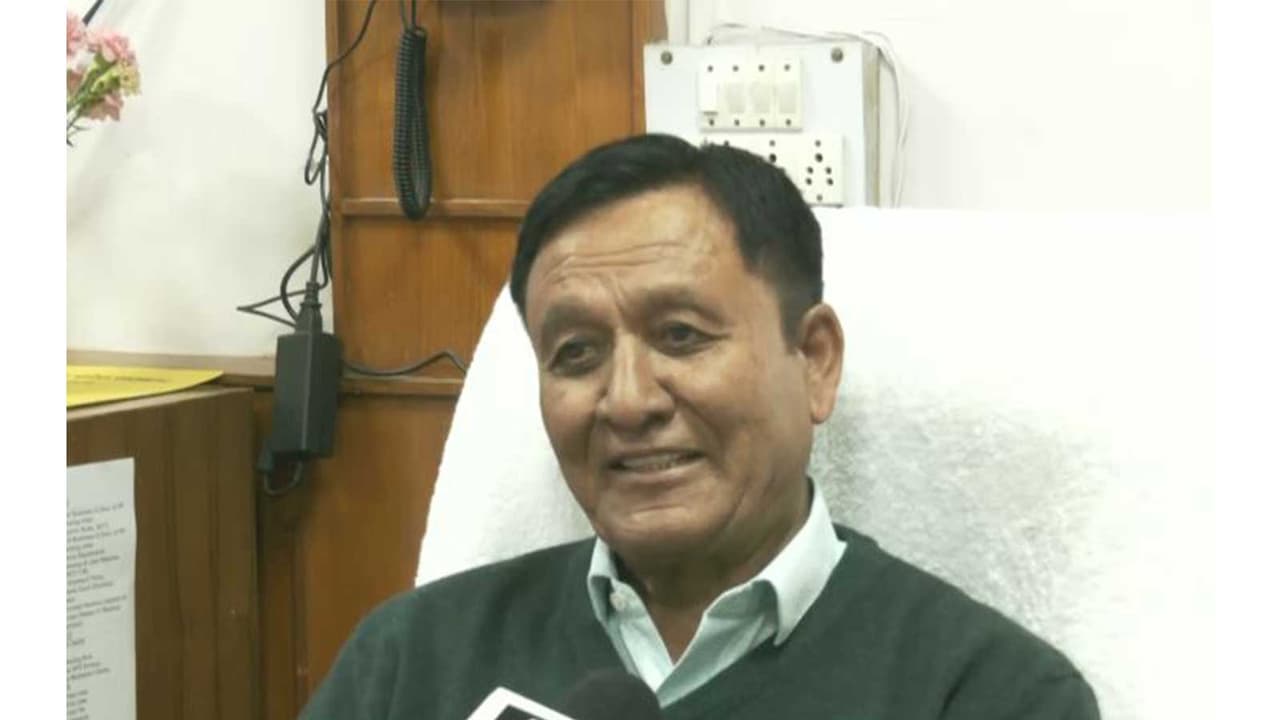
HP Minister Jagat Singh Negi said an overloaded truck, not a technical flaw, caused the Bailey bridge collapse in Kinnaur. He noted the bridge had a 10-tonne limit and assured that the state is fully prepared for the upcoming monsoon season.
The Revenue and Horticulture Minister of Himachal Pradesh, Jagat Singh Negi on Tuesday said the collapse of the Bailey bridge in the Urni area of Kinnaur district was caused by an overloaded vehicle and not due to any technical or material defect. He also asserted that the state government has made extensive preparations to tackle monsoon-related disasters across Himachal Pradesh.
The iron bridge collapsed in Kinnaur district today and a dumper truck loaded with sand fell into the Sutlej river while the driver escaped with minor injuries.
Overloaded Vehicle Blamed for Collapse
Speaking to ANI, Negi said the bridge, which had been functioning successfully for several years, was constructed as an alternative arrangement after a massive landslide in the Urni-Dhak area disrupted the original road alignment. "Neither the material nor the engineering of the bridge failed. There was no technical fault. The bridge was installed in 2016 as a temporary alternative arrangement after continuous landslides created a major geological hazard in the Urni-Dhak area," Negi said.
The minister recalled that the original road had become unsafe due to a massive landslide zone, forcing commuters to take a much longer route. The state government, with assistance from the Indian Army and local agencies, developed an alternative alignment and installed Bailey bridge to maintain connectivity. "At that time, even the Army could not permanently stabilize the landslide zone because of the complex geological conditions. We created an alternative route and installed two Bailey bridges to ensure uninterrupted movement of traffic. The arrangement served the area efficiently for nearly a decade," he said.
Negi said preliminary findings indicate that an overloaded truck crossed the bridge during the night, exceeding its prescribed carrying capacity of around 10 tonnes. "The bridge had a fixed load-bearing capacity. A fully loaded heavy vehicle crossed it despite restrictions. Photographs clearly show the overloaded vehicle that fell along with the bridge. When any structure is subjected to loads beyond its design capacity, such incidents can occur," he said.
He said the bridge had been operating successfully for more than eight years and was functioning under continuous monitoring. "This was an unmanned bridge where compliance depended on vehicle operators adhering to prescribed limits. Action will be taken against those found responsible for violating load restrictions," Negi added.
No Major Traffic Disruption
The minister said there would be no major disruption to traffic movement as an alternative road remains operational. "Fortunately, the old alignment is already open. Its width has been improved and strengthening work has been completed. Traffic was immediately diverted after the incident, ensuring that commuters do not face significant inconvenience," he said.
Long-Term Solutions Underway
Negi also informed that major stabilization works worth around Rs 50-60 crore are currently underway in the Urni-Dhak landslide zone, including tunnelling and slope stabilization measures aimed at providing a long-term solution to the area's recurring geological challenges. "The Urni stretch is strategically important for us. Extensive engineering works, including half-tunnelling and slope stabilization, are already in progress to make the road safer and more resilient," he said.
Monsoon Preparedness and Disaster Management
Replying to a question on monsoon preparedness, Negi, who also heads the State Disaster Management Authority as Vice-Chairman, said all departments and district administrations have been placed on alert to deal with potential natural disasters during the rainy season.
He acknowledged that while weather forecasts can indicate the likelihood of heavy rainfall, it remains impossible to predict the exact location and timing of natural disasters. "Even today, technology cannot precisely predict where a disaster will strike. We can estimate rainfall patterns, but specific incidents such as landslides, flash floods or cloudbursts cannot be forecast accurately in advance," he said.
State and National Response Teams on Alert
The minister said multiple review meetings have been held under the chairmanship of Chief Minister Sukhvinder Singh Sukhu and Chief Secretary KK Panth to assess preparedness. "All concerned departments, including Public Works, Jal Shakti, Electricity Board and district administrations, have been instructed to keep machinery, equipment and manpower ready for immediate deployment," he said.
Negi said mock drills have been conducted at various levels and Deputy Commissioners across the state have finalized district-specific disaster response plans. The minister further stated that teams of the State Disaster Response Force (SDRF) and National Disaster Response Force (NDRF) are being strategically positioned at vulnerable locations across the state. "We have identified highly vulnerable points and directed SDRF and NDRF teams to remain deployed or ready for quick deployment in those areas. Home Guards, police and local administration have also been integrated into the response mechanism," he said.
Strengthening Community-Based Response
Highlighting community-based disaster management efforts, Negi said the government has strengthened the 'Aapda Mitra' programme and is working to establish trained volunteers in every panchayat. "Our objective is to have trained disaster volunteers in every panchayat. Large-scale training programmes have already been conducted, and we have started providing basic rescue kits, stretchers, first-aid equipment and emergency response tools at the grassroots level," he said.
According to Negi, the initiative is aimed at ensuring immediate local response during emergencies before specialized rescue teams reach affected areas. "In the event of any disaster, local volunteers can provide immediate assistance and save valuable time until SDRF or NDRF teams arrive. Strengthening community response is a key component of our disaster management strategy," he added.
(Except for the headline, this story has not been edited by Asianet Newsable English staff and is published from a syndicated feed.)