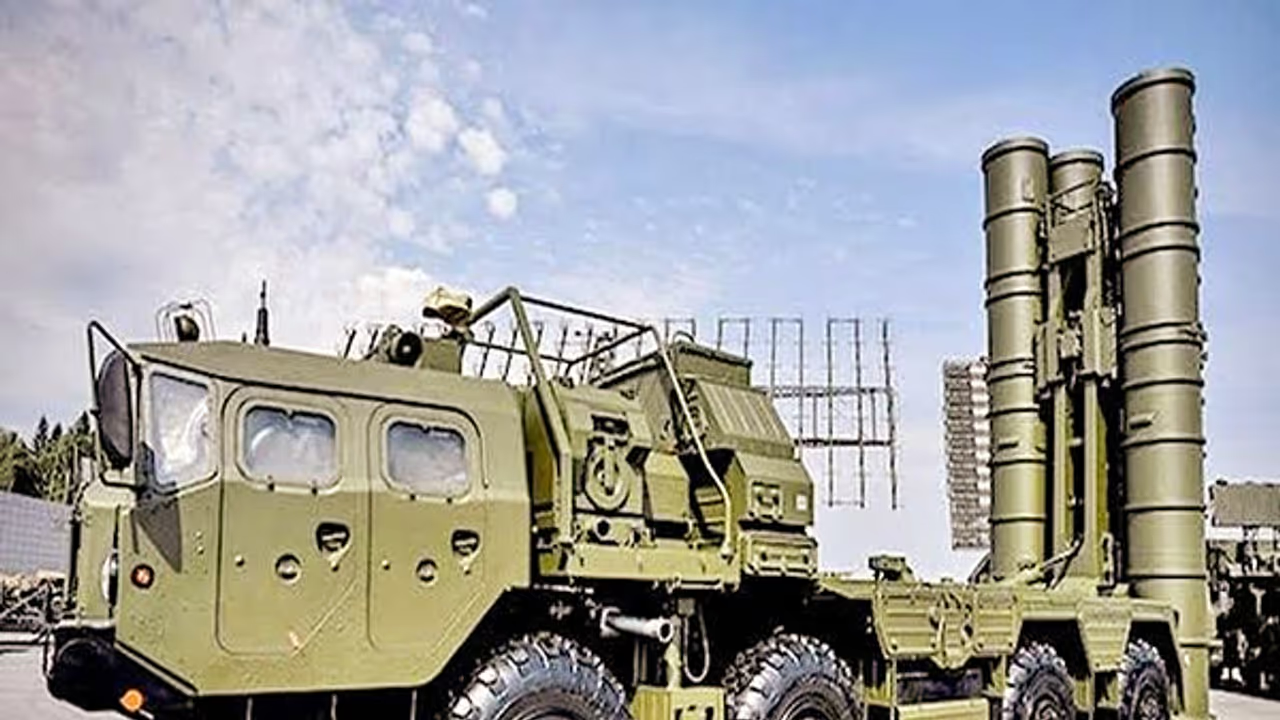
India's integrated air defence network, comprising multi-layered missile systems and radars, successfully thwarted Pakistan’s aerial attacks during the four-day Operation Sindoor.
New Delhi: In modern warfare, airspace dominance is crucial for gaining an upper hand over the enemy. During the recent India-Pakistan tensions, where India showcased its military prowess under ‘Operation Sindoor’, New Delhi successfully safeguarded its skies, military bases, and civilian infrastructure through a highly integrated and layered air defence network.
India’s robust air defence grid—comprising Counter Unmanned Aerial Systems (C-UAS), air defence guns like the L70 and ZSU-23 Shilka, MANPADS, Akash, and the S-400—effectively repelled multiple offensive strikes from Pakistan.
Between May 7 and 10, India’s extensive radar network, missile batteries, and real-time interception capabilities played a pivotal role in neutralising aerial threats and minimizing damage to strategic assets.
Related Articles

Pakistan launched strikes on over 60 locations—from Leh in Ladakh to Naliya in Gujarat—targeting both civilian and military sites. However, except for three instances, India's formidable air defence systems successfully intercepted the entire barrage of missiles and drones. The seamless integration of long-range (S-400), medium-range (Akash, Barak-8), and short-range (QRSAM, SPYDER) missile systems, supported by Counter-Unmanned Aerial Systems (C-UAS) and the Integrated Air Command and Control System (IACCS), formed a layered shield that neutralised Pakistan’s aerial threats.
In a special briefing, Director General of Air Operations (DGAO) Air Marshal AK Bharti detailed how India's integrated air defence grid, strategically deployed across the country, was swiftly activated the moment Pakistani drones, fighter jets, and surface-to-surface missiles attempted to infiltrate Indian airspace. The IACCS nodes, positioned at key locations, effectively coordinated and monitored air defence operations across India’s 18,000-km-wide airspace.
The Four Layers of India's Air Defence Grid During Operation Sindoor
According to Air Marshal AK Bharti, India's air defence grid during Operation Sindoor was structured into four distinct layers to provide comprehensive protection against aerial threats.
The longest range is the S-400 with a range of 400 km, followed by the MRSAM (Medium Range SAM) with a range of around 70 km, Akash (25 km), Israeli Spyder SAM (around 10 km), and then legacy systems such as the Osa-AK and Tunguska systems.
First Layer: Drones and MANPADS for Low-Level Threats
The first layer involved drones and MANPADS (Man-Portable Air Defence Systems)—shoulder-fired missiles designed to neutralise low-flying aircraft, helicopters, and cruise missiles.
Second Layer: Akash and Spyder Neutralise Close-Range Attacks
The second layer comprised point air defence systems and short-range surface-to-air missiles. The indigenous Akash missile system, with a top speed of Mach 2.5 and a range of 80 km, was instrumental in countering drone swarms with pinpoint accuracy. The Israeli Spyder system, optimized for low-flying aircraft and drones, is credited with neutralising the majority of aerial threats during the four-day conflict between two nuclear-armed nations.
Third Layer: MRSAMs and the Key Role of Barak-8
The third layer consisted of MRSAMs, jointly developed by India’s DRDO and Israel Aerospace Industries. These missiles are designed to intercept cruise missiles, UAVs, and fighter aircraft at extended ranges and are deployed with both the Indian Army and Air Force.
Among them, the Barak 8 MRSAM system stood out with its 70 km operational range, playing a crucial role in intercepting threats during the operation. On May 10, Islamabad launched a Fatah-II ballistic missile aimed at Delhi. Weighing 275 kg and capable of carrying a 60-kg warhead, the missile was successfully intercepted mid-air by the Barak-8 missile defence system near Sirsa in Haryana.
Fourth Layer: S-400 or 'Sudarshan Chakra' and VSHORADS
The S-400, referred to as “Sudarshan Chakra” in India, is a mobile air defence system capable of engaging targets at both medium and long ranges. It is equipped with four types of surface-to-air missiles designed to counter a wide range of aerial threats.
This Russian-origin system can intercept stealth aircraft, drones, as well as ballistic and cruise missiles. Its advanced radar can track up to 300 targets simultaneously within a 600-km radius and engage up to 36 threats at once.
During Operation Sindoor, the Indian armed forces also deployed several short-range air defence systems with ranges between 5 and 115 km. These included Russian-made Igla, OSA-AK-M, Pechora systems, as well as L-70 anti-aircraft guns, Zu-23, and Shilka platforms.
Pakistan sent waves of drones, including Turkish-origin – Songar and YIHA Kamikaze drones to target India’s military bases and civilian infrastructures but most of them were thwarted mid-air by India’s air defence system. It has been informed that Pakistan used over 350 Turkish-origin drones.
Operation Sindoor marked a defining moment in India’s modern air defence capabilities, showcasing a seamless integration of indigenous and foreign systems across a multi-layered grid. From thwarting ballistic missiles and drone swarms to intercepting advanced aerial threats, India’s preparedness and technological edge proved decisive in maintaining airspace dominance.