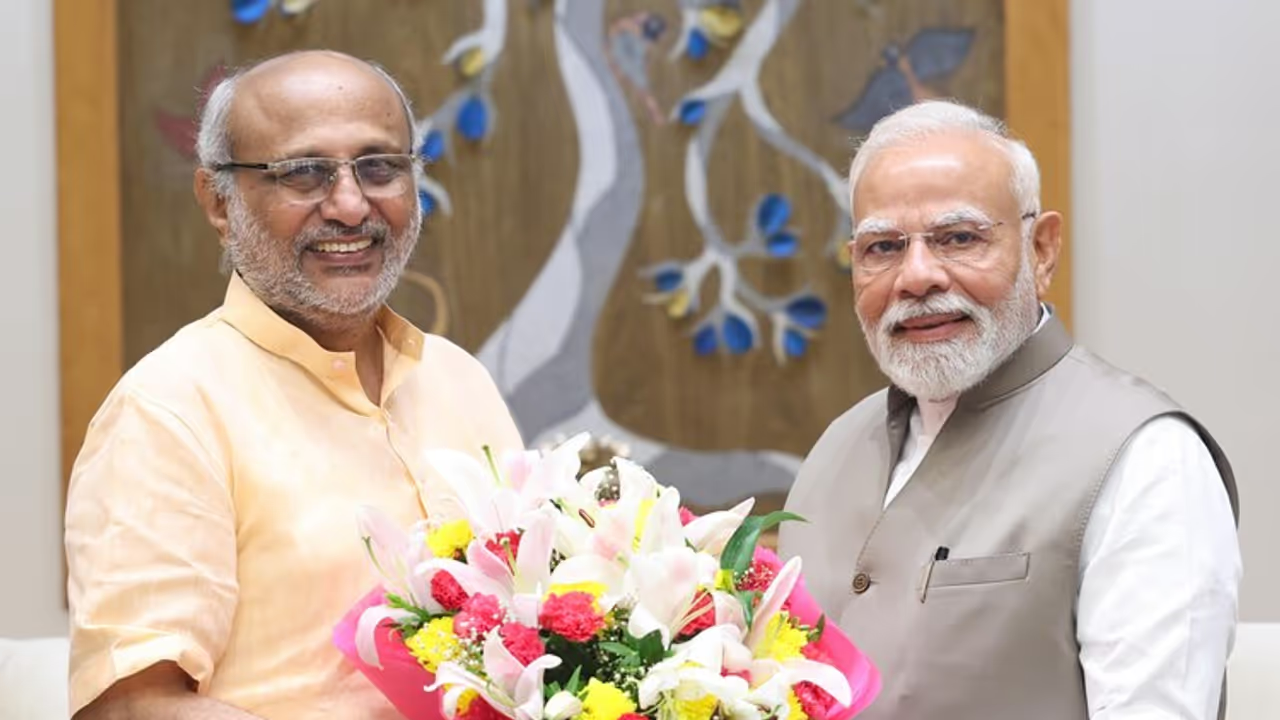
NDA nominee and Maharashtra Governor C.P. Radhakrishnan has been elected as Vice President of India with a total of 452 votes. He will also serve as Rajya Sabha Chairman, strengthening NDA’s parliamentary position. B Sudershan Reddy got 300 votes.
Maharashtra Governor CP Radhakrishnan, the NDA’s candidate, has been elected 15th Vice President with a total of 452 votes. The Vice Presidential election took place amid strong political interest, with Radhakrishnan facing joint Opposition candidate B. Sudershan Reddy.
Opposition nominee B Sudershan Reddy got 300 votes, said the Returning Officer. The counting of votes was held on Tuesday evening, confirming Radhakrishnan’s clear victory. This win strengthens the NDA’s position in Parliament, as Radhakrishnan will now serve as the Chairman of the Rajya Sabha.
Vice Presidential election
The Vice Presidential election saw strong participation from leading political figures. Prime Minister Narendra Modi cast the first vote, followed by Congress leaders Sonia Gandhi, Priyanka Gandhi, and Congress President Mallikarjun Kharge. BJP President and Union Minister J.P. Nadda, along with Union Minister Nitin Gadkari, also voted.
Related Articles

Voting for the Vice President began at 10 am and continued until 5 pm. The counting of votes started at 6 pm, and by nightfall, C.P. Radhakrishnan was declared the winner. His election fills the vacancy created after Jagdeep Dhankhar resigned on July 21, 2025, citing health reasons. His resignation took effect immediately under Article 67(a) of the Constitution.
CP Radhakrishnan vs B. Sudershan Reddy
CP Radhakrishnan, 68, is a two-time Lok Sabha MP from Coimbatore and currently serves as Maharashtra Governor. He belongs to the Gounder-Kongu Vellalar OBC community. Radhakrishnan expressed that his victory was a reflection of Indian nationalism and the vision for a “Viksit Bharat” (Developed India).
His opponent, Justice B. Sudershan Reddy, 79, a retired Supreme Court judge from Telangana, was backed by the opposition INDIA bloc. Justice Reddy is well-known for rulings on issues such as Salwa Judum and black money investigations. He said his campaign aimed to awaken public conscience and highlighted the importance of constitutional values.
Voting followed a secret ballot system under proportional representation with a single transferable vote. MPs marked preferences in order of choice, and ambiguous ballots were rejected. Preventively detained MPs such as Sheikh Abdul Rashid and Amritpal Singh voted via postal ballots.
The electoral college included 781 MPs-238 from Rajya Sabha and 543 from Lok Sabha. However, with BJD and BRS abstaining, the effective strength became 770 MPs, setting the majority mark at 386 votes. The NDA had a theoretical strength of 425 MPs, supported by YSR Congress and likely backing from AAP’s Swati Maliwal, pushing the total to 436. The INDIA bloc stood at 324 MPs, along with some undecided independent and smaller party MPs. According to sources, 13 MPs abstained from voting while Congress said that all of the 315 Opposition MPs turned up for voting.
This election was seen as a significant political test of strength for both the NDA and the INDIA bloc. Analysts had expected a narrower margin of victory compared to 2022, when Jagdeep Dhankhar won by 346 votes. With Radhakrishnan winning by 452 votes, the result confirmed the NDA’s firm standing in Parliament ahead of upcoming sessions.
As Vice President, C.P. Radhakrishnan will also serve as the Chairman of the Rajya Sabha, giving him a key role in parliamentary deliberations and debates. His tenure is expected to shape how the Upper House functions in the coming years.