NCERT's new Partition modules blame Congress, Jinnah and Mountbatten for India's division, highlighting horrors and long-term impact. Congress has opposed the content, sparking a political row over how Partition and its leaders should be remembered.
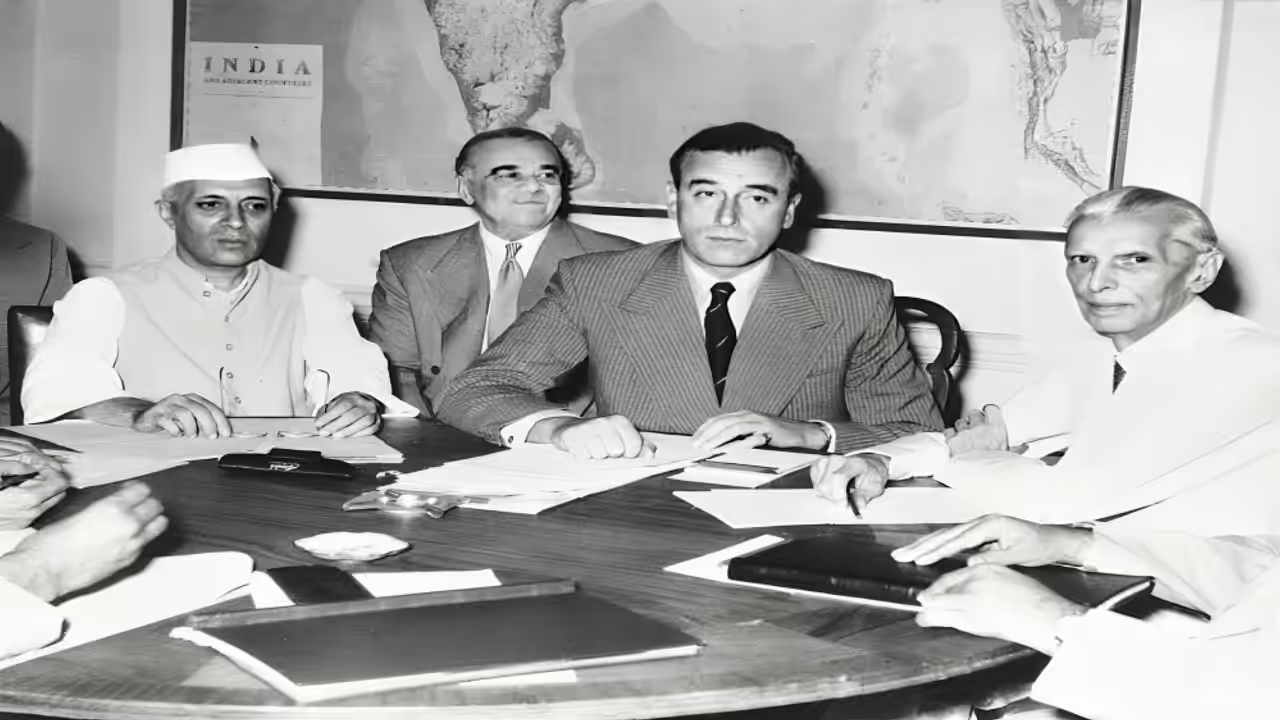
The NCERT has released new special modules on the Partition of India to mark Partition Horrors Remembrance Day. The content places major responsibility on the Congress leadership, saying they accepted the plan of Partition and underestimated Muhammad Ali Jinnah. It states that Partition was not inevitable, but the result of three actors — Jinnah, who demanded it; Congress, which accepted it; and Lord Mountbatten, who formalised and implemented it.
Horrors of partition described
The modules describe Partition as 'an unprecedented human tragedy, with no parallel in world history'. They highlight the killings, displacement of nearly 1.5 crore people, sexual violence, and refugee trains that often arrived 'filled only with corpses'. They also mention earlier communal violence in Noakhali, Calcutta, Rawalpindi, Thoha, and Beval as warning signs before the final division.
Jinnah's role and Congress's response
According to the modules, Jinnah’s call for Direct Action Day in August 1946 led to large-scale violence and pressured Congress leaders like Nehru and Patel to concede to partition. Jinnah himself is quoted as saying he never expected to see Pakistan in his lifetime. The modules also recall the 1940 Lahore Resolution where Jinnah argued that Hindus and Muslims belonged to 'two different villages' with different cultures and customs.
Related Articles

Mountbatten criticised for haste
Lord Mountbatten is strongly criticised for preponing the transfer of power. Initially scheduled for June 1948, the date was advanced to August 1947. The modules argue that this rush caused widespread chaos, with many people unsure on Independence Day whether they were in India or Pakistan.
Gandhi, Nehru and Patel on partition
The content cites Vallabhbhai Patel saying India had become a battlefield, and partition was better than civil war. It notes that Gandhi opposed partition but refused to stop Congress through violence. Eventually, Gandhi persuaded the Congress Working Committee in June 1947 to accept partition.
The secondary stage module links Partition to long-term challenges for India, including the Kashmir conflict, communal politics, and Pakistan’s policies. It says Pakistan fought three wars to capture Kashmir and later exported terrorism, all as consequences of Partition.
Political backlash from Congress
The new interpretation has sparked political controversy. Congress spokesperson Pawan Khera called for the module to be burnt, saying it does not tell the truth. He accused the RSS and Hindu Mahasabha of being the first to propagate the idea of partition. He claimed the Hindu Mahasabha spoke of partition in 1938, before Jinnah repeated the demand in 1940. Another Congress leader, Sandeep Dikshit dared NCERT for a discussion on Partition. Calling it a 'fake history of BJP,' he alleged they (BJP) have NCERT under their control, they don't know anything about Partition and are printing anything. This has been going on since a long time."
The new NCERT modules are not part of regular textbooks but are designed as separate lessons for Classes 6-8 and 9-12. They aim to teach students about the horrors of Partition and its causes. However, the blame assigned to Congress has triggered a new political battle over how India’s history is taught, and which leaders bear responsibility for the division of the country.
(With ANI inputs)