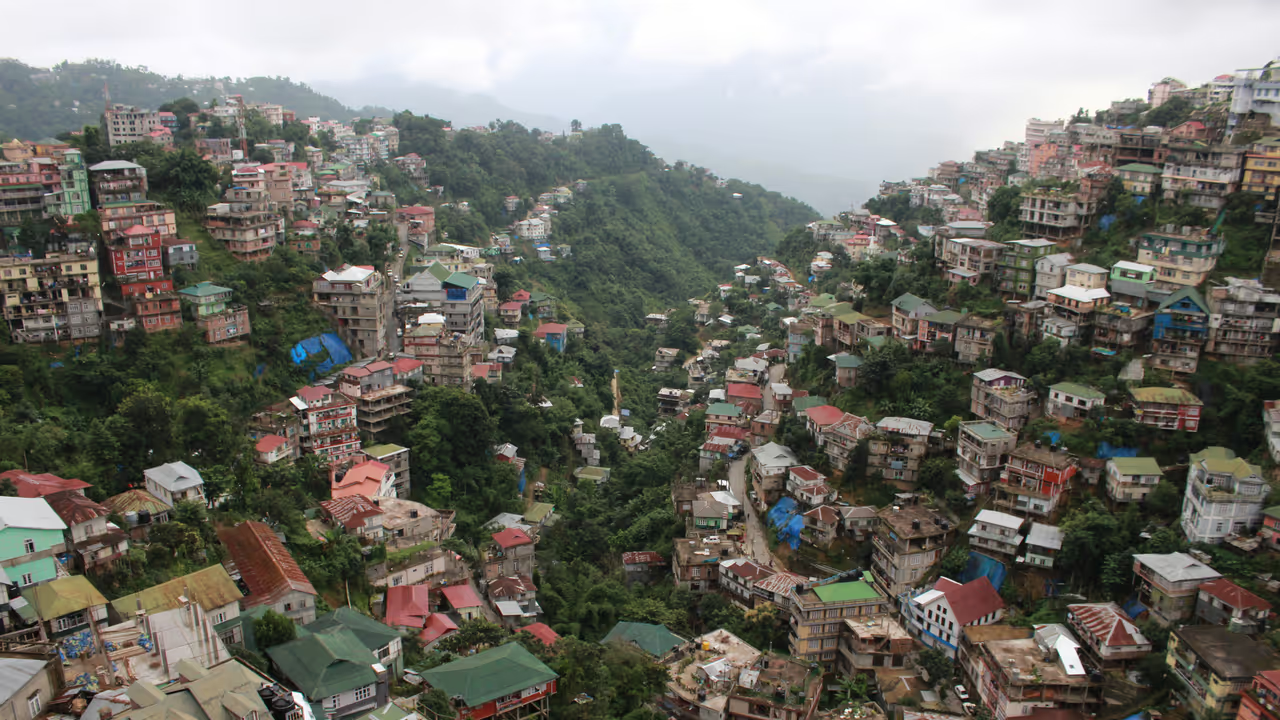
Mizoram saw major progress in 2025, becoming fully literate state and gaining railway link to Aizawl. The year brought healthcare expansion and economic recognition. However, protests over border policies, refugee pressures posed serious challenges.
The year 2025 proved to be a landmark period for Mizoram, marked by major achievements in education, transport, healthcare, and agriculture. At the same time, the northeastern state faced serious challenges linked to border policies, refugee inflows, infrastructure stress, political tensions, and natural crises.
From becoming India’s first fully literate state to finally getting railway connectivity to its capital, Mizoram witnessed long-awaited developments. Yet, protests, economic strain, and humanitarian responsibilities continued to test the resilience of the state and its people.
Mizoram becomes India's first fully literate state
On May 20, Mizoram was officially declared India's first fully literate state, with a literacy rate of 98.2 per cent. The achievement marked a proud moment for the state and reflected decades of community-led efforts to promote education.
Related Articles

Officials said the success was rooted in a long educational tradition that began in 1894, when Christian missionaries set up the first school in the region. The state had already recorded a high literacy rate of 91.33 per cent in the 2011 Census, and continued public participation helped bridge the remaining gap.
Community involvement, church groups and local leaders played a key role in ensuring that adults and school dropouts were brought back into learning programmes.
Rail link brings Mizoram onto national map
A major infrastructure milestone came with the inauguration of the Bairabi-Sairang railway line, finally connecting Mizoram’s capital Aizawl to the national rail network.
Prime Minister Narendra Modi inaugurated the project on September 13. Built at a cost of over Rs 8,000 crore, the railway line was described by the Prime Minister as one of the most challenging railway projects undertaken in India.
The rail link was completed 38 years after Mizoram became a state and 78 years after India’s Independence. With this, Aizawl became the fourth northeastern state capital to be connected by rail, ending decades of isolation.
Assam Rifles relocation clears space in Aizawl
In March, the Centre fulfilled a long-standing demand to relocate the Assam Rifles base from the congested heart of Aizawl. The unit was shifted to Zokhawsang, around 15 km east of the capital.
Union Home Minister Amit Shah described the move as a milestone for Mizoram’s development and said it showed the Centre’s responsibility towards the Mizo people. The relocation freed up valuable land in the city centre and reduced traffic and security pressures.
Ginger capital tag boosts state's economy
Mizoram received national recognition in November when NITI Aayog declared it the 'Ginger Capital of India'. Ginger is the state's flagship crop and a major source of income for farmers.
The sector has been supported by the ZPM government's 'Bana Kaih' handholding scheme, which offers minimum support prices for selected farm produce. Officials said the scheme has helped protect farmers from price crashes and encouraged higher production.
Universal health care scheme rolls out
Healthcare saw a major boost with the launch of the Mizoram Universal Health Care Scheme (MUHCS) in March. The scheme provides cashless treatment of up to Rs 5 lakh per family each year. According to officials, nearly 60,000 beneficiaries have already received treatment under the scheme, with total healthcare spending crossing Rs 100 crore. The programme aims to reduce out-of-pocket medical expenses for families across the state.
Border policy protests and refugee burden
Despite these gains, 2025 began with strong opposition to the Centre's decision to regulate movement along the 510-km Indo-Myanmar border. The Free Movement Regime was replaced with a border pass system, leading to repeated protests by civil society groups.
Mizoram also continued to carry a heavy humanitarian burden. The state hosted around 31,000 refugees from Myanmar who fled after the 2021 military coup. Fresh violence in July forced more than 3,000 additional people to cross into Mizoram.
In addition, the state sheltered over 2,000 refugees from Bangladesh’s Chittagong Hill Tracts and nearly 7,000 people displaced by ethnic violence in neighbouring Manipur.
Political unrest and infrastructure strain
Political tensions rose after the state assembly adopted the Forest (Conservation) Amendment Act in August. The decision led to widespread protests and a statewide shutdown called by the opposition Mizo National Front in October.
Infrastructure problems also caused disruption. The poor condition of National Highway-6/306, Mizoram’s main supply route, triggered repeated strikes by transporters, especially during the monsoon, affecting essential supplies.
Natural crises and drug concerns persist
The state faced serious agricultural losses due to a rodent outbreak linked to bamboo flowering, which damaged crops in all 11 districts. African swine fever continued to devastate the piggery sector, affecting thousands of families.
Drug trafficking and substance abuse remained major concerns. Authorities intensified enforcement through ‘Operation Jericho’, involving police, excise officials, and civil society groups, but challenges persist.
Mixed political results for ruling party
In electoral politics, the ruling Zoram People's Movement had mixed results. It performed well in local body elections early in the year but later lost the Dampa assembly by-election to the MNF and failed to secure a majority in the Lai Autonomous District Council.
As 2025 draws to a close, Mizoram stands at a crossroads. The year brought historic progress in literacy, transport, and healthcare, but also exposed deep challenges linked to governance, infrastructure, and regional instability. How the state builds on its gains while addressing these pressures will shape its future.