
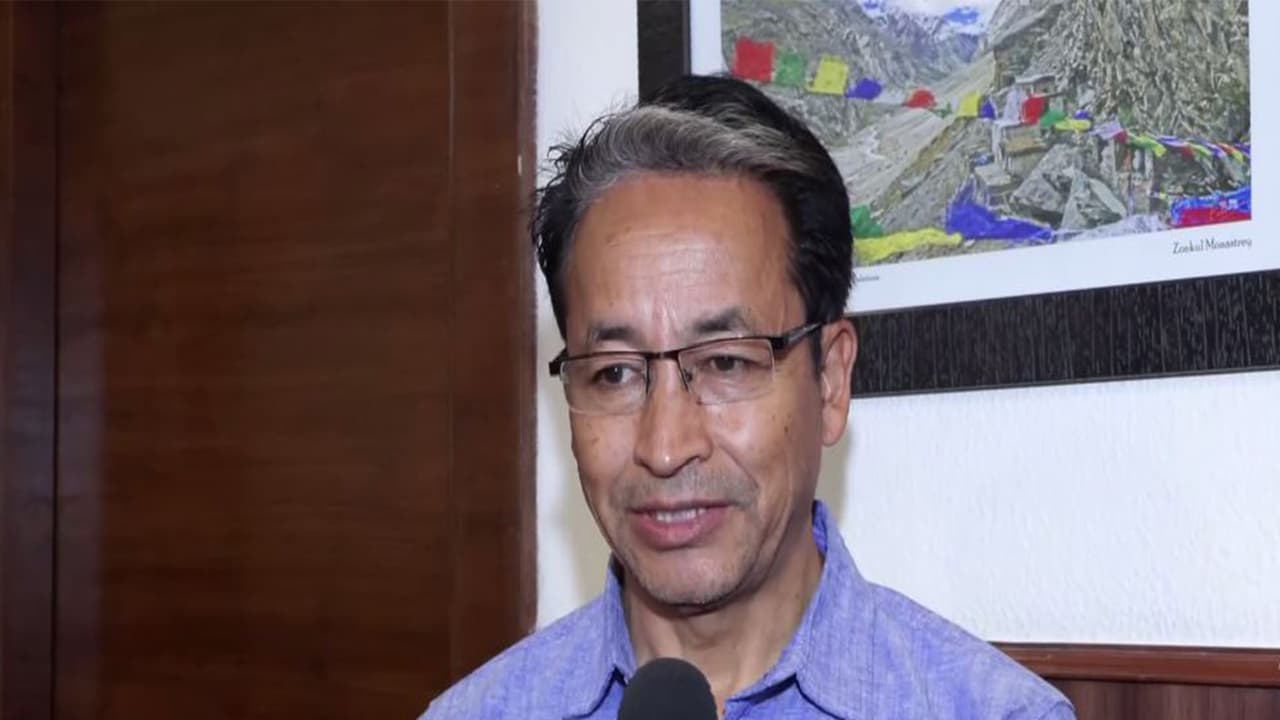
The Union Home Ministry has proposed granting constitutional safeguards to Ladakh under Article 371, says activist Sonam Wangchuk. The offer, an alternative to the Sixth Schedule demand, emerged from a high-level meeting in New Delhi.
In a sign of flexibility in months, offering a glimmer of hope to locals who have been protesting for land, job, and cultural protections in the ecologically fragile Himalayan region, Ladakh-based climate activist Sonam Wangchuk on Saturday said that the Union Home Ministry has proposed granting constitutional safeguards to the region under Article 371.
The proposal emerged during a high-level meeting in New Delhi attended by representatives of the Leh Apex Body (LAB) and the Kargil Democratic Alliance (KDA), the two primary bodies spearheading Ladakh's protests for constitutional protections. While Ladakh has steadfastly demanded inclusion under the Sixth Schedule (Article 244) alongside full statehood, the government's alternative offer marks a shifting dynamic in the prolonged negotiations.
A 'Work in Progress'
Wangchuk emphasised that while the shift in the government's stance is notable, no final decisions have been locked in. "There was only a proposal and no decision was taken as we need to work on its details," Wangchuk stated, cautiously describing the current state of negotiations as a "work in progress."
According to Wangchuk, the government's proposal to implement Article 371-style protections introduces a structural catch: it requires an elected legislative body to function effectively. However, Ladakh currently lacks the internal revenue to sustain a full-fledged state apparatus and pay government employees. "Yesterday we had a meeting at the Home Ministry, which was attended by members of the Kargil Democratic Alliance and the Leh Apex Body. We talked about some new beginnings and a step in it. Ladakh has always demanded safeguards under Article 244, 6th Schedule of the Constitution, and statehood. The government proposed to grant similar safeguards under Article 371, which cannot be implemented without an elected Assembly," he said.
To bridge this gap, Ladakh's representatives floated a compromise. "We proposed to have an Assembly which is not full statehood but works at Ladakh's level until we achieve the necessary revenue. People will get elected and have the power to make laws for Ladakh," said Sonam Wangchuk.
Proposed Transition Model for Governance
The ongoing negotiations between the Union Home Ministry and Ladakh's leadership have zeroed in on a concrete "Proposed Transition Model." If implemented, this framework would fundamentally rewrite how the strategic Himalayan border region is governed, shifting it away from direct central rule and toward local self-governance.
For nearly seven years, Ladakh has been managed as a Union Territory without a legislature, leaving local administration entirely in the hands of a bureaucratic apparatus. The newly proposed model aims to break this deadlock by introducing an interim, revenue-linked democratic structure.
Administrative Control
Under the Current System, administrative control is highly centralised. The entire state bureaucracy reports directly to the Centre-appointed Lieutenant Governor (LG), a setup that local activists argue alienates the indigenous population from day-to-day decision-making.
The Proposed Transition Model upends this completely. It mandates that the bureaucracy will answer directly to a locally elected leadership, restoring accountability to the people of Leh and Kargil.
Legislative Power
Right now, Ladakh's Legislative Power is controlled almost entirely by New Delhi. While Hill Development Councils exist locally, their legislative reach is strictly limited, leaving them unable to pass robust laws protecting local land and jobs.
The compromise model introduces an Elected Assembly. This body would grant local representatives the formal power to draft, debate, and pass laws specifically tailored to safeguard Ladakh's distinct cultural and ecological identity.
Financial Framework and Hybrid Model
The steep hill the region must climb is financial independence. Currently, Ladakh's Financial Status is heavily reliant on central funding just to cover basic administrative overheads and pay government employees.
Because full statehood is financially unviable right now, the transition model introduces a creative workaround: a Hybrid Assembly model. This temporary setup gives Ladakh democratic law-making powers without the massive financial burden of full statehood, remaining in place until local revenue generation becomes entirely self-sustaining.
"Earlier, all the bureaucracy was under the LG, but now it will be under the person who gets elected by the people, which was what was decided yesterday. I would say the work is still in progress," said the climate activist.
(Except for the headline, this story has not been edited by Asianet Newsable English staff and is published from a syndicated feed.)
