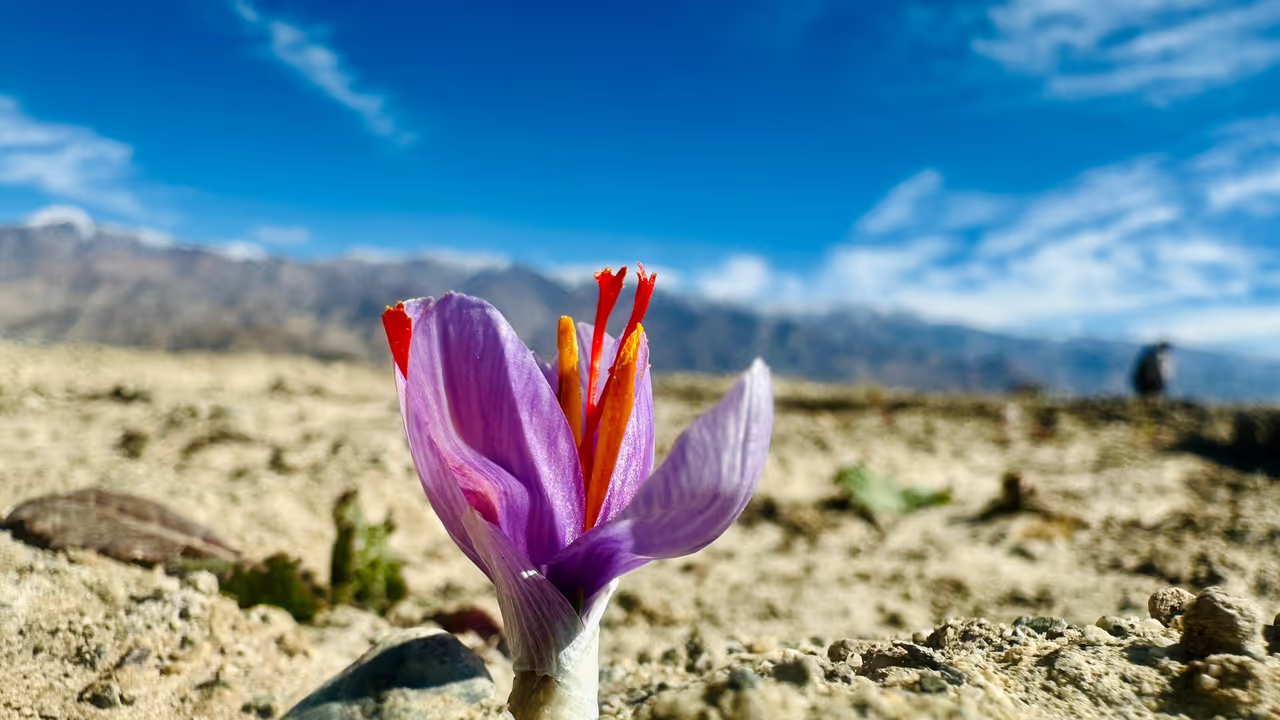
Ladakh's experimental saffron cultivation project has recorded its first bloom within 30 days of plantation and yielded nearly 22 grams of saffron in four days, raising hopes of high-value farming in the Union Territory.
An experimental saffron cultivation initiative in Ladakh has recorded its first bloom within just 30 days of plantation, considerably earlier than the usual two-month period required for the flowers to appear. The pilot project, being carried out on restored degraded land in Leh, has also yielded nearly 22 grams of saffron during its first four days of flowering. The early results have raised hopes of introducing high-value saffron cultivation in the Union Territory, with the administration assessing the crop's potential under the region's high-altitude climatic conditions.
Ladakh Lieutenant Governor VK Saxena visited the experimental field on Sunday to witness the first bloom and later shared the development on X.
“Proud to announce that the experimental saffron cultivation, over recently restored degraded land in Leh, has begun to blossom, in a record-breaking 30 days, against the usual two-month timeline for the first bloom. Inspected the saffron field today to witness the first saffron bloom,” he later posted on X.
According to the Ladakh administration, the field is currently recording an average of 20 to 25 blooming flowers each day. On Monday morning alone, 72 flowers were recorded at the site.
90,000 Saffron Corms Planted Across 4,000 Square Metres In Leh
The pilot initiative involves cultivating premium Iranian saffron across an area of approximately 4,000 square metres in Leh. Around 800 kg of saffron corms, numbering nearly 90,000, were planted on October 1.
Saffron corms are underground, bulb-like structures from which saffron plants grow. They are used to propagate the crop and produce new plants.
Related Articles

The cultivation site was previously barren before being restored and rejuvenated under Project Him Sarovar, an initiative undertaken under the guidance of Lieutenant Governor VK Saxena. The appearance of the first flowers within 30 days marks an encouraging development, considering that saffron generally takes around two months to reach its first flowering stage.
Why Is Ladakh Exploring Saffron Cultivation?
Saffron, also known as kesar, is among the world's most expensive spices and is valued for its distinctive colour, aroma and flavour. Its high market value makes it a potentially profitable crop that could provide farmers with an additional source of income.
In India, Jammu and Kashmir accounts for approximately 90% of the country's saffron production. The Ladakh administration is now examining whether the crop can adapt to the region's high-altitude environment and whether its cultivation could create new livelihood opportunities for local farmers.
Retail prices for genuine Kashmiri saffron start at around ₹300 per gram and can rise considerably depending on the quality and variety.
The experimental project is part of wider efforts to diversify farming practices and encourage the cultivation of high-value crops in Ladakh. The administration has also undertaken floriculture initiatives, including the large-scale cultivation of Lilium and Gladiolus in Leh. These projects have helped create livelihood opportunities for farmers, self-help groups and local entrepreneurs.
LG VK Saxena Calls Saffron Bloom
A Significant Achievement Describing the early flowering as an important milestone, Lieutenant Governor VK Saxena said the experiment highlighted the potential of high-altitude agriculture in Ladakh. He also expressed hope that the results could lay the foundation for commercial-scale saffron production in the region.
"This remarkable achievement is a powerful testament to the resilience of our environment and the immense, untapped potential of high-altitude farming in our region. This breakthrough lays a promising foundation for commercial-scale production, thereby, opening up new avenues for cultivation, agro-based entrepreneurship in Ladakh and paving the way for a stronger, thriving, self-reliant local economy. My deepest appreciation and congratulations to the Agriculture Department of UT Ladakh, our dedicated and hardworking field staff, for significantly contributing to the success of this pilot project,” Saxena wrote on X.
The administration will continue to assess the crop's performance under Ladakh's climatic conditions to determine whether the experimental cultivation can eventually be expanded to a larger scale.