
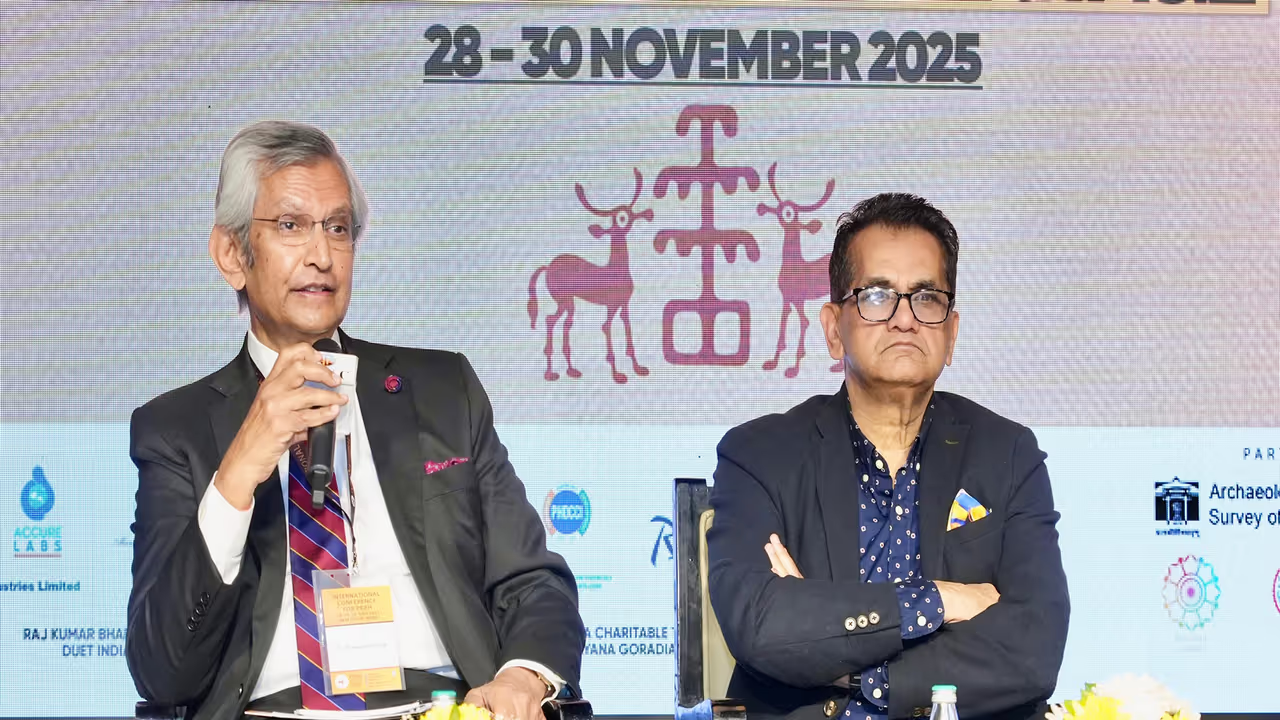
Day 2 of a conference on rural Buddhist heritage saw experts discuss conservation and community participation. Former NITI Aayog CEO Amitabh Kant called for heritage protection as a national priority and sustainable tourism over commercialisation.
The second day of the International Conference on the Preservation of Rural Buddhist Heritage, organised by the Indian Trust for Rural Heritage and Development (ITRHD), saw wide-ranging discussions on conservation practices, community participation and institutional capacity-building. The event, held at the Dr Ambedkar International Centre (DAIC), continued to attract scholars, practitioners and policymakers from India and abroad. Supported by the Ministry of Culture, the Archaeological Survey of India, the International Buddhist Confederation (IBC) and several academic institutions, the three-day gathering is examining the challenges facing lesser-known Buddhist sites across rural India.
Participants from Nepal, Russia, Thailand, Sri Lanka and the United States contributed insights on architectural conservation, historical reconstruction, skill development and sustainable pilgrimage.
Amitabh Kant Calls for National Priority on Heritage
A major highlight of the day was an address by former NITI Aayog CEO Amitabh Kant, who stressed that India as the birthplace of Buddhist philosophy, bears a particular responsibility to safeguard its associated cultural and spiritual landscapes. He argued that heritage protection must be treated as a national priority and called for tourism models that promote reflection, learning and local benefit rather than unchecked commercialisation.
Experts Highlight Gaps, Urge Global Best Practices
At a session focused on Buddhist architectural traditions, Prof (Dr) Amareswar Galla underlined the gaps in documentation of rural Buddhist sites and the limited training available in heritage law and conservation. He noted that thousands of sites remain unrecorded and vulnerable, and pushed for modernised academic curricula, digital mapping and stronger community involvement in conservation.
Harvard University's Dr Prajapati Trivedi urged India to draw from global examples where Buddhist heritage has been effectively preserved. Suggesting an international showcase of best practices at next year's conference, he emphasised the need for measurable standards and frameworks to protect "living heritage" alongside physical structures.
Plans for National Heritage Academy Outlined
Several panels throughout the day shaped the outline of the proposed National Academy for Rural Heritage Conservation and Development Training, to be set up on a five-acre site at Nagarjunakonda, granted by the Andhra Pradesh government. Envisioned as a first-of-its-kind institution, the Academy aims to focus on unprotected heritage while linking rural communities to economic opportunities rooted in culture.
As the conference prepares for its closing day, delegates are expected to consolidate recommendations and chart a long-term roadmap for strengthening India's role in global Buddhist heritage preservation.
(Except for the headline, this story has not been edited by Asianet Newsable English staff and is published from a syndicated feed.)