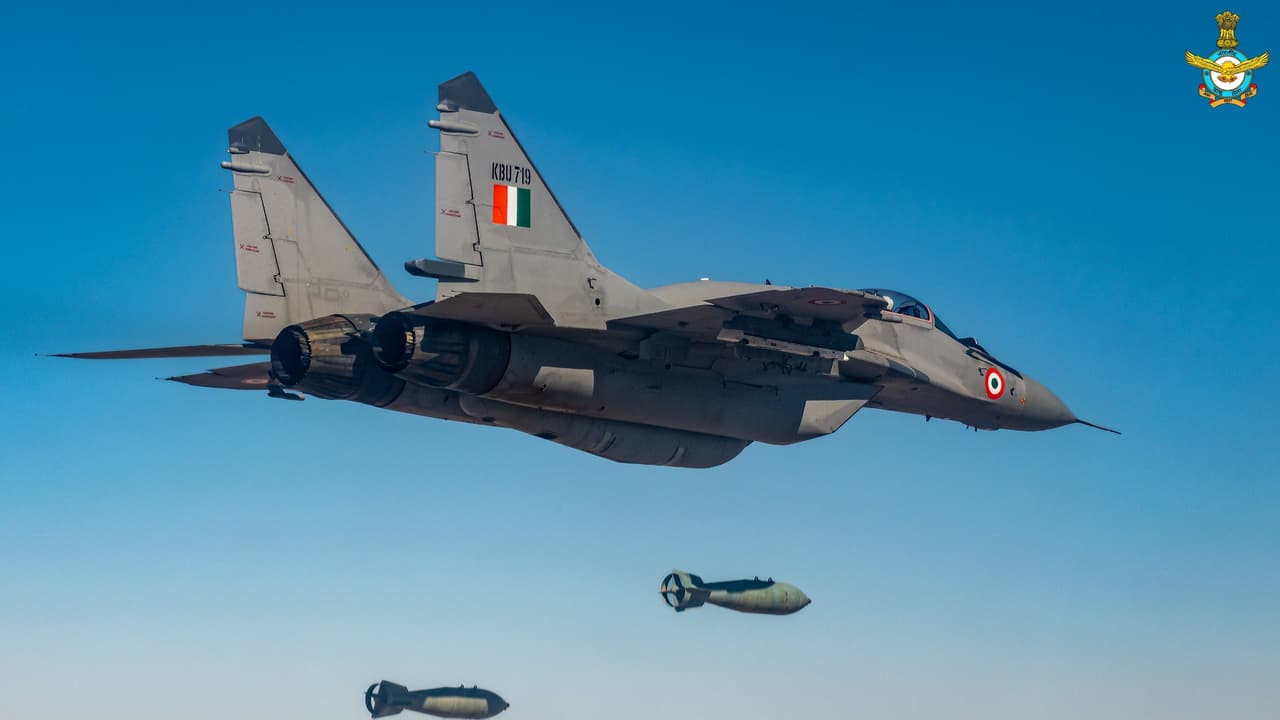
IAF plans to arm MiG-29 UPG jets with ASRAAM, replacing R-73 missiles. The move boosts close-combat capability amid China’s PL-10 and Pakistan’s PL-10E deployments.
New Delhi: After successfully integrating the advanced ASRAAM missile on its indigenous LCA Tejas and British-origin Jaguar fighters, the Indian Air Force (IAF) is now planning to equip its Russian-origin MiG-29 UPG fleet with the European within-visual-range-capable air-to-air missile system.
Developed by European defence major MBDA, the Advanced Short Range Air-to-Air Missile (ASRAAM) is primarily a within-visual-range (WVR) air dominance missile with a strike range exceeding 25 km.
In this context, the Ministry of Defence issued a Request for Proposal (RFP) on March 25 for the integration and certification of ASRAAM on the MiG-29 UPG. The proposal also includes associated equipment such as launchers, tools, testing systems, and crew training.
Related Articles

Currently, the IAF operates more than 55 MiG-29 aircraft, including eight trainer variants.
The integration of ASRAAM will replace the legacy R-73 missile—a 1980s-era infrared-guided weapon with a range of 10 to 15 km—with a far more advanced fourth-generation missile.
ASRAAM has already been selected as the next-generation close-combat missile to replace the R-73 across multiple IAF platforms.
In August 2021, MBDA and Bharat Dynamics Limited (BDL) signed a licensing agreement to establish a Final Assembly, Integration, and Test (FAIT) facility at BDL’s Hyderabad complex. This facility will also support maintenance, repair, and overhaul operations.
All About ASRAAM
ASRAAM is a highly agile, heat-seeking air-to-air missile designed for close combat and dogfighting scenarios within visual range. It is known for its exceptional maneuverability and “fire-and-forget” capability.
The missile can travel at speeds exceeding Mach 3 and strike targets at distances beyond 25 km. It can sustain up to 50g of maneuverability, enabled by advanced body-lift technology and tail control fins.
ASRAAM entered service with the Royal Air Force (RAF) in 1998.
Its fire-and-forget capability allows it to guide itself to the target after launch, eliminating the need for further pilot input. It is also optimized for high-G engagements against fast-moving fighter aircraft.
The missile measures 2.9 metres in length, has a diameter of 166 mm, and weighs approximately 88 kg. It carries a high-explosive blast fragmentation warhead, equipped with both impact and laser proximity fuses.
How It Stacks Up: China’s PL-10 and Pakistan’s PL-10E
India’s adversaries, China and Pakistan, have deployed or are deploying comparable within-visual-range missiles—the PL-10 and its export variant, the PL-10E—making ASRAAM’s integration a significant capability upgrade for the IAF.
China’s PL-10 entered service in 2015 after development began in 2004, with design approval in 2010 and production starting in 2013.
It was developed as a short-range infrared-guided missile for next-generation Chinese fighter aircraft, including the J-10C, J-16, and the fifth-generation J-20.
The PL-10 has a reported maximum range of around 20 km, though some estimates suggest it can reach up to 30 km under specific conditions.
With a top speed of Mach 4, the PL-10 is faster in peak velocity compared to ASRAAM. However, ASRAAM compensates with a larger rocket motor (166 mm versus approximately 160 mm for the PL-10), providing better sustained speed and extended engagement range.
Pakistan became the first export customer for the PL-10E, integrating it onto its JF-17 Block III fighters starting in 2021 as part of a broader defence partnership with China.