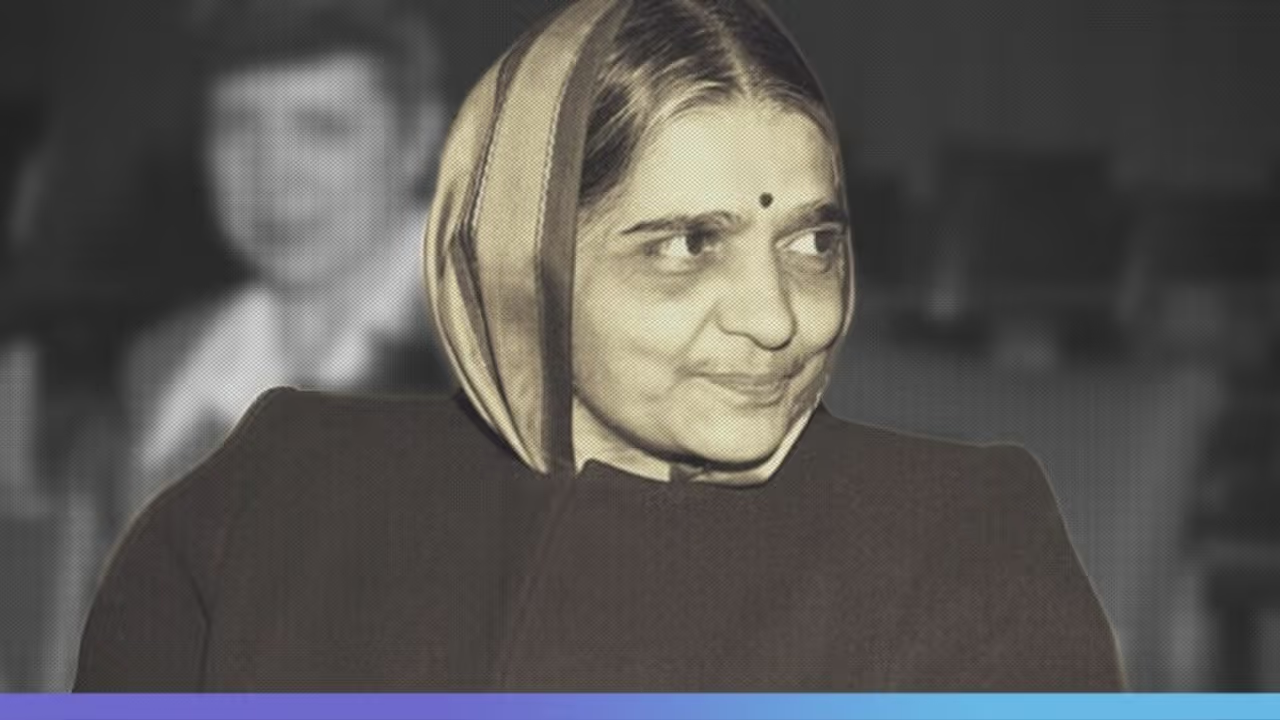
Hansa Jivraj Mehta, a freedom fighter and champion of women's rights, was singlehandedly responsible for amending a critical feature of the Universal Declaration of Human Rights adopted by the United Nations General Assembly in 1948.
Hansa Jivraj Mehta - freedom fighter, reformist visionary and an advocate of women’s rights etched her name into global history with a single, seismic correction when, in 1948, the world drafted the Universal Declaration of Human Rights (UDHR). Appointed by Prime Minister Jawaharlal Nehru to the United Nations Human Rights Commission, Hansa noticed a phrase in Article 1: “All men are born free and equal.” She insisted that the world deserved a more inclusive truth. Following her intervention, the text evolved into the now-iconic declaration: “All human beings are born free and equal.”
It was a subtle change — but a monumental one that framed the trajectory of gender equality globally. Former UN Secretary-General Ban Ki-moon himself acknowledged her legacy in 2015, saying, “The world can thank a daughter of India, Dr Hansa Mehta…”
On November 22, 1949, during a reflective gathering of Assembly members shortly before the Constitution’s adoption, Rohini Kumar Chaudhuri made a derogatory remark equating women’s advancement with an inconvenience even comparing them with cows. Hansa’s retort, sharp yet dignified, was “The world would have thought very little of the men if they had asked for protection against women…”.
Related Articles

Personal, political life
Born into privilege on July 3, 1897, in Baroda, Hansa was raised in an environment of intellectual richness. After studying Sociology and Journalism in England, her destiny sharpened when Sarojini Naidu introduced her to Mahatma Gandhi in 1918.
She plunged headlong into the Non-Cooperation and Swadeshi movements, bravely facing arrests while leading demonstrations against British-allied establishments. In 1924, she married Dr Jivraj Narayan Mehta, defying rigid caste lines and societal disapproval. The Maharaja of Baroda himself intervened to ensure her family’s presence at the wedding — a moment Hansa recalled in her writings with affection.
By 1937, she was elected to the Bombay Legislative Council, serving critical terms that eventually led her to the Constituent Assembly’s Fundamental Rights Sub-Committee. Here, she worked alongside Dr BR Ambedkar and Rajkumari Amrit Kaur, arguing passionately for gender equality, a progressive civil code, and universal civil rights.
Long before she entered the Assembly, Hansa was shaping India’s educational landscape. As a pivotal member of the All India Women’s Conference, she helped establish Lady Irwin College in Delhi and authored children’s literature in Gujarati, translating global classics like Hamlet and Gulliver’s Travels for young Indian readers.
In 1946, she helped draft the Indian Women’s Charter of Rights and Duties — an audacious blueprint demanding equal pay, equal access, inheritance rights, healthcare, education, and fair marriage laws. Her vision was radical for its time, yet profoundly rooted in democratic ideals.
Inside the Assembly, she championed the Uniform Civil Code (UCC) with unwavering conviction, insisting that a modern nation required a unified, progressive identity. “The Civil Code that we wish to have must be on a par with… the most progressive of the personal laws,” she insisted. Though the UCC faced resistance and was ultimately relegated to Directive Principles, her arguments remain foundational to the ongoing national debate.
She played a decisive role in shaping the Hindu Code Bill, supporting Dr Ambedkar’s transformative suggestions on inheritance, marriage, divorce and adoption. “This Bill… is a revolutionary Bill,” she acknowledged, while pushing for further reform aligned with democratic equality.
And then came the historic midnight of August 15, 1947. It was Hansa who presented independent India’s first national flag on behalf of the nation’s women. “In presenting this symbol of our freedom, we once more offer our services to the nation,” she declared.
Post-Independence, she continued her global leadership — serving in the UN Human Rights Council, contributing to UNESCO, and becoming one of India’s earliest woman vice-chancellors at the Maharaja Sayajirao University of Baroda. In 1959, the nation honoured her immense contributions with the Padma Bhushan.
(This article has been curated with the help of AI)